


|

Kodokan seminar 2006
BKA News Online
Issue # 26
October 06
Contents
Submission
Guidelines
Contact Details
Introduction
Notices
Reports
Diary of Events
Grading/Taikai
Results
Shopping &
book list
Articles
21st Kodokan
International Kendo Seminar
Seminars/Competitions: Forms & Details
Last
Words
Submission
Guidelines:
Submitting articles for use online (and thus the
newsletter) is easy - just email either the editor and/or the Webmaster with the
article/idea and take it from there. We are constantly looking for people to
write articles and contribute to the website, so please don’t be shy.
This news online is produced courtesy of the
website, please remember, we can only publish things that we get, so if we
don’t get anything relating to a specific event, then we can’t do anything
about it. You can help us by:
Registering
your interest to do an article before
an event
Be
conscientious - if you say you are going to do it, then do it!
Supplying
content in digital format (with pictures)
Get
someone to proof-read your article
Spell-check
it!
Electronic
submissions must now be supplied in HTML format, or WORD in an uncomplicated
format, pictures sent separately in JPEG format [small resolutions please] if
not inserted correctly into the document
Items
that involve the team in retyping or reformatting will not be undertaken and returned to the originator. However some
typewritten formats may be acceptable, as these items can sometimes be electronically
scanned and included.
Send Postal Submissions to: BKA Newsletter, co: P A
Budden. Gomms Corner. Copperkins Lane. Amersham, Bucks. HP6 5QB
Contact Details:
President John Howell
president@kendo.org.uk
Chairman: Geoff Salmon
chairman@kendo.org.uk
Vice Chairman: Gavin
Murray-Threipland
vice.chair@kendo.org.uk
Treasurer: David Spacey
treasurer@kendo.org.uk
Secretary: Ric Schofield
secretary@kendo.org.uk
Membership queries
bkamembership@duco-personnel.co.uk
Kendo
Bucho: Paul Budden
kendo.bucho@kendo.org.uk
Iaido
Bucho: Vic Cook
iaido.bucho@kendo.org.uk
Jodo
Bucho: Alan Nash
jodo.bucho@kendo.org.uk
BKA
PRO: Paul Gray
bka.pro@kendo.org.uk
Iaido & Jodo PRO: Fay
Goodman
pro.iaijo@kendo.org.uk
Health and Safety Officer: Donald Gordon
health.safety@kendo.org.uk
First
Aid Advisor: Trevor Chapman
first.aid@kendo.org.uk
Webmaster: Carl Ranger.
bka.webmaster@kendo.org.uk
News
Online Editor: Paul Budden
editor@kendo.org.uk
National Phone line
01494 581503
Automated response for a BKA leaflet
and Club list only.
A comprehensive and up-to-date
list of BKA contact details can be found online
Introduction:
Dear
members,
Welcome
to the October edition. At this time I would ask all members to please send any
articles and information for submission in the December issue to me by the end
November latest please.
Don’t
forget to check out the new BKA Iaido & Jodo Website: http://www.iaido-jodo.org.uk
Notices:
The
Health & Safety forms and guidelines have been updated. Please check out
the website under General Information –Executive for the documentation.
Mumeishi
Taikai 11th November: Contact Mr T Holt at: mumeishi@mumeishi.co.uk
Special Young Males Kendo
Practice and Squad training:
November 18th & 19th at Kodokan
Saturday: Young Males [15 to 25 years] 10am to 1pm.Seniors
2:00-5:00pm
Sunday: 10:00am-1:00pm
The National Kendo Refereeing
seminar date has been changed to Saturday the 9th December. Venue
remains the same: Kashi no ki Ollerton and we would
like to remind all 3rd Dan Kendo members and above of the grading
requirements relating to refereeing as published on the website.
Kendo & Jodo Grading Questions are now only
published on the BKA website: all candidates must bring their completed papers
with them on the day of the examination.
There will be no official BKA Hatsugeiko next year .
All Dojo/Clubs are encouraged to hold their own local events. Please submit
information and it will be published on the website.
There will be a FREE Kendo Kangeiko for Juniors at
KODOKAN on Sunday the 18th February 10. 30am to 5pm .
All Juniors members are invited to attend. Please
contact: kendo.bucho@kendo.org.uk
Diary of Events
Here is a list of all
Kendo, Iaido, and Jodo related events in the U.K. and others of interest in
Europe. Events that span all three
disciplines are marked (All).
This information
is Provisional at the time of going to print and will be updated in future
issues.
The CLOSING DATE
for all shinsa (gradings) is TWO CALENDAR MONTHS prior to the day of the
exam. Contact FOR ALL UK shinsa is the Grading Officer
and NOT the person in charge of running the seminar. For all overseas Grading, members must contact John Howell
for a letter of permission.
|
Date 06
|
Description /
Details
|
Location
|
Discipline
|
Contact (addresses not expanded can be found in
Contact Details)
|
|
11th November
|
Mumeishi 3’s
Taikai
|
Mumeishi
Cranford
|
Kendo
|
Terry Holt
mumeishi@mumeishi.co.uk
|
|
18th
& 19th
November
|
Kendo Squad
Training
|
Kodokan
Rickmansworth
|
Kendo
|
Sotaro Honda
kendo.coach@kendo.org.uk
|
|
8th
to 10th December
|
13thWKC
|
Taipei, Taiwan
|
Kendo
|
John Howell
president@kendo.org.uk
|
|
9th December
|
National Kendo
Refereeing seminar & Taikai experience workshop
|
Kashi no ki
Ollerton
|
Kendo
|
Trevor Chapman
kendo.member@kendo.org.uk
|
|
11th
December
|
13thWKC Kendo
Grading up to 7thDan
|
Taipei, Taiwan
|
Kendo
|
John Howell
president@kendo.org.uk
|
|
Date 07
|
Description /
Details
|
Location
|
Discipline
|
Contact (addresses not expanded can be found in
Contact Details)
|
|
6 & 7th
January
|
Kendo Squad
Training
|
Kodokan
Rickmansworth
|
Kendo
|
kendo.coach@kendo.org.uk
|
|
10th
& 11th February
|
Kendo Squad
Training & Ladies Practice
|
Kodokan
Rickmansworth
|
Kendo
|
kendo.coach@kendo.org.uk
|
|
February
|
Kendo
Refereeing Seminar
|
Brussels
|
Kendo
|
John Howell
|
|
February
|
EKF Kendo
Grading Including 7th Dan
|
Brussels
|
Kendo
|
John Howell
|
|
18th
February
|
Junior
Kangeiko
Free for all Junior
Kendo members
|
Kodokan
Rickmansworth
|
Kendo
|
Paul Budden
kendo.bucho@kendo.org.uk
|
|
3rd
& 4th March
|
Kendo Squad
Training & Juniors Practice
|
Kodokan
Rickmansworth
|
Kendo
|
kendo.coach@kendo.org.uk
|
|
10th
March
|
Glasgow Kendo Seminar
|
Glasgow
|
Kendo
|
Gerry Kincaid
|
|
11th
March
|
Scottish Kendo Grading
1st
Kyu to 3rd Dan
|
Glasgow
|
Kendo
|
grading.officer@kendo.org.uk
|
|
24th
March
|
Kendo Grading
seminar
|
Kodokan
Rickmansworth
|
Kendo
|
Paul Budden
kendo.bucho@kendo.org.uk
|
|
25th
March
|
Southern Area Kendo Grading
1st
Kyu to 3rd Dan
|
Kodokan
Rickmansworth
|
Kendo
|
grading.officer@kendo.org.uk
|
|
31st
March 1st April
|
Ozawa Sensei Seminar
|
Kashi no ki
Ollerton
|
Kendo
|
Trevor Chapman
kendo.member@kendo.org.uk
|
|
6th
to 9th April
|
Five Nations
Cup
|
Edinburgh
|
Kendo
|
Paul Budden
kendo.bucho@kendo.org.uk
|
|
14th
April
|
National Kendo Refereeing seminar &
Taikai experience workshop
|
Kashi no ki
Ollerton
|
Kendo
|
Trevor Chapman
kendo.member@kendo.org.uk
|
|
27th
to 29th April
|
European Kendo
Championships
|
Lisbon
Portugal
|
Kendo
|
John Howell
|
|
29th
April
|
EKF Kendo
Grading Including 7th Dan
|
Lisbon
Portugal
|
Kendo
|
John Howell
|
|
12th
May
|
AGM and Spring
Practice
|
Kodokan Rickmansworth
|
All
|
Ric Schofield
|
|
19th
May
|
First Aid
Course
|
Kashi no ki
Ollerton
|
All
|
Trevor Chapman
kendo.member@kendo.org.uk
|
|
19th
May
|
Kendo Seminar
|
Tsunami
Watchet
|
Kendo
|
Adrian Rowe
Rowerovers@aol.com
|
|
20th
May
|
Kendo Grading
1st
Kyu to 3rd Dan
|
Tsunami
Watchet
|
Kendo
|
grading.officer@kendo.org.uk
|
|
8th
& 9th June
|
Sir Frank
Bowden Taikai & Premier’s cup
|
Kashi No Ki
Ollerton
|
Kendo
|
Trevor Chapman
kendo.member@kendo.org.uk
|
|
14th
July
|
Kendo seminar
|
Kagami shin
Stoke
|
Kendo
|
Steve Plimbley
|
|
15th
July
|
Kendo grading
1st Kyu to 4th Dan
|
Kagami shin
Stoke
|
Kendo
|
Keith Dawick
grading.officer@kendo.org.uk
|
|
24th
to 26th August
|
22nd
Int Kodokan Kendo seminar
|
Kodokan
Rickmansworth
|
Kendo
|
Paul Budden
kendo.bucho@kendo.org.uk
|
|
26th
August
|
Kendo grading seminar members only
1st
Kyu to 5th Dan
|
Kodokan
Rickmansworth
|
Kendo
|
Keith Dawick
grading.officer@kendo.org.uk
|
|
1st
September
|
British Open
Kendo championships
|
Kashi no ki
Ollerton
|
Kendo
|
Trevor Chapman
kendo.member@kendo.org.uk
|
|
2nd
September
|
First Aid
Course
|
Kashi no ki
Ollerton
|
All
|
Trevor Chapman
kendo.member@kendo.org.uk
|
|
20th
October
|
Kendo Pre
grading seminar
|
Kodokan Rickmansworth
|
Kendo
|
Paul Budden
kendo.bucho@kendo.org.uk
|
|
21st
October
|
Kendo Grading,
1stKyu to 4thDan
|
Mumeishi
Cranford
|
Kendo
|
Keith Dawick
grading.officer@kendo.org.uk
|
|
October
|
Kyusha Seminar
and Grading 7th to 2nd kyu
|
Kashi No Ki
Ollerton
|
Kendo
|
Trevor Chapman
kendo.member@kendo.org.uk
|
|
17th
November
|
Mumeishi 3’s
Taikai
|
Mumeishi
Cranford
|
Kendo
|
Terry Holt
mumeishi@mumeishi.co.uk
|
|
1st
December
|
National Kendo
Refereeing seminar & Taikai experience workshop
|
Kashi no ki
Ollerton
|
Kendo
|
Trevor Chapman
kendo.member@kendo.org.uk
|
Kendo Squad Training &
Schedule:
Squad training sessions are usually
held once a month. These take place over a weekend. Anyone interested in being
involved with the squad is welcome to attend. There is a charge of £3 per
session to help cover costs.
The
next training weekend will be held at Kodokan Dojo in Rickmansworth on Sat &
Sun 18th & 19th November
Saturday: Young Males practice[15 to 25 years ] 10am to 1pm
seniors
2:00-5:00pm
Sunday: 10:00am-1:00pm
There
will be no squad training in December: Team at the 13thWKC in Taipei.
Dates for 2007:
January
6th & 7th
Times
Saturday: 2:00-5:00pm
Sunday: 10:00am-1:00pm
February
10th & 11th
Saturday: Ladies practice[all ages ] 10am to 1pm
seniors
2:00-5:00pm
Sunday: 10:00am-1:00pm
March 3rd & 4th
Saturday: Young Males practice[15 to 25 years ] 10am to 1pm
seniors
2:00-5:00pm
Sunday: 10:00am-1:00pm
Venue
Kodokan Kendo Dojo
Princess Marina Sports Complex
The Royal Masonic School for Girls
Chorleywood Road
Rickmansworth
Herts. WD3 4HF
Directions (View
a map)
By Road: From the M25 Junction 18 (Amersham/Chorleywood exit) take the A404
towards Rickmansworth for about 1 mile. The school is on the left hand side;
use the second, signposted entrance (the first is closed). If you reach the
Rickmansworth Station roundabout, you’ve gone too far, so go back up
Chorleywood Road (A404) and the entrance is about 400m on the right. Parking is
in the main school car park. Access to the sports complex is on foot (follow
the signs). The gates are not locked, but please close after entry.
By Rail: Rickmansworth Station is on the Metropolitan Line (Baker
Street-Amersham) and the Chiltern Line (Marylebone-Aylesbury). The school is
just a short walk from the station. From the station front entrance, turn right
and follow the above directions from the station roundabout.
Accommodation
Check out: www.stilwell.co.uk
Hertfordshire inc Rickmansworth and surrounding area.
We particularly want to
encourage more women to come and
join the squad.
The only requirements are that you are keen to compete and willing to attend
squad training sessions
Please
contact The Chief National Kendo Coach
to register Males: kendo.coach@kendo.org.uk
or The National Ladies
Kendo Coach to register Ladies: ladies.coach@kendo.org.uk
Grading Results:
IAIDO 15th
August 2006
Ikkyu:
O. Woode, A. Parker, J. Griffiths, R. Boers
(Netherlands), S. Ridler, M. Klompenhouwer (Netherlands), C. Grainger, S. Day, S.
Schagen (NL), C. John, J. Spencer, A. Keeble, S. Leitch, S. Fitzpatrick, P.
Saliba, S. Williams, G. Salvoni, R. Grainger
18 out of 18 passed (100%)
Shodan:
H. Williams, J. Leech, L. Earley, L. Cole, A.
Nash, J. Day, D. Smith, D. Glover, G. Hartley, P. Hawrylczak, R. Pimlott, S.
Halton, P. Rossi, G. Wacey, S. Sanford, S. Page, L. Hofstede (Netherlands), A.
Turpin, A. Delhomme
19 out of 19 passed (100%)
Nidan:
S. Merchant, S. Gray, R. Shaddick, N. Motherway,
A. Moseley, D. McLean, L. Higgins, R. Maunder, S. Edgar
9 out 11 passed (82%)
Sandan:
I. Swyer
1 out of 5 passed (20%)
Yondan:
S. Fletcher, D. Davidson, D. George
3 out of 7 passed (43%)
Godan:
G.S. Murray Threipland, D. Evans, S. Boyle, R.
Ballisti (Switzerland)
4 out of 7 passed (57%)
JODO 18th
August 2006
Ikkyu:
L. Campbell
1 out of 1 passed (100%)
Shodan:
L Earley, J. Armstrong, K. Scott, L. Higgins
4 out 4 passed (100%)
Nidan:
G. Turner, S. Page
2 out of 2 passed (100%
Sandan:
0 out of 1 passed (0%)
Kendo 20th
August 2006 : Kodokan Rickmansworth
Ikkyu:
A. Faraj 8331
Shodan:
T. Serby (Sweden), E. Yamazaki 8283, J.C.
Wightman 7475, R. Dossett 8079, G. Campbell 7540
Nidan:
A Bennett 7585, J. Lawley 7191, P. Ybo (Sweden),
A. Wagstaff 7454, K. Matzaras (Greece)
Sandan:
M. Coleby 5071, F. Vinelott
Yondan:
J. Petrie 5025, T. Yamazaki 6649, R. Fleming
(South Africa)
Godan:
G. Dockwray 808, M Molloy 3414, N Kettle 3837,
T. Hughes (South Africa), B. Ayres 1532, D. Storli (Norway)
Kendo. Mumeishi October 15th 2006
Ikkyu:
T. Suehara 7583, C.
Merlini 8766, P. Aghakhani 8120, A. Wadlow 7881, E.Kollarova 8423, P. Collard
8160, R. Bastin 8375, D.Magee 8314, L. Gunneratne 8731, K. S. Cha 8732, Y. K. Yong
8473, J. Hirst 8361, K. Paryag 7985, K. Towler 8474, T. Yokoyama 8294, W. Hesketh
8418
Shodan:
J. shido Kidd 5634,
Y. Kuriyagawa 5633, S. Yoshita 8763, N. Kuriyagawa 5632, S. Ito 8725, A. O’Brien
8460, R.Parkin 8197, J. Tsoi 8023, D.Antipin 7613, D. N. Brestrup 7936, N. Davey
7448, H. Basi 7143, P. Marples 6061, D. Cuthbertson 8467, N. Clegg 6435, A. Hosono
7428, I. Lindsay 8036, A. Jackson 7800
The following
candidate failed the kata section and so will be allowed to re-take the kata
element of the grading at any BKA kendo grading in the next 12 months: D Cole
7538
Nidan:
S. Yamazaki 7479, A.
Rowberry 7460, L. O’Connell 7550, J. Hall 6560, A. Jarvis 6507, R. Chaudery
6525, R. W. Foster 7659
The following candidates
failed the kata section and so will be allowed to re-take the kata element of
the grading at any BKA kendo grading in the next 12 months:
Y.Seiya 8769, T.Ito
7445, T.Saxton 7834.
Sandan:
A.Fisher 6865, T. Miyoshi
6195, A. Vacheret 8520, A. Burch 5833
The following
candidate failed the kata section and so will be allowed to re-take the kata
element of the grading at any BKA kendo grading in the next 12 months: N. Treen 6129
YONDAN
The following
candidate failed the kata section and so will be allowed to re-take the kata
element of the grading at any BKA kendo grading in the next 12 months: J.Kinoshita
8671
British Open 2006
Results
Ladies Category
1st. Kim Holt
2nd. Catherine Goetze
3rd. Joanne Hirst
3rd. Dee Hanson
Fighting Spirit. Karen Brazil
Senior Plate
1st. Y Hiyama
2nd. S Tsuchihara
3rd. K Yamazaki
Fighting Spirit. R Vermeulen
National Category
1st. S Gibson
2nd. M Halls
3rd. W Wright
3rd. C Stewart
Fighting Spirit. N Sharpe
Juniors 9 to 12 Years
1st. Takumi Suehara
2nd. Takashi Suehara
3rd. Ruben Casserley
Fighting Spirit. Rick Collins
Juniors 13 to 15 Years
1st. H Shuell
2nd. J Casserley
3rd. J Stainsby
Fighting Spirit. H Shuell
Juniors 16 to 17 Years
1st. H Yamazaki
2nd. A O’Brien
Kata Competition
1st. S Plimbley - B Hayes
2nd. C Ranger – A Jackson
3rd. L Molloy – A Wagstaff
Shopping:
The BKA recommend Nine Circles
and Emai shop UK for all equipment purchases.
www.ninecircles.co.uk www.emaishop.com
BKA
Book List (available only from nine
circles)
Kendo
The Definitive Guide - Ozawa
Looking
at a Far Mountain - Budden
Fundamental
Kendo Vols 1 & 2 - ZNKR (BKA Only item)
Japanese-English
Kendo Dictionary - ZNKR (BKA Only item)
Check out the ‘Kendo World’ list of available titles
Nippon Kendo Kata - All Japan
Kendo Federation – NEW
Iai Manual - All Japan Kendo
Federation – NEW
The
BKA have the following items on offer to members only!
39
Shinai ‘Gold quality’ @ £30 each
BKA
tenegui @ £5 each
Car
stickers £3 each
Blazer
badges £12 each
BKA
pin badges £3
Referee's progress
log £3
12th
WKC items:
Shinai bags £10
Sweat shirts £8
Tenegui £2
Limited amount of
polo and T shirts £4
Key rings £1
Pin badges £1
Pens £1
Towels £3
Luggage tags £1
Mouse mats £1
All items are plus
post & packaging and can be purchased by cheque/cash.
Contact:
Dean Wormall
bka.sales@kendo.org.uk
If you have budo related equipment item[s] that you
wish to part with then please email us with
details and you can be included in the next
newsletter (online and printed version).
This can include books, shinai, clothing, 2nd
hand bogu, etc - anything relevant.
Complete set of adult armour and two
complete childrens sets
both Japanese
quality
Contact Alex
McIntyre: mob no. 07966 377043
Iaito for sale
Length: 2.3
Hamon: none
Same: black
Ito/sageo: dark
blue silk
This classy iaito
is hardly used and in excellent condition, originally bought from
Swordstore.com for about £350, but turned out to be unsuitable for the person
it was bought for.
I would like £275
for it.
Contact: Dave
Fanning, dave@hagakure.eu or
020-7249-6527
Compression
suits …check out: http://www.bsccompression.co.uk
Contact Paul
Budden: paul.budden@kodokankendo.org.uk
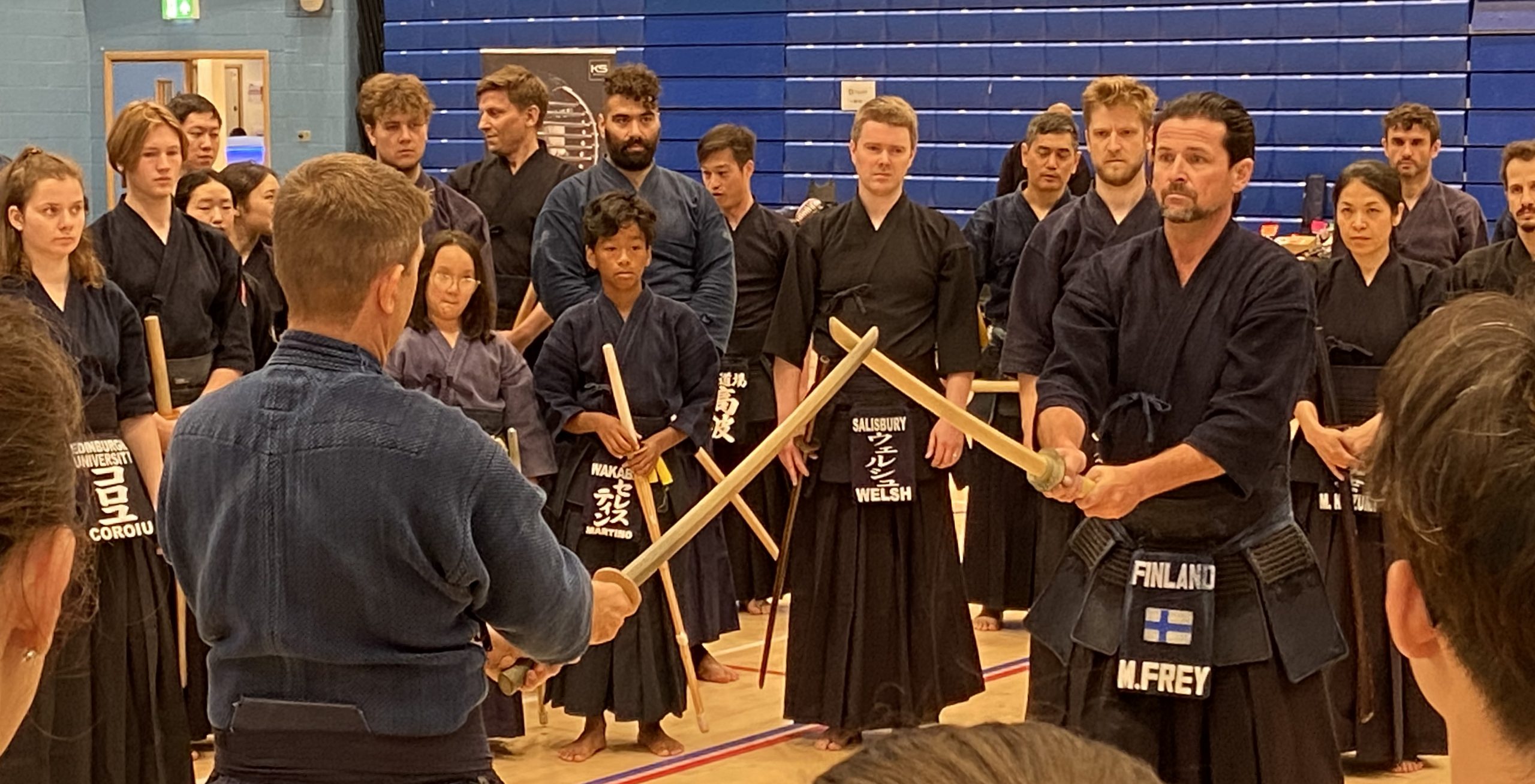
21st Kodokan International
kendo seminar
A new decade of kendo

For the 21st
seminar a new teacher was present Kai sensei (a floating foot specialist).
Junpei Matsumoto returned as did Tashiro sensei and Kumamoto sensei. Also
visiting from Japan was Shinbo sensei. As usual the team of teachers were
strengthened by Howell sensei, Yanai sensei, Holt sensei Honda sensei
O’Sullivan sensei, Salmon sensei and this year attending from Italy Castelli
sensei.
In all 16
nationalities were represented. Thanks as always must go to Paul Budden and the
Kodokan dojo for their organisation of the event.
In his opening
address Sumi Sensei said that this year’s seminar was to have three themes, and
as promised we would be breaking new ground.
1.
We would try
to build the ability to resist the opponent’s spirit (pressure), and develop
resolve, patience, calmness and become more relaxed.
2.
We were to be
prepared to go beyond our physical and mental limits by developing endurance
and patience.
3.
We were asked
to reflect carefully on our practice of kendo. To have an open mind not a
narrow view and to consider the different approaches possible.
It was apparent
even at the first of the evening practices that Sumi Sensei had a more intense
approach. He was ruthless in driving students to correctly cut and finish off
techniques. To end a practice students were asked to complete three sets of
kirikaeshi instead of the customary two.
This was further
confirmed at the opening address where we were promised “hard training”
Sumi sensei
formally introduced Kai sensei (Hachidan Hanshi) a former senior police kendo
instructor in Miyazaki prefecture who has won both the All Japan police
championships and the All Japan eighth dan championships.
For more than 20
years Kai sensei has been teaching kendo to children and beginners. This is a
particular area of interest for him. He shared with us his training precepts:
- Make them like kendo
- Make them enjoy kendo
- Make them do quality kendo

When asked
typically how long it should be before a beginner was allowed to train in armour
the response was about 6 months (training once or twice a week). Sumi sensei
interceded to say this should be on a case by case basis.
The usual format
was employed with participants being put into teams. Each team has a general.
Practices followed the established format with the generals doing the bulk of
the teaching and Sumi Sensei, Kai Sensei and Tashiro Sensei circulating and
giving advice and demonstrations on the finer points.
Kiri Kaeshi
We were introduced
to a new variation of Kiri Kaeshi where kakarite steps in from long distance
and cuts MEN then steps back to do five cuts on the spot, before separating to
long distance again. This was repeated three times. To improve breath control
the whole exercise was to be done in only three breaths.
Ashi Sabaki (Footwork)
Sumi sensei
discussed the way of using the feet when doing shikake waza. For attacks from
long distance first we must slide in the right foot maintaining balance and an
upright stance (seme). When the moment is right the left foot is quickly
snapped into position behind the right foot causing the weight distribution
over the feet to change (more weight on the left foot). The instant that this
happens the right foot is driven forward (a stretching step) and the arms are
raised sharply keeping the body upright. When cutting from issoku itto no maai
(perhaps the opponent has stepped in) there is no need (or room) to do an extra
step. All that is needed is a stretching step driven by the left foot and a
sharp raising of the arms.
In either case the
stamping movement should not be over heavy and the effort in the arms as the
strike makes contact should not be excessive. In this way the body will stay
more relaxed.
The strike will be
powerful and the use of energy will be more efficient. By relaxing the upper
body when striking it is possible to keep better posture and balance. In
addition you will be more easily into the next strike or defence.

Te waza (handwork)
Sumi sensei
discussed the mechanics of cutting. What do the hands and arms do? In his
method they lift up and then come down. The majority of the effort should be on
the lift up part of the cutting action and most of the power to do this should
come not from the arms but from the back. The tip of the sword should stay
forward towards the opponent never going farther than the Jodan position and
the arms and wrists should fully extend at the end of the cut to give maximum
reach. At no point should the shoulders and arms become stiff as this will slow
down the cutting action and cause the upper body to lose its shape. Striking
with strength (really hard) is in fact not only painful for the opponent but
also damaging to the posture and balance.
Tai Waza (Using the body)
When you drive
forward to strike the opponent the body should not lean forwards or back. It
must not twist or tilt to either side, and the upper body must remain relaxed.
In order to
develop a feeling for this we practised driving forward with the right foot
into quite a deep stance. In the first exercise the left foot does not move.
The body is kept perfectly straight by tensing and pushing the abdomen forward.
In the second
exercise the left foot is allowed to slide along the floor, and in the final
exercise the left foot is quickly snapped up into position behind the right
foot.
The position and
attitude of the head is very important when considering balance and posture.
Wherever the head goes the body follows.
An alternative approach
Kai sensei has
developed the skill of floating his right foot as he attacks. This allows him
to change points of attack or even make multiple attacks in one stepping
action. He was able to cut straight and then change to the left or right side.
He seemed able to strike over even the fastest attack with a seemingly large
slow cutting action.
Shikake Waza
Long MEN, short MEN (Debana),
long KOTE, short KOTE (Debana)
Tobikomi DO (start from long range, slide in the right foot, snap
up the left and drive forwards raising as if for MEN. As the opponent raises
the shinai to defend strike DO and cut through quickly on the opponent’s right
side).
Nuki DO (Debana) (start from long range, slide in the right foot, snap
up the left. As the motodachi attacks MEN take a small step to the right front
diagonal and strike DO by using the UP/DOWN cutting action and turning
the body towards the motodachi. Turn as the motodachi cuts through to maintain
zanshin).
MEN KOTE (start from long range, slide in the right foot, snap
up the left and drive forwards a short distance raising as if for MEN as you stamp
with the right foot. As the opponent blocks make a second right foot stamp as
you cut KOTE).
Oji waza
KOTE Nuki MEN (Rise up onto the toes as the shinai is pulled up and
back and then drop the body to strike). This can be added to by using Kaeshi DO
as a counter
MEN Nuki MEN (Move quickly forwards and to the right turning the
body towards the motodachi. Strike simultaneously with the motodachi. Nuki MEN
in this style is very similar to Debana MEN).
KOTE Kaeshi KOTE (slide the left foot back and to the left as you
deflect the shinai. Strike as you pull the right foot back to the left). This
exercise can be added to by using suriage KOTE as a counter
KOTE suriage MEN, MEN suriage
MEN.
Key Points in the NIHON KENDO
NO KATA
This year we (the
godan/rokudan group) had two excellent kata sessions with Sumi sensei. And Kai
sensei. They looked at our practice of all of the Tachi-no-kata in detail and
found ways of improving virtually each one of them. Sumi sensei is able to show
the kata in a sophisticated way containing many fine points and details that
are not obvious to the naked eye. When the kata is performed with all these
nuances running through the mind it becomes much more real and intense. I have
attempted to list below the key points that I can remember from these sessions:
Hidari Jodan: Sensei asked the question “how many times is Hidari
Jodan used during the performance of the kata?” He stressed the fact that each
time this is done the kamae should be the same. It is most important to ensure
that the left hand is above the left foot and not in the centre.
Sambonme: when lifting the sword up from Gedan both attempt to control the
centre. The swords should come all the way up to chudan no chamae. Pressure
must be built up before attempting to do Tsuki. The Uchdachi does tsuki
downwards into the upper belly of the shidachi. The Shidachi uses Nayasu to
pull the attacking sword downwards and out to the left. The counter Tsuki must
be immediate. This means very quick footwork for the Uchidachi.
Yonhonme: When doing Aiuchi at the start of the kata it is important to cut to
the opponents head height. Both stop short of actually cutting by holding back
the right foot. You must fight for the centre as the swords are lowered to
chudan (all the way). The distance must be chika maai. Uchidachi does tsuki to
the right side of shidachi’s chest. This is a downward thrust from chudan.
After the Maki Kaeshi MEN, the point of Uchidachi’s sword should be below their
hands. Shidachi must not release the pressure that is holding uchidachi
(zanshin).
Zanshin: A basic concept of zanshin is used for the first 4 kata. For 5, 6
& 7 a more advanced concept is used. This means that Zanshin should be more
intense. Zanshin kamae is taken earlier (as soon as the kiai is completed). The
whole body is used to dominate/control the opponent.
Roponme: In this kata shidachi applies Seme three times:
Seme 1- From Gedan
attack the hands/Tsuba area by raising the sword as you push in with the waist
(bend the knee).
Seme 2- As uchidachi
steps back to left Jodan attack the left hand.
Seme 3- As
uchidachi retreats to chudan attack the centre (nodo).
Uchidachi’s KOTE
cut must be small but straight. The suriage is done with the shinogi; the hands
being pushed forward, upwards and to the right (point towards the Uchidachi’s
left shoulder) as the left foot moves to the left rear. After cutting KOTE move
quickly into Jodan.
Nanahonme: From chudan in the centre Uchidachi takes a short
step and thrusts towards the solar plexus turning the sword over slightly
(right hand on top). Shidachi takes a large step and cancels the Tsuki (Sosai)
by thrusting towards the solar plexus turning the sword over the opposite way,
so that the left hand is on top. Maintain the feeling of mind contact as you return
to chudan “Rejoice in your mind contact, enjoy it” (M.Sumi).The distance
achieved after the tsuki and before the MEN Nuki DO should be at least yokote.
The distance can be wider than this providing the mind contact is not broken.
Uchidachi must correctly cut the shidachi’s MEN (In two steps). The shidachi
must correctly cut the right side DO of the uchidachi with the monouchi. After
the cut the shidachi must move quickly to the zanshin kamae as the body is very
exposed.
Reishiki: When placing or retrieving the kodachi the leg nearest to the shomen
(Kami no ashi) is not to be knelt on. It is the other leg, that farthest from
the Shomen that is placed on the floor. The unused sword is placed on the same
side as this leg (Shimo no ashi) with the edge facing towards the body and the
tsuba in line with the knee.
IPD and Steve Bishop lectures
(Laurel & Hardy)
This year our
resident dynamic duo combined their input. There were two related themes, both
concerning teaching/motivating students, and particularly juniors.
The first theme
was to do with image (having a picture of kendo/good kendo) Steve referred to
advice given to him many years ago by John Hepburn about having a picture in your
mind of what good kendo looks like. He encouraged Yanai sensei to share with us
his description of kendo: For him it must be “|simple, natural and beautiful”.
The second theme was to do with accessibility.
Iain showed us a
photo of his 3 year old grandson dressed up in home made cricket equipment and
holding a bat (reasonably effectively). Even at this tender age youngsters have
a picture (and basic understanding) of games such as cricket, football, tennis,
rugby etc. By the time they are entering their teens many can discuss the fine
points of the offside rule and how it should be applied. This is clearly not
the case with kendo in this country (although it probably is in Japan and
Korea?)
The question is;
if kids and their parents don’t know what it is or how you do it, how can we
get them interested? Entering into the unknown is always daunting, and typical
kendo classes do little to help this situation. They are filled with stern
types wearing strange clothes and masks who scream at each other and lay into
each other with large sticks. Classes are often mixed and this in itself can be
off putting for both parents and children.
Both Ian and Steve
have had success by developing family/community classes where parents are
involved in the classes. They have developed less threatening and more familiar
ways to train skills i.e. by striking balls instead of heads.
There is now a
coaching manual available that outlines approaches and methods for working with
young people. Steve and Ian are both more than willing to discuss these
approaches and make suggestions to anyone who is contemplating recruiting
junior kendoka.
After all they are
the future of kendo aren’t they?


In conclusion
Once again we had
a weekend’s training of the highest quality and were given the opportunity to
see and feel variations of the very best standard of kendo. Old friends were
met and new ones made. I think everyone enjoyed themselves and left enthused
and ready to redouble their efforts.
At the close of
the seminar Sumi sensei had a few words to say. He told us that kendo has many
aspects and these are all equally important: Kihon, kata, Keiko, Shiai. We must
not neglect any of these.
He set a challenge
for all those present: by next year’s seminar we are to be cutting with much
less effort/strength, and oh yes. He’ll be back!
As usual the
seminar ran smoothly (thanks to Paul Budden and the members of the KODOKAN).
Everyone was motivated and enthused, trained very hard and took away new
concepts for themselves and those that they train with. Paul also gave a few
words in closing the event about the E word – enjoyment, not just about how the
students had enjoyed the Sensei[s], but also how the Sensei had enjoyed and
appreciated the efforts of the students and how all parties had manifested this
both in and out of the Dojo.
These Sensei are
very special indeed, long may they continue to support and promote International friendship through Kendo
G.O’Donnell (Do Shin Ken Yu
Kai)
Last Words
We would
like to have the ability to communicate via email with every single BKA dojo.
The contact doesn’t need to be the dojo leader or secretary, though this is
preferable - any member of your dojo could be a point of contact. This will
greatly assist in distributing information. Please email your dojo contact
information to Webmaster.
Also,
if dojo could check their contact information on http://www.kendo.org.uk/ and
make sure any email addresses are valid that would help us greatly.
* Any
dojo that are hosting events are more than welcome to send out documentation
with the newsletter. The newsletter comes out every 2nd month online
and 3 hard copies per year. See the contact Submission Guidelines / Contact
Details at the top of the newsletter.
* Reminder: National Phone
Line - 01494
581503. This is for information only and has a recorded message. This is to
generate a written response to enquiries received from other than the web site
[Combat magazine/ libraries and other sources] together with information
leaflet and a Dojo list. We would appreciate if you would circulate this
number, wherever you may feel the need for people to contact the Association
who may not have Internet access. This number is NOT for contacting the Association about general matters or members
of the EC such as the Grading officer or General Secretary.
Please
help our web presence by 1. If you have a dojo website that is not listed on
the website please supply it to us: 2. Adding a link to
http://www.kendo.org.uk/ to your website; 3. If you already have a link please ensure that it points to the correct
URL: 4. If you have a BKA dojo listing please remove it ASAP - you are
displaying wrong information.
* Visit the BKA website -
http://www.kendo.org.uk/
Thanks for your time and best
regards from the News Online team.
Data
Protection Act 1998
The
Association reserves the right to [a] hold your membership record - name,
address, telephone /fax number and e-mail address [if any] and Kendo, Iaido or
Jodo interests notified to the Association by you, on computer as part of the
Association’s membership list, [b] to distribute that list among Association
members, and[c] to disclose your name and address to the Association’s
printer/distributor to permit the distribution of the ‘ BKA News Online’ by
them by means of computer generated address labels, along with any loose
advertising material the Association or it’s editor may wish to include with a
particular issue of the publication. Members who object to this may register their
objection in writing to the Association’s Secretary and their names and data
will then be removed from the computer record and lists for the future. Your
consent to these procedures will be presumed unless you object.
|