


![]()

IKET Edinburgh 2005
BKA News Online
Issue #19 August 2005
|
Contents |
|
|
Submission Guidelines |
|
|
Contact Details |
|
|
Introduction Notices Diary of Events Grading Results Shopping & book list |
|
|
Articles: IKET 2005 Premier Cup 2005 European
Kendo Championships 05 Why? Midlands
Kendo High Grade Practice Seminars/Competitions:
Forms & Details Last Words |
|
Submission Guidelines:
Submitting articles for use online (and thus
the newsletter) is easy - just email either the editor and/or the Webmaster with
the article/idea and take it from there. We are constantly looking for people
to write articles and contribute to the website, so please don’t be shy.
This news online is produced courtesy of the
website, please remember, we can only publish things that we get, so if we
don’t get anything relating to a specific event, then we can’t do anything
about it. You can help us by:
Registering your interest to do an article before an event
Be conscientious - if you say you are going to do it, then do it!
Supplying content in digital format (with pictures)
Get someone to proof-read your article
Spell-check it!
Electronic submissions must now be supplied in HTML format, or WORD in
an uncomplicated format, pictures sent separately in JPEG format [small resolutions
please] if not inserted correctly into the document
Items that involve the team in retyping or reformatting will not be undertaken and returned to the
originator. However some typewritten formats may be acceptable, as these items
can sometimes be electronically scanned and included.
Send Postal Submissions to: BKA Newsletter, 1 Manor Cottages, Heronsgate
Road, Chorleywood,
Herts. WD3 5BJ
Contact Details:
|
President John
Howell president@kendo.org.uk Chairman:
Geoff Salmon chairman@kendo.org.uk Vice Chairman: Gavin Murray-Threipland vice.chair@kendo.org.uk Treasurer:
David Spacey treasurer@kendo.org.uk Membership
Secretary: Mukhtar Hussein memb.sec@kendo.org.uk Secretary:
Ric Schofield secretary@kendo.org.uk Kendo Bucho:
Paul Budden kendo.bucho@kendo.org.uk Iaido Bucho:
Vic Cook iaido.bucho@kendo.org.uk Jodo Bucho:
Alan Nash jodo.bucho@kendo.org.uk BKA PRO:
Fay Goodman bka.pro@kendo.org.uk Kendo PRO:
Steve Bishop kendo.pro@kendo.org.uk Health and Safety
Officer: Stuart Shirreff health.safety@kendo.org.uk First Aid
Advisor: Trevor Chapman first.aid@kendo.org.uk Webmaster:
Carl Ranger. bka.webmaster@kendo.org.uk News Online
Editor: Paul Budden editor@kendo.org.uk National Phone line 01494 581503 Automated
response for a BKA leaflet and Club list only. |
A comprehensive and up-to-date list of BKA contact details can be found online
Introduction:
Dear members,
Still lots happening in the second half of the year….. So please check out the diary to make sure
you don’t miss out on any of the forthcoming events.
I would ask you to pay special attention to the important information
published in the Notices here.
Notices:
Coaching Qualifications
Important notice for all Dojo leaders/secretaries
It is necessary for us, as the National Governing Body
for Kendo, Iaido and Jodo in the UK, to implement measures to bring us
voluntarily in line with recognised ‘best practice’ in order that we are not
inconveniently and forcibly ‘regulated’ by future Government legislation, child
protection policies, the possible restriction on the carrying of Swords in
Scotland and the hire of Sports facilities.
We would like to make it quite clear that we are not
‘moving the goal posts’ or operating a closed door policy. However, as an Association we have, through
you as instructors, a ‘Duty of care’
to all members and this dictates that there should be
a qualified First Aider and qualified Coach present at every session. It is therefore imperative that there are
sufficient personnel with these qualifications registered to your Dojo/club. Every effort will be made to assist, at
least, all current Instructors/Dojo leaders to attain these requirements.
From January 2006, in order to qualify for the
Professional Indemnity (PI) insurance, for your club/Dojo and full BKA
registration, you must have, in addition to a qualified First Aider, a fully
qualified Coach registered to your Dojo/club.
Qualification must be to a minimum BKA level 1 or
an external qualification recognised by the Executive Sub Committee of the BKA set up
to oversee this process.
If you, as Dojo leader feel it is impossible in your particular
circumstances to meet these requirements, then what we will ask from you is a
written guarantee/ promise that you or someone (named) in your Dojo will obtain
the required qualifications in the year 2006.
At the
moment the current database of the BKA Executive does not list all of
the relevant coaching and First Aid qualifications and held by members. A dedicated mail shot with the appropriate
form will be sent out to all Instructors/dojo leaders/club secretaries so that
they can register the names of all members in their Dojo who hold any relevant
Coaching First Aid qualifications, together with details of what those
qualifications are and the date they were gained.
Please
include any relevant (this could be for other sports) coaching
qualifications, along with any practical experience that you feel may contribute
(also Renshi, Kyoshi if
applicable)
The BKA desires to have in place, members with the
necessary skills, commitments, and qualifications to open new dojo in areas of
the Country where there is currently no representation making our arts
readily available to the more people
Contd.
In order to
help as many members as possible gain at least minimal qualification, the BKA
Executive is offering the following courses.
Special 2 Day National Coaching Course
Levels 1 & 2
Saturday 3rd & Sunday the 4th Sept 2005 for all
grades
Course cost £ 40
Light Hall School Hathaway Road, Shirley, Solihull, B90 2PZ.
Attendees will need to organize their own accommodation and food
requirements
Contact in writing please to: Mr. E
Schofield. Cross Lane, Braunston,
Daventry NN1 7HH
First Aid Course at Kashi No Ki, Ollerton. Saturday 3rd Sept 05.
Contact: Trevor Chapman
Visits by Coach Assessors to your Dojo/club to assess
potential coaches to BKA level 1
Contact in writing please to: Mr. E
Schofield. Cross Lane, Braunston,
Daventry NN1 7HH.
Future National Coaching and First Aid Courses [will
be published in the diary of events]
BKA Executive July 2005
A full list of Taikai Rules will be published shortly. In the interim we offer the following:
The Sir Frank Bowden Memorial Team Event
The rules of
participation will change from the requirement of 5 persons being
registered to a dojo/club with the BKA, to a minimum of 3 persons, this is
to cater for smaller clubs, and who may not have sufficient registered members
to take part, by allowing other BKA members to be included
within such teams.
Age category18 years and above.
Mixed ladies and men at this time,
with the use of Tsuki being restricted in mixed matches
The Premier's Cup Individual Event
For British Nationals only.
Age category 18 years and
above for Shiai
Mixed ladies and men at this time, with the use of Tsuki being restricted in mixed matches
Kagamishin Junior Open Event
For British Nationals
only. Age category 13 to 17 years for Shiai.
Mixed boys and girls at this time,
with the use of Tsuki being restricted in all matches
British Open Individual Events
National and Senior Plate:
1st Kyu to 3rd
Dan. Males only. Age category 18 years
and above
4th Dan and above. Males only. Age
category 18 years and above
Junior Categories
Ages 10 to 12 years for Hantei
Competition.
The use of Tsuki Waza and will not be permitted in this category and subject to
numbers at the time of registration
Ages 13 to 15
Mixed boys and girls at this time,
for Shiai
The use of Tsuki Waza and will not be permitted in this category
Ages 16 to 17
Mixed boys and girls at this time,
for Shiai
The use of Tsuki Waza being
restricted in mixed matches
Ladies Category
Ages 18 and above for Shiai
BKA Kata Competition
Open to male and female pairs, grades up to
5th Dan.18 years and above.
Lidstone Taikai
Kyu grades for Shiai. Ages 18 and
above.
Mixed ladies and men at this time,
with the use of Tsuki being restricted in mixed matches
All participants must be fully paid up members of the
Association and will be required to show their BKA membership at registration
IKF/EKF rules apply to all matches.
Notification from the Kendo Bu on Kendo Kata Grading requirements.
After reviewing the overall presentation of Kendo Kata demonstrated at
gradings throughout 2004 it has been decided to concentrate on raising the
required standard. This will be undertaken at the various seminars throughout
2005 and from the Autumn grading held in London after the Lidstone Taikai, the
examination process will be tightened up to include the following:
IKKYU:
To complete the first three forms without any error and to show the
correct Reiho and individual appearance.
SHODAN:
To complete the first five forms without error and show the correct
cutting action from each kamae used, in addition Utsu-mai must be effective.
NIDAN:
To complete the first seven forms without error, distance and timing
also the manner of all actions should be clearly visible.
Overall an understanding of practical application of the forms should be
evident. (Why you are doing what you are doing)
SANDAN:
To complete all ten forms without error using the correct Utsu-maai and
manner (pace of the form and cutting timing)
The forms should show the correct purpose and intention with regard to
the action/reaction principles.
YONDAN:
To complete all forms without error and showing effective use of the
bokken.
Also the connection between Uchidachi and Shidachi in regard to timing
and spirit should be at a high level.
The performance should also reflect the principles of Juho and Goho.
GODAN:
The performance should contain the virtues of Grace, Sincerity, Dignity
and Wisdom.
Effective action and reaction should be visible, mental contact between
Uchidachi / Shidachi should also be un-broken.
Procedures in the event of an error being made during presentation:
1 further attempt to demonstrate the correct procedures if either
candidate feels they have made an error or if asked by the panel to demonstrate
again.
This applies 1st kyu to 3rd Dan only.
For 4th Dan and above 1 attempt only to demonstrate the correct
procedures if either candidate feels they have made an error.
Further to this Notification
The
following concession will be made for all persons taking 3rd to 5th
Dan:
If on passing the Shinai section of their grading and then failing the Kata section, a further one off attempt at the kata section will be permitted within a set time frame after the date of the failed grading.
Further attempts after these periods will not be permitted and an applicant will have to reapply to take all of the sections [Shinai, Kata and written paper] of the Kendo grading.
This concession will apply to BKA National gradings only and will not forfeit a member wishing to take a full overseas grading in the interim.
Period of
validation:
For those failing 1st Dan to 5th Dan: 6 months
In all cases
a further full BKA grading fee will be required
This will
come into effect from the August Kendo grading at the Kodokan seminar 2005
Kendo Bu
August 2005
Members are required to produce their membership books for registration
At all BKA Events: AGM, Seminars and Taikai
National Kendo Coach
If you would like a visit from the Squad & National Kendo Coach:
Sotaro Honda, to your Dojo/club during regular practice sessions [where
feasible] or to host a mini seminar/event.
Please contact the Kendo Bu
and we will prepare a schedule of availability for you.
The Next Kendo High Grade Practice will be Sat 17th
Sept at:
Oxford University Club
Iffley Road
Sports Centre
Oxford
OX4 1SR
Contact: Malcolm Goodwin, Nagamitsu Dojo Birmingham, to confirm attendance
BKA website Club Directory
This is a notification in respect of dojo/clubs that have been non
compliant in respect of the H &S requirements for BKA registration and
Instructors Insurance. These dojo/clubs have now been removed from the BKA
Directory website directory and will not be reinstated until the correct
procedures and relevant documentation has been put in place. BKA members who
continue to practice at these dojo/clubs are themselves at risk, as their
individual insurance is in effect null & void .for full clarification.
Contact the H & S officer Stuart Shirreff: health.safety@kendo.org.uk
Special Kendo Squad Training.
On Saturday the 8th of October from 10.30am to 1.30pm there
will be a special practice for Ladies[no
age limit] and on Saturday the 5th November from 10.30am to 1.30pm
there will be special practice for Males
[age 15 to 25 years].
These two sessions are as an introduction
to Squad training for those who would like to learn about Shiai, with a view to
joining the regular Squad training sessions and future selection for the
National Teams.
All eligible BKA members are cordially invited to attend
Please contact The National Coach
to register Males: kendo.coach@kendo.org.uk
or The
Assistant Kendo Coach
to register Ladies: ladies.coach@kendo.org.uk
Diary of Events
Here is a list of all Kendo (K), Iaido (I), and Jodo (J) related events in the U.K. and others of interest in Europe. Events that span all three disciplines are marked (A). This information is Provisional at the time of going to print and will be updated in future issues.
The CLOSING DATE for all shinsa (grading) is TWO CALENDAR MONTHS prior to the day of the exam. Contact FOR ALL UK shinsa is the Grading Officer and NOT the person in charge of running the seminar. For all Grading abroad, members must contact John Howell for a letter of permission.
|
Date |
Description / Details |
Location |
Discipline |
Contact |
|
14th to 19th August |
University of Sussex Brighton |
I |
|
|
|
16th August |
Iaido Grading |
University of Sussex Brighton |
I |
|
|
19th to 21st August |
20th Int Kodokan Kendo seminar With Masatake Sumi Sensei |
Kodokan Rickmansworth |
K |
|
|
21st August |
Kendo grading seminar members only |
Kodokan Rickmansworth |
K |
|
|
3rd & 4th September |
Level 2 Coaching Course |
Light Hall School Birmingham |
A |
Ric Schofield |
|
3rd September |
First aid course |
Kashi no ki Ollerton |
A |
|
|
10th and 11th September |
Kodokan |
K |
||
|
24th September |
Kagami shin Stoke |
K |
||
|
8th and 9th October |
Kodokan |
K |
||
|
16th October |
Kyusha Seminar and Grading |
Kodokan Rickmansworth |
K |
|
|
16th October |
Kodokan Rickmansworth |
K |
||
|
22nd October |
Lidstone Taikai |
Nenriki London |
K |
|
|
23rd October |
Kendo Grading, 1stKyu to 4thDan |
Mumeishi Cranford |
K |
|
|
29th and 30th October |
Kashi No Ki Ollerton |
K |
||
|
5th and 6th November |
Kodokan |
K |
||
|
12th and 13th November |
Kyusha Seminar and Grading 7th to 2nd kyu |
Kashi No Ki Ollerton |
K |
|
|
19th November |
Iaido & Jodo Northern seminar |
Darlington |
I J |
|
|
19th November 10.30am start |
Mumeishi 3’s Int Kendo Club Competition |
Mumeishi Cranford |
K |
mumeishi@mumeishi.co.uk |
|
20th November |
Iaido & jodo grading |
Darlington |
I J |
|
|
3rd December |
National Kendo Refereeing seminar |
Kashi no ki Ollerton |
K |
|
|
10th and 11th December |
Kodokan |
K |
Kendo Squad Training & Schedule
Squad training sessions are usually held once a month. These take place over a weekend. Anyone interested in being involved with the squad is welcome to attend. There is a charge of £3 per session to help cover costs.
Training Dates for 2005:
No squad training in August
September 10th & 11th
October 8th & 9th with special Ladies session in the morning * see below
November 5th & 6th with special Males session in the morning * see below
December 10th & 11th
The next training weekend will be held at Kodokan Dojo in Rickmansworth on the September 10th & 11th
Times
Saturday: 2:00-5:00pm
Sunday: 10:00am-1:00pm
Venue
Kodokan Kendo Dojo
Princess Marina Sports Complex
The Royal Masonic School for Girls
Chorleywood Road
Rickmansworth
Herts. WD3 4HF
Directions (View
a map)
By Road: From the M25 Junction 18 (Amersham/Chorleywood exit) take the A404
towards Rickmansworth for about 1 mile. The school is on the left hand side;
use the second, signposted entrance (the first is closed). If you reach the
Rickmansworth Station roundabout, you’ve gone too far, so go back up
Chorleywood Road (A404) and the entrance is about 400m on the right. Parking is
in the main school car park. Access to the sports complex is on foot (follow
the signs). The gates are not locked, but please close after entry.
By Rail: Rickmansworth Station is on the Metropolitan Line (Baker
Street-Amersham) and the Chiltern Line (Marylebone-Aylesbury). The school is
just a short walk from the station. From the station front entrance, turn right
and follow the above directions from the station roundabout.
Accommodation
Check out: www.stilwell.co.uk
Hertfordshire inc Rickmansworth and surrounding area.
We particularly want to encourage
more women to come and join the
squad.
The only requirements are that you are keen to compete and willing to attend
squad training sessions
* Special Kendo Squad Training.
On Saturday the 8th of October from 10.30am to 1.30pm there will
be a special practice for Ladies[no
age limit] and on Saturday the 5th November from 10.30am to 1.30pm
there will be special practice for Males
[age 15 to 25 years].
These two sessions are as an introduction
to Squad training for those who would like to learn about Shiai, with a view to
joining the regular Squad training sessions and future selection for the
National Teams.
All eligible BKA members are cordially invited to attend
Please contact The National Coach
to register Males: kendo.coach@kendo.org.uk
or The
Assistant Kendo Coach
to register Ladies: ladies.coach@kendo.org.uk
Grading Results:
KENDO:
Stoke Seminar 17th July 05
IKKYU
T.SUEHARA, P.CHOJNACKI, H.SHUELL, T.ITO, C.GRAY, J.LAW, S.YAMAZAKI, D.ORMAN, S.OTAKE, D.FLEW, R.MANNING, L.O’CONNELL, S.McDONALD, R.HEAMS, C.MEDDINGS, S.CHONG, A.ROWBERRY, R.PIMLOTT, M.CARTER, L.LAW, K.PEPPER, J.WALKER.
SHODAN
L.TAYLOR,
A.WRIGHT, K.HOLT, R.DAUNTON, A.IDEUS, S.WASSELL, J.HALL, S.BUTTERWORTH,
J.LAWLEY, K.TANG, G.SINGH.
NIDAN
N.DIXON, M.LOWE, M.PALMER.
SANDAN
S.STARR, C.McNAUGHT, A.GRAHAM.
YONDAN
A.FONTANOT.
Shopping:
Nine Circles
Nine Circles will act as the official distributor of certain BKA merchandise,
including books,
videos and BKA tenegui.
New address: PO Box 9054, Gloucester. GL2 9ZB
New Tel / Fax
No: 01452 739007
Website (no
change): http://www.ninecircles.co.uk
New Email:
info@ninecircles.co.uk
BKA Book List (available from nine circles)
Kendo The Definitive Guide - Ozawa
Looking at a Far Mountain - Budden
Fundamental Kendo Vols 1 & 2 - ZNKR (BKA Only item)
Japanese-English Kendo Dictionary - ZNKR (BKA Only item)
Check out the ‘Kendo World’ list of available
titles
Nippon Kendo Kata
- All Japan Kendo Federation – NEW
Iai Manual - All
Japan Kendo Federation – NEW
The BKA Also Recommend: Emai Shop, UK:
Kendo, Iaido and Jodo equipment, plus repairs
and Japanese articles
The BKA have the following items on offer to members only!
39 Shinai ‘Gold quality’ @ £30 each
may be purchased by cheque/cash by contacting:
Trevor Chapman, Rob Wix or Dean Wormall
Kashinoki.kenyukai@btopenworld.com
If you have budo related equipment item[s]
that you wish to part with then please email us with
details and you can be included in the next
newsletter (online and printed version).
This can include books, shinai, clothing, 2nd
hand bogu, etc - anything relevant.
Two good shinai bags which I no longer need and would like to sell. One is a single shinai bag, dark blue cotton cloth with white floral pattern, in very good condition. The other is a double shinai bag, made in dark blue canvas with white Japanese script on it - this one is completely unused. Any reasonable price would be acceptable for either or both.
Contact Teddy Bourne
E-mail:
eobourne@btopenworld.com
Tel: +44 (0)20 7433 1948
Fax: +44 (0)870 458 1644
Asstd. Items:2 x shinai size 39. 1 x bokken white oak. 1x
shoto white oak both with tsuba and canvas bag. 1 x men protecter. Canvas bogu
bag. Delux bogu set 2mm stitch black Do/men size A 59 cm/kote size A 24 cm/men
size B 71 cm/kote size B 19 cm/girth 95 cm embroidery dark blue. Hakama
height 165 -180 cm indigo.Keikogi size 175-180 cm 90kgs indigo. All the
above is great condition would sell as a set for £ 450
Contact Andrew
knight. tel no 07775525858
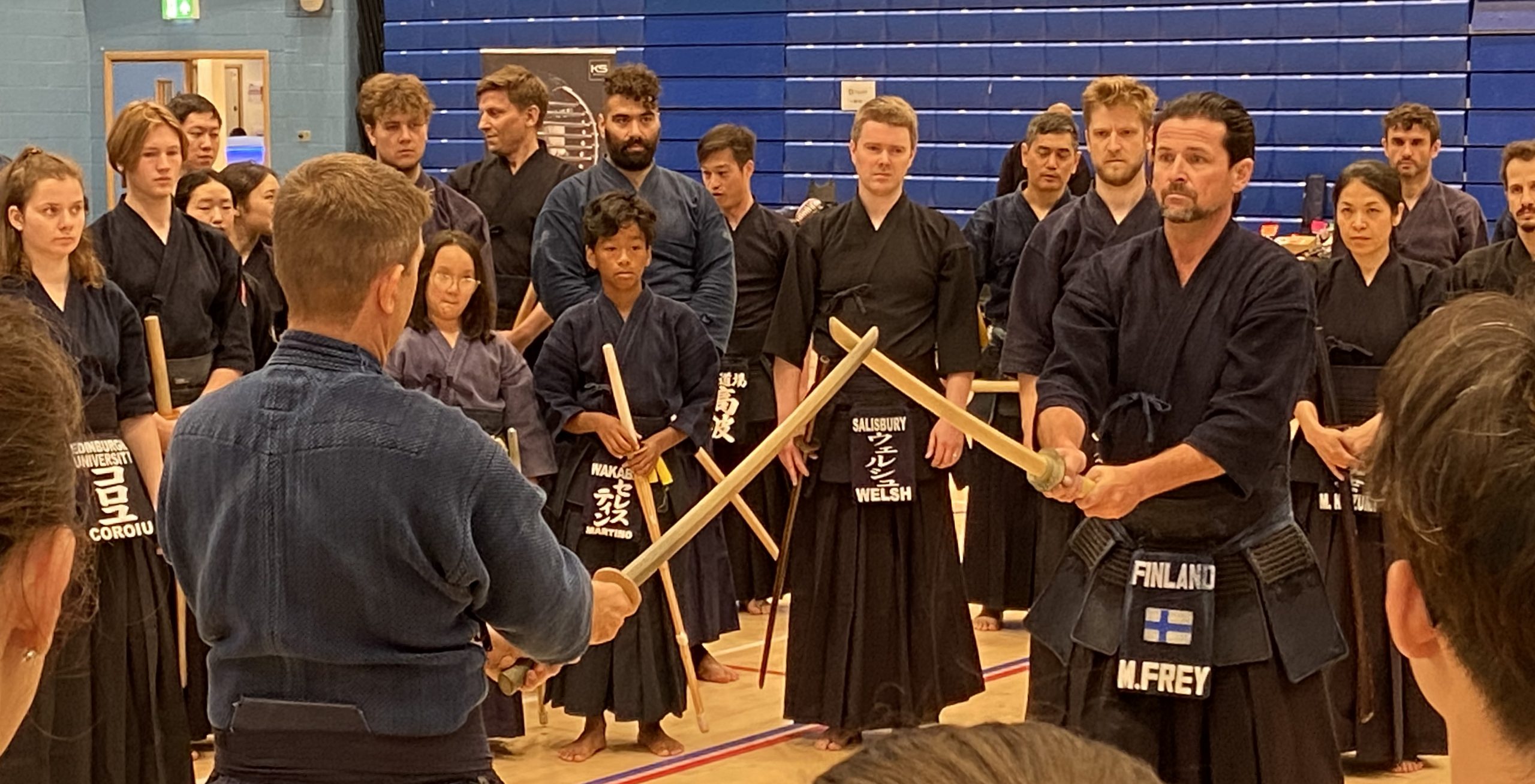
IKET 2005. Edinburgh: Friday 1st-Sunday 2nd July

Hachidan (8th Dan) Demonstration Matches
Chiba Masashi 8th Dan Hanshi and Sumi
Masatake 8th Dan Hanshi
Once again the Centre for Sport and Exercise
(CSE) at the University of Edinburgh played host to the Second International
Kendo Enbu Taikai that has left, as last year, a great impression on those who
experienced this superb weekend event. Organised by the British Kendo
Association (BKA), in conjunction with Edinburgh Kendo Club (EKC) this year’s
event featured as part of the EU-Japan Person to Person Exchange 2005 and
received promotional support from the Japanese Consulate in Edinburgh as well
as the Embassy website in London. Our special thanks go to them.

Japanese Folk Songs and Dance: Yoshie Asano-Campbell
The idea of holding a Kyoto style Enbu
event (friendly competition) was proposed more than two years by the British
Kendo Association (BKA). Since that initial idea, the event has evolved into a
kendo seminar weekend and festival of Japanese martial and cultural arts
ranging from Kyudo to Tea Ceremony and from Ikebana to Iaido; with new for this
year, Japanese Folk Song and Dance.
Both Geoff Salmon (Rokudan Renshi)
Chairman of the BKA and Paul Budden (Rokudan Renshi) BKA Kendo Bucho, have
developed kendo relationships and friendships with high-level Japanese sensei
over many years, which has allowed this event to feature such a high level of
kendo teaching and support.
What follows is an overview of some of
the training and social events that took place, primarily in the words of those
who took part.
The sensei who travelled from Japan this
year were Sumi Masatake (8th Dan Hanshi), Chiba Masashi (8th Dan Hanshi),
Ueigaki Isao (8th Dan Kyoshi), Tashiro Junichi (8th Dan Kyoshi) and Hayashi
Kozo (7th Dan Kyoshi). Arriving late Tuesday evening on 28th of
June, for most of them it was a return to Edinburgh but for Hayashi sensei it
was his first visit to the UK and of course to Scotland, but all were
enthusiastic to travel into the city and sample Scotland’s famous hospitality
and “Heavy” brown beer.
There is never much time at events for
the sensei to relax but EKC had arranged sightseeing to the Scottish Highlands
the following day. The trip was routed along Loch Lomond (40km in length) and
up into the mountains on the West coast. There the sensei saw some of the
stunning scenery that Scotland has to offer-not unlike the highlands of Japan.
For lunch the sensei travelled on to
Loch Fyne, an enormous sea loch that had for many years sustained a huge
herring fishing industry, with at one time over 600 boats on its waters. Now it
features a wonderful seafood restaurant with produce that is fished daily from
the waters of the Loch. Here the sensei ate fresh oysters and other local
produce with a glass of chilled French white wine.
At the end of this particularly long
day, the sensei still gave all their energy to a one-hour kendo session held
that evening. Edinburgh Kendo Club has a reasonably large membership for a UK
kendo club of around 50, but as it was a ji geiko session for those in bogu
only there was only a queue of 3 or 4 kendoka for the Hachidan sensei, which
meant that it was possible train with all of them in a single session!
On Thursday the sensei visited Edinburgh
Castle and witnessed the ceremony of the “One O’clock Gun”. This dates back to
a time when the local sea captains were required to set their watches
accurately for navigation purposes. The tradition continues today with the
firing of a large piece of field artillery. It caught some of our guests by
surprise how very loud the gun is, but the port of Leith that the signal was
designed for is some 7km away.

That evening kendoka began to arrive
from all over the UK and Europe, with notably larger groups from Ireland and
Norway. The furthest anyone had travelled to the event was from Beijing. Muir
Dickie, a founder member of EKC organised a family trip home to coincide with
IKET. Also we were very happy to welcome back Tanaka Satoru from Nagoya and
Nicolas Bergeron from Paris. Both former members of EKC their personal
contribution to the Edinburgh Club and IKET 2004 was so great, we felt it was
appropriate to invite them back.
A general practice focussed on men
cutting and kiri-kaeshi was held with around 50 participants. This was followed
by sensei-geiko during which the sensei were all very generous teaching us
through their superb cutting and later with their advice.
“During keiko Tashiro sensei was just so immovable!”
“After twice receiving tai-atari from a
broadly grinning Uegaki sensei - once ending up into the wall - I now
understand the importance of not going backwards!”
The social side of this event is as
important as the kendo and the sensei mixed freely were very happy to talk with
everyone when we met later for a drink in a local pub.
“Sumi sensei reviewed my footwork on
Thursday– light bulbs went on in my head! In a few words he marked out a whole
new way for me to practise, and also taught me the importance of paying close
attention to what we do when we practise.”
For the weekend of events beginning on
Friday, there were around 80 participants and it was a real eye-opener for many
of those who have never faced kendo sensei of such high quality before. The
seminar commenced with Bokuto Ni Yoru Kendo Kihon-waza Keiko-ho for beginners
and kyusha. Devised by the Zen Nippon Kendo Renmei, this features use of the
bokuto to learn basic shinai kendo techniques. Kyusha performed the Keiko-ho 50
times (25 per side) and the main teaching points were to:
Hold the centreline (chushin) until the
last possible moment
Keep an upright and strong
posture at all times
Use a quick snapping motion
(sae) with the wrists when
performing cuts
Keep an even balance of
weight on each leg for effective movement
This was followed by 100
suburi with bokuto and then (men, kote and doh) in bogu. All cuts were made
from long distance to practice footwork and maintaining correct posture while
having to reach out to cut our opponent.
“I learnt how to increase the speed of
my cuts.”
Dan and senior dan groups practiced
Kendo no Kata.
“On Friday I really enjoy kata practice with Uegaki sensei while
Honda sensei gave really good explanations; sensei’s perfect demonstrations
showed clearly how important posture and body movement are in kendo-no-kata.”
“During the Friday kata session with
Tashiro sensei, we slowly went through all the kata, but certain
important points were practiced repeatedly in isolation. For example in
gohonme, suriage was just repeated fifty times, with little emphasis footwork
until the sensei were satisfied we had understood the main points they were
trying to make. I am not sure what others thought, some may have found
this approach unexciting, but I found it really useful and appreciated the
personal attention I received from the sensei.”
After a break the finer points of
teaching and performing kakari-geiko were demonstrated by Ueigaki sensei and
Honda sensei (GB national Coach). Keiko was formatted as follows from the menu
below, depending on the individual sensei:
Kiri -kaeshi – Kakari geiko - Ippon-Keiko
- Kiri kaeshi
Queues were long enough so that
participants were able to fully recover between each practice and also benefit
from mitori-geiko as the sensei gauged the level of each kendoka and adjusted
the intensity of the practice appropriately.
As last year, the sessions were by no
means exhausting in any physical sense but were intended to leave participants
with a lot to consider; and as always both Sumi sensei and Chiba sensei
emphasised the simplicity of practice to get the basics right.
That evening after dinner, many thirsty
Kendoka descended on “The Sheep’s Heid (Head)” public house, just outside
Edinburgh and joined the sensei in sampling some fine Scottish whisky. There
has been a pub on this sight, in the small village of Duddingston since 1360
and this added to a superb atmosphere that was fuelled by fine weather, our
beautiful surroundings at the edge of the Royal Park and some serious kendo
discussion.
“I started my IKET weekend learning how
to hold the tension as motadachi for kakarite to strike during kihon keiko-ho;
also how not to shuffle my feet after seme but rather to cut with one positive
step.”

The Enbu Takai on Saturday commenced
with the pipes and drums of the City of Edinburgh Pipe Band and welcoming
speeches from John Howell President of the British Kendo Association and Jim
Aitken Managing Director of the Centre for Sport and Exercise. There was
evidence of Japanese and Scottish cultural as special features were a
traditional Scottish Sword dance performed by Kerry Pretsell and Taiko drumming
presented by the Taiko-Therapy Drummers:
Jake Perry and Beeslack Community High School, Penicuik
This initiated the day as an event for
cultural exchange and building ‘Bridges of Friendship’ between the very
different groups who may often be seen as somewhat insular, but here all
working together to present the very best of Japanese Culture in the UK enhanced with excellent Budo spirit and
the fantastic demonstrations:
Kendo no Kata: Sumi Masatake (8th Dan
Hanshi) and Chiba Masashi (8th Dan Hanshi)
Aikido- The Way of Harmony: William Coyle, Sensei
Makotokai Aikido Association, Glasgow
Kendo- The Way of the Sword: University of Edinburgh
Kendo Club and Edinburgh Kendo Kids’ Club
Judo- The Gentle Way: David Hammond, 2nd Dan and
Kata partner Stuart Gordon, 2nd Dan. British Judo Council
Karate- Empty Hand: Gordon Mathie (5th Dan) and
members of Takushoku Karate Club (Dunfermline)
Japanese Folk Songs and Dance: Yoshie Asano-Campbell
Jodo- The Way of the Staff: Keith Rose (5th Dan) and
Steve Boyes, Doshinkenyukai, William Smart 4th Dan and Hugh Darby, Shonenjiku
Iaido Club, Glasgow
Iaido- The Way of Sword Drawing: Fay
Goodman (7th Dan Renshi), Masamune Dojo, Birmingham
Culminating in the:
Hachidan (8th Dan) Demonstration Matches:
Sumi Masatake 8th Dan Hanshi and Chiba
Masashi 8th Dan Hanshi
Ueigaki Isao 8th Dan Kyoshi and Tashiro
Junichi 8th Dan Kyoshi
and finishing with:
Kyudo-The Way of the Bow: Liam O’Brien: 7th Dan
Kyoshi, Ritsuko Uechi 4th Dan. UK Kyudo Association

Cultural Workshop Programme
15.00-16.00: Tea Ceremony with Yamazaki
Kazuo
15.30-16.15: Japanese Folk Dance with
Asano-Campbell Yoshie
Japanese Cuisine: Bonsai www.bonsaibarbistro.co.uk
Japanese Shop: http://emaishop.com/top.htm
Weapons Display courtesy of Raymond
Flockhart
Ikebana with Ruth Davies
Bonsai Exhibition by the Scottish Bonsai
Association (Penicuik)
Photography and Artwork by Phill
Thornton and Dennis Rewt
“In the Enbu on the Saturday morning, I was initially pretty
nervous, but once in the shiai-jo, this disappeared. I was trying to show
ni-dan waza using harai, maki-otoshi and uchi-otoshi to take the centre prior
to making a strike. In addition I tried to use kote-men strikes and feigned
kote strikes to open men. I was able to strike at kote either taking the shinai
over or under my opponent’s shinai; I felt we both showed some of our best
kendo.”
“I simply loved it. Fighting in front of an audience and sensei
galvanizes your efforts. There were no nerves at all, just pure enjoyment of kendo.
My partner and I knew each other well enough to be sure that it would be about
good kendo, not about winning and - therefore - we accepted good cuts and
acknowledged ippon in the right spirit. This was a little like a grading but
without any of the pressure.”

Kyudo: Liam O’Brien: 7th Dan Kyoshi
Ritsuko Uechi: 4th Dan
UK Kyudo Association
“From watching the hachidan enbu matches, it
was exciting to be concentrating the important things in a kendo match for the
first time, and not getting lost in unimportant details, or the overall
spectacle.”
“The enbu match between Sumi sensei and Chiba sensei – there was everything there that we need to try and learn about being a good kendo person.”

Iaido: Fay Goodman (7th Dan
Renshi), Masamune Dojo, Birmingham
“At the Cultural events, I watched the Tea Ceremony. This is very
complex requiring great concentration, and was quite meditative. I’m not sure
how you remember all the actions; it makes learning the kendo kata look quite
simple! After watching the ceremony, the sensei made extra green tea for
interested people, and it was delicious.”
On Sunday the
session was split into 4 groups:
Juniors younger than 17years old
Kyusha
Shodan and Nidan
Sandan to Rokudan
Chiba sensei supervised the senior group
and from the basics of tenouchi created a very interesting and varied oji-waza
practice culminating in mawari-geiko when we were encouraged to fight with the
same purpose as during kihon and to allow ourselves to accept a cut. In this
way our training would be more effective.
“Chiba sensei demonstrated how, in its
purest (and simplest form) tenouchi is the foundation for all waza- and not
just oji-waza.”
“Uegaki sensei’s teaching on Sunday was lots of suburi; but mostly the feeling he transmits is that he hauls you upwards towards greater and greater intensity in your kendo (in fact all of the sensei seem to effortlessly pull more out of you than you thought possible). Intensity of practise was my biggest lesson from this weekend.”
Sumi sensei took the youngest and
perhaps most inexperienced kendoka for an unforgettable 2 hours of excellent
coaching. I know at least one very young kendoka who is now practicing at home
having been inspired by what he was taught and learnt.
“Understanding, and putting into practise for the first time, the importance of footwork and body movement over and above considering what your hands are doing – this was a feeling I got from Uegaki sensei.”
“On Sunday I learnt to do kiri-kaeshi
and practised trying to do it one breath (with great difficulty). Tashiro
sensei spoke to me about my posture and encouraged me to keep my back straight
and not to lean forward. He also mentioned that I should practice with my
kensen falling on the same spot on each cut instead of wavering, suggesting I
use a lighter shinai to improve focus of the kensen.”
“I really enjoyed being instructed by Tashiro Sensei. Salmon
Sensei interpreted sensei’s instructions but many of the demonstrations were so
clear, none was necessary. It was really inspiring to be working with such
excellent sensei, and I felt it really helped my kendo.”
“Before the Sunday session, I was unable
to gauge whether beginners without bogu should attend. Anyhow, came
along and was pleased I did. Tashiro sensei's teaching was quite
different from other teaching styles I have experienced. No shinai were
involved in this lesson as we were just concentrating on footwork, and each
point was repeated again and again with just a slight change or progression
added. I'm not sure what the others thought, but I found this really
useful, and I learned a lot.”
After another wonderful of kendo
weekend, Sumi sensei left us with a well-known set of principles to follow:
“Ichi-gan, ni-soku, san-tan, shi-riki”
First-gaze, second-footwork,
third-mental power, fourth strength.
Edinburgh Kendo Club would like to thank
the sensei, and the BKA for allowing us to host this event and we look forward
to the 3rd International Kendo Enbu Taikai in Scotland next year. If
you wish to contact us please use the following e-mail and website addresses.
British Kendo Association: www.kendo.org.uk
Edinburgh Kendo Club: www.edinburghkendo.co.uk
Steve Bishop (Dojo Leader): steve@edinburghkendo.co.uk

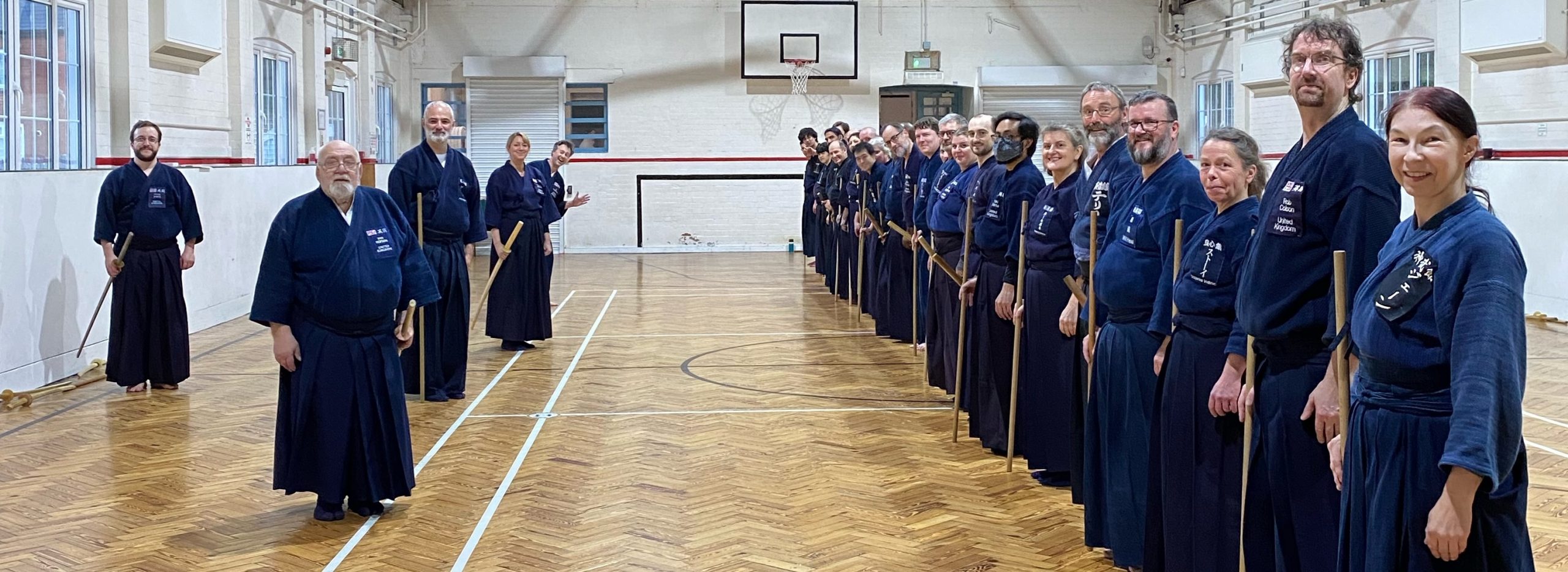
IKET Group 2005
Premier Cup 2005
Sunday 5th June saw the Premier Cup Individual Taikai taking
place at Kagami Shin Dojo Stoke-on-Trent for the third time.
This is one of the best competitions in the year and is open to any BKA
member irrespective of grade who is a UK subject. A well attended taikai with
50+ competitors and with pre-registration the draw took only a few minutes to
complete after the closing time. With the sheets printed (thanks to Errol
Blakes programs) we were able to get underway at 10:30 on two shiai courts.
It might be just my opinion but I think the general standard of kendo
has got better over the last couple of years and this was for me anyway
evidenced in the quality of many of the matches.
There were some good pairings in the first round notably Stuart Gibson/
Malcolm Goodwin and Will Wright/Gerry Kincaid which lead to exciting kendo with
difficult to predict outcomes. Malcolm’s experience against ‘Gibbos’ reach and
speed for one example.
A surprise return to taikai was the appearance of Mick Taylor from
Northumberland Uni dojo. The third round saw him paired with an OLD
(deliberately in upper case) rival Derek Raybould from Nagamitsu. They were
both members of the national team years ago. Mick managed to see off Derek to
progress to the quarter final. Up to this point one of the best matches I had
seen was the encounter between Brian Hayes and Anthony Scott. Some lovely
kendo, fast, accurate, and aggressive and the match could easily have gone
either way. Both of them are members of the current squad and Honda sensei was
taking a good look. Finally Scotty made it to the quarter final stage with a
trademark hike-men.
The quarter-final line up was as follows Dennis Straughan/Anthony Scott,
Mick Taylor/Robbie Brogan, Barry Straughan/Stuart Gibson and Gerry Kincaid/Alan
Thompson. At this point I would like to remark on the fine performance of
Dennis Straughan to reach the quarters. Dennis as we all know is not the
youngest of competitors and he fought well from the very first round and he was
delighted with his days work. Sadly for him it ended here, Scotty was too quick
and accurate for him.
The semi-final line up emerged as Anthony Scott/Mick Taylor, Stuart
Gibson/Gerry Kincaid. For sheer entertainment value the first semi final was
excellent. Mick chasing Scotty across the floor with his Shinai in his throat
on more than one occasion. He took it in good spirit and I’m glad it was not my
neck on the end of Mick’s shinai. Eventually Scotty caught up with him to
progress to the final.
The second semi saw Gibbo’s youth and speed allied with good kendo
triumph over Gerry’s experience.
So the final match was a pairing of the first ever winner of this
taikai, Scotty and the defending champion Gibbo, both members of the current
national squad. A pairing which lived up to its promise of some exciting kendo,
Gibbo managing to retain his title.
Results:
Winner Stuart
Gibson
2nd Anthony
Scott
3rd Gerry
Kincaid/ Mick Taylor
Fighting Spirit Alan
Thompson.

‘Gibbo’ getting the trophy again.
And as usual can’t take it home so it’s stored at Brian’s until next
year.
Juniors.
For the first time we held a junior taikai at the Premier Cup. I
understand that this will become a feature for future years to encourage our
younger members to take part in competitions.
We used a pool system to allow them to get more than one fight and there
was plenty of effort and commitment shown. I would urge all juniors to take
Mark Halls as an example of some first class kendo.
Results:
Winner Mark Halls
2nd Kyle
Brogan
3rd Kerr
Brogan
Mark ‘Scarface’ Halls
Finally thanks must go to the Referees for their efforts over the two
days and to all the people who helped out on tables and scoreboards, especially
to Mike and Oscar Carter from Liverpool who have supported this event in the
three years its been held in Stoke.
Also to Jane Hall for spending most of the day tying ribbons and to
Gibbos team for their work on Sunday and ultimately to the members of Kagami
Shin for hosting this event.
I look forward to seeing most of you back in Stoke for the British Open
on the 24th September 2005 and YOU
MUST REGISTER FOR THIS EVENT BEFORE THE 19th.
Steve Plimbley
Kagami Shin
EUROPEAN KENDO CHAMPIONSHIPS – BERNE (15-17 APRIL 2005)

Picture
courtesy of Emai Shop
Women’s Team Report (Alex Burch)
It was a dark and stormy night when the squad met to set off for the 2005 European championships but it was good to be travelling with a full complement of players including 5 girls and 2 juniors (especially as Lin introduced a previously unseen sense of style to the British Team). Having flown into Basle we took a short train trip through beautiful alpine countryside to Bern where we were met by our Swiss guide (who bore an uncanny resemblance to Mike from the Young Ones). The hotel we were staying in was 5 minutes walk from the Sports hall and our early morning start meant we arrived in plenty of time for a practise (which helped ease the nerves that some of us were feeling). In the evening, the squad went out for a very Swiss meal of pizza and Gibbo unleashed his bling-tastic tracksuit on an unsuspecting Swiss public (I’m sure it will catch on).
As usual, the first day of competition was the women’s teams and the junior’s individuals. We had been drawn in a pool against Sweden and Spain and felt confident that we would be able to get through into the next round. The first match between Sweden and Spain was nothing if not quick since despite only having 2 players, Spain scored 2 points in each match rapidly to beat Sweden 4-2. Then it was our turn against the Swedes and unfortunately we lost the first two matches before drawing the 3rd. Obviously, this really put the pressure on us in our 2nd match but Lyndsey went out and fought with a huge amount of spirit to keep her opponent to a no-score draw, we won the second bout by default and I managed to only go 1-0 down in the third match. Unfortunately, whilst each of the three teams had beaten one of the others we were knocked out on points whilst Spain and Sweden had to have a fight-off to establish who went through first. It was a disappointing result for us and as we showed in out 2nd match we have the ability – we now have to work at being consistent in scoring and employing tactics. In the end the German team emerged victorious beating France in an exciting final which was gutsy and decisive.
At the same time that we were fighting, Mark and Lin were battling away on Shia-jo A both showing awesome fighting spirit and some great Kendo (a lesson to all of us) and whilst they were disappointed not to go all the way I’m sure they came away stronger and more determined for next time.
This year the women were competing on all three days so instead of having Saturday off it was a shock to the system to find we were up and out at 6am to warm up for the individuals’ pools. Unfortunately Tanya was not able to compete due to injury, however she more than made up for her absence from the Shia-jo with sterling support and advice. After the disappointment of the previous day we were all determined to learn from our mistakes and get out of the pools. Lyndsey gave her opponents a full and frank introduction to Kendo, Kim made scoring Men seem effortless whilst Frankie showed off her patented Kote Kaeshi Men technique prompting a chorus of “In the jungle…” from the boys. This really put the pressure on me as I didn’t want to let the team down and be the only one not to go through. Fortunately I won my first fight 2-0 before losing to an old rival. Having all got through the pools we could then settle back, bite our nails and support the guys. They met Portugal and Germany in the pools and were experiencing a new fighting order. Germany were tough opponents and unfortunately Scotty met his old nemesis, Ulmer, who seems to determined to get him on his back however, Will fought magnificiently to beat the German no. 3. This meant that GB went through and onto a great match against France. The GB team really fought their best and showed that no team is now out of their reach and although they lost they all showed us some exciting Kendo and it was great to see Gibbo beat Blanchard who went on to win the Men’s individuals the next day.
On the Sunday, the cold icy rain we had experienced the day before had changed to thick snow. The guys set off early as they had pools and competition proper, whilst the girls set off slightly later arriving in time to support them. Again everyone fought really well and all the boys got out of their pools although Will did insist on fighting everyone three times in an effort to confound Swiss timekeeping. It was around this point that the lights in the hall went out, and all daylight was blocked out by the heavy snowfall on the ceiling panes the consequence of which that many of the guys had to fight in a strange half-light (congrats to the referees for being able to see what was going on). The girls weren’t due to re-start their competition until after lunch when we found a quiet spot to warm up and practise the pointers that Sotaro had given us the previous day. My first fight was against Belgium and I felt extremely confident especially being given the sound advice to not do too much. Having scored Kote I was able to fend her off for the rest of the 5 minutes and go through. In my next fight I thought I’d follow the same pattern and all was going to plan when I scored the first Kote however she quickly came back to score Gyaku-Do. After a gruelling 5 minutes (which included a rather protracted time in sonque as she re-tied her Men slowly) I finally went out in Encho. Kim meanwhile was busy extracting revenge on Maj of Poland who had the temerity to beat her at last year’s Mumeshi 3’s. All the work Kim had put in, watching the video of that fight and learning what went wrong paid off as she triumphed and went through to the next round where she met Ahlstrom of Sweden. Again Kim scored the first point but then lost the next two. Frankie met the aptly named Hell of Romania and too managed to knock her out to go through. Unfortunately in a repeat of last year’s luck, she then met her team mate, Lyndsey, who had had to wait to 4 pm for her first fight of the day. Watching team mates fight is always really awful as you always want both to win and neither to lose. This time it was Lyndsey’s day as she went through to the next round (going the furthest of all of us). It was here she met a small Russian lady, who seemed determined to go for kote and then drew a surprise Men out of the bag to score. By the time we had finished we were all exhausted (mentally as well as physically) and obviously the evening was spent quietly over a pint or two although I do have a distinct memory of seeing Mark and Lyndsey praying to the DJ for ‘one last song’ and Gibbo doing his bit to further Anglo-French Relations.
The Women’s Team would really like to thank their team members for their support not only during the competition but also during training, Sotaro for all his input and hard work and the BKA for supporting us. The weekend showed that we are growing stronger as a team and we are all looking forward to the next year’s training and competitions.
Men’s team report (Anthony Scott)
It was a long journey out: early morning flight to Basle, then a train to Berne. But we arrived at the station in good spirits and in blazing sunshine where we were met by our own personal Swiss guide for the weekend. He proved to be super efficient and shepherded us everywhere on time, although I’m not sure whether by Sunday he thought he’d drawn the short straw by having to look after the British team. I think Gibbo’s sense of humour left him slightly bemused at times!
The hotel was only a 15 minute walk from the championship venue which was convenient as it meant not having to worry about queuing for buses all the time. However, the weather was slightly English: sunny for the first two days, snow the whole of the next day and rain the following day. The two little mini-buses were consequently in great demand on the final day. It was only Steve Bishop who stuck his nose up at the mini-buses, donned his soft floppy fishing type hat and trudged off into the pouring rain!
The first day of the championships belonged to the women and juniors but as the women’s captain, Alex, is writing about the ladies’ competitions, I will pass quickly on to our juniors who were Mark and Shao Lin. Both seemed to be in good form: Shao with his quick hands and Mark playing his usual waiting game and then pouncing as soon as an opportunity appears. However, both were knocked out earlier on in the competition than they perhaps should have been as the two finalists were definitely no more technically proficient than either of them. Mark lost in one of his trademark long encho’s which will perhaps teach him to finish his opponent off earlier on in a fight!
The men’s team competition took place on the second day. We had Germany and Portugal in our pool and our ever astute coach, Sotaro Honda, worked out that we had to come top of the pool if we were going to avoid France in the early stages of the knock-out competition. This was always going to be a challenge as the British team hadn’t beaten Germany for quite a while and this sadly proved to be the case again. The men’s team consisted of Brian as senpo, Andy/Barry as jiho, Will (aka Bermondsey Bomber) as chuken, Gibbo as fukusho and Scotty as taisho. We fought Germany first and were still in the running after Will’s excellent victory, but Gibbo unfortunately lost 2-0 against a jodan fighter and that was that. I always seem to fight the same player and was fortunately only knocked over on to my back once by him this time (my record is three times in one fight by him!).
We took on Portugal next and beat them convincingly. Barry stepped in for Andy and scored some good points using hiki-men, while Bomber took another scalp with his mighty kiai and Gibbo returned to his winning ways with a quick victory. Brian was finding the role of senpo difficult but seemed to be adapting with each fight. We consequently made it out of our pool and faced Belgium in the first round of the knock-out competition. Will’s winning streak came to an end as he was beaten by a young fellow who happened to be a previous European champion, which meant that Gibbo needed to win to keep us in contention. He duly did this with a 2-0 victory. I consequently had to win to get us through to the next round of the competition. This I duly did with another 2-0 win.
As anticipated, France were our next opponents. Although we lost the first three fights 2-0, it was not the walk-over I remember of a few years ago when we fought previously at the European Championships in Nantes. Andy in particular had a good fight and it is exciting to imagine how good he will be after he has gained more experience in championships. Gibbo was on fire in his fight and won 2-0 against the fellow who was to be crowned European Champion the following day (a fact we were reminded of over and over again and are not likely to forget in a hurry!). The semi-finals were contested between France/Hungary and Spain/Germany. Both matches were very close indeed but eventually saw France and Spain go through to the final. The latter was a very exciting affair with France’s orthodox style of kendo up against the more flamboyant style of the three Castro’s and their team-mate using ni-to. The crowd were rooting for a Spanish victory and not disappointed. It was an exciting final and you could see by all the hugs at the end how much the victory meant to them!
The third and final day, Sunday, saw the men’s individual competition take place. It was encouraging that all the men made it out of their pools, although it was a shame that no one went far enough to challenge for the medals. Brian fought more freely on this day and his fast men-cut was more in evidence. He also scored a great tsuki, while Gibbo scored a wonderful sounding gyaku-do, which just shows that Sotaro has improved our repertoire of techniques. Indeed, we all now tend to look on tsuki and gyaku-do as just normal techniques and nothing out of the ordinary. Gibbo was flying again and winning his fights with ease, until he came up against Jorg Sengfielder (from Germany who beat him with a kote and men-kaeshi-do. I must, however, add that Gibbo thought his men-cut hit the target first! Will, as usual, had to fight about four times as much as the rest of us just to make it out of his pool. Three players in his pool of four were equal on points after the initial fights and it took a series of ippon shobu’s and then san-bon shobu’s before the top two players could be distinguished! The improvement in Will’s hiki-waza was obvious to all and again shows how Sotaro’s teaching of hiki-waza at squad sessions is paying off.
It was unfortunate that Brian had to face Barry after they had both got through their pools. On this occasion Brian ended up the victor! Andy seemed comfortable in the shiai-jo and it was encouraging to see him using a wide range of techniques. I experienced something new in one of my fights, namely fighting in a somewhat darkened room as there was a city-wide power failure which meant that none of the lighting worked. The piled-up snow on the sky lights also did not help matters. However, the darkness did help to hide my embarrassment when my men-himo snapped as I was re-tying my men out on the shiai-jo. Steve Bishop’s knot tying skills were greatly appreciated! Sengfielder eventually came third along with Soulas from France while the runner up was the German who was also runner up last year (the self same one who knocks me on to my back at each competition!) and the winner was from France who (in case you forgot) Gibbo beat 2-0 in the team competition!
There was a great team spirit at these championships. When people were not fighting, they were always looking after and encouraging those who were fighting. Praise must go out to the juniors who only fought on the Friday and then spent the Saturday and Sunday looking after every whim of the ladies and men! The presence of Steve Bishop must also be mentioned as it definitely did not go unnoticed! I’m not sure what advice he kept giving his [ looks like but I’m sure she’s not] long-suffering wife, Lyndsey, but it must have worked on the evidence of her great fights! He selflessly helped out during the training sessions and also during the competition itself, making sure everyone had the appropriate food and drink and turned up for their fights on time. Kazuo Matsuda did likewise for the women and its great news that she is now involved in the future development of the women’s team, as she has so much to offer.
The Sayonara party was eventful as usual. Gibbo and Steve were as couth as ever at the dinner table, trying to cram each dish into their mouth all in one go. At least we were afforded some peace and quiet for a few precious moments as they munched away! Apparently the French team stripped down to almost nothing and ran the length of some sport’s pitch, but I missed that fortunately. I think this did, however, prompt Gibbo (who does not like to be out done) to plaster his body with strange sticky slogans and wear netting type things on his head. The normally reserved Brian also came to the fore doing a John Travolta impersonation, which led to him complaining the following day that he was so sore and stiff from all that dancing! The juniors, for their part, had evidently been working on a dance routine based on the flag waving movements of the kendo referees! Sotaro managed to dance with the same Russian lady who asked him to dance at the last championships in Hungary. He was chuffed, however, that on this occasion it was he who was able to “dump” her on the dance floor and not the other way around!
All in all it was an encouraging championship for the British team. It was a shame we were drawn with France relatively early on in the knock-out stage of the competition as I felt we could have gone a lot further if we had not had to face them just then. The improved strength in the team overall was also evident by the fact that we all made it out of our pools in the individual competition. This strength in depth will improve further as our talented juniors become eligible for the senior team and the younger members of the team gain more experience of international competition. I am sure Sotaro must get exasperated by our tendency to still start competitions slowly, to lose a point soon after we have just scored one, to go out of the area due to a lack of spatial awareness, to fail to protect ourselves properly once we have made a cut etc., but I really do believe that his patient teaching and new ideas are beginning to bear fruit. I know that all members are extremely grateful for the time and effort he puts in to coaching the squad and also for the gracious support from the BKA.
I can only end, as usual, by encouraging more BKA members (both male and female!) to turn up to our monthly squad training weekends. I look forward to seeing you all there!
WHY?
The question of why people practice Kendo, Iaido or Jodo, or why or how people are initially attracted to these arts is one which I imagine has been posed in a number of ways and on different occasions over many years within the various committees of the BKA in an attempt to identify good strategies to firstly attract new members and then to keep them; and in fact the Executive Committee meeting minutes of February this year mention the need for measures to retain members. Recently, prompted by various events or things that have come up in conversation, I seem to have had cause to give this question a few thoughts myself. I doubt that any of the officers of the association have come to a definitive answer on this and I further doubt that I will here, but here are at least a few of my own thoughts along with any conclusions that I may have reached, offered for scrutiny in the hope that they may strike a chord with others and perhaps open a dialog that will eventually help to attract newcomers to the BKA and also help to continue to supply the right environment for established members to continue enjoying their chosen interests.
As I’ve deliberated, it occurs to me that there probably isn’t a topic which could be associated with BKA that couldn’t be mentioned in an article such as this. For the person who has just read about or just seen something of Kendo, Iaido or Jodo , or has in some other way become intrigued or excited at the prospect of actually taking part in such exotic pastimes then I think things are relatively simple. I would suggest that at this stage only two or three things are really of concern, namely, the attraction they feel, how to get involved and possibly the cost! For the established member though, things are more complicated. Fees, administration, coaching, examinations, seminars, competitions, practice in the dojo etc, are all elements that may enter into a kind of ‘stay or go’ equation of a current member and are all subjects that will have to be touched upon here.
So, preamble over, I’ll get to it and try to express why I continue to practice and to speculate why others might, so to speak, stay or go.. Though I practice Kendo, Iaido and Jodo, in some sections I’ll mostly be talking about Iaido; not because what I have to say applies exclusively to Iai, I’m sure for some people the things I mention could equally be applied to Kendo or Jodo, but at least some of the thoughts I’m trying to get across seem more clearly defined to me when I think about Iaido. So as not to get myself hopelessly lost I’m going to split the rest of the article into three main sections; Administration, Competition and Practice, and these sections will be spread over three issues of the BKA News.
PART 1 :
ADMINISTRATION
With respect to the people currently involved in administering the BKA, this is perhaps the least important topic I wish to discuss, it is of course vital in its’ way, but I doubt that anyone joins or stays in the BKA solely on the grounds that they like the way it is administered, though of course for existing members poor administration may contribute to reasons for leaving! It seems to me that the main purposes of administration within the BKA must be facilitation, promotion and, increasingly, regulation. By facilitation I mean the provision of seminars and gradings etc and for myself I think that this aspect of the BKA is at least adequate and at best is often very good. As members I think we are generally well served with opportunities to further our chosen study, to advance in rank if we are able and choose to do so, to enter competitions, and most importantly we have good access to teachers whose skill and experience is above challenge. Whether we always use this access to its best advantage I’m not sure and I suppose that’s something that could be looked at more closely at another time. I’m also not sure if the money spent on facilitation in the BKA is always spent to its’ best potential, other people may have clearer views on this point, but certainly in my own opinion the fees we pay for membership etc seem fine. In brief, I think the facilitation is generally very good, perhaps my only reservation being that sometimes there is a tendency to hold events at low key venues, which may be a little short sighted and leads nicely on to my thoughts on Promotion of the BKA.
As for promotion, I certainly think that the BKA is right to promote Kendo, Iaido and Jodo, and in recent times it seems to be becoming more successful at doing so. In terms of appealing to potential members, the ease of looking up information on the internet and being able to access dojo lists etc, coupled with a little help from various film makers recently, seems to have made a big difference to the volume of enquiries received. To reinforce a comment made in the BKA News a while ago, once we’ve attracted new people to the dojo it’s obviously up to us to try and ensure they stay! Better promotion is also achieved by holding high profile events etc at good high profile venues and in some parts of the BKA I think this is starting to happen. Obviously expense is a factor here, but a little investment in holding events at venues that offer good quality facilities offers a double benefit in my mind in that it improves the general quality of events for the people attending and this in turn should help with member retention, and it also helps to give Iaido etc more general exposure.
Also, some thought has to be given to where, geographically, events are held. For example, in his recently published report [BKA News issue 15, Dec 04] to the AGM the then Jodo Bucho [Jock Hopson] refers to the Watchet seminar as ‘well attended and enjoyable’, but then goes on to point out that only four people from the local dojo were in attendance and continues then to offer that as possible justification for moving the seminar to a different location, quoting a financial mandate in the constitution to further support his implied opinion. I think that what Jock says is of course logical in one sense, but in terms of promotion maybe there are other factors that need to be considered. The fact that the seminar was ‘well attended and enjoyable’ possibly/ probably indicates that people attending the seminar are generally happy with the facility being provided and also, perhaps particularly in the case of Watchet, that they like the locale where the event is held. In regard to retaining members this sounds good, and in terms of promotion, well, you can’t always preach to the converted. If the BKA is to be properly regarded as a national association it will have to promote itself in areas where it does not already have particularly good local representation. As far as I know, the Watchet seminars [Kendo and Iaido, Jodo] are the only national BKA events held in the South West of the country and for the Jodo Bu to be pulling out of the seminar on purely financial grounds may not be in the association’s best interest when assessing the bigger picture.
As a kind of post script to the last paragraph I should say that having attended the Watchet seminar in March of this year, which was for Iaido only this time, I can confirm that it was very well attended, in fact so well attended that it would probably be impractical to hold a Jodo seminar alongside Iaido in the future, so some kind of change to the previous arrangement seems inevitable. I’m not sure how many of the people in attendance were from the local dojo [Tsunami], but I would think in percentage terms it would be a fairly low figure, but none the less, in terms of the Iai Bu this surely was a very successful event and holding the event there can only help further promotion of the BKA in the South West.
Overall I think the improvement in promoting the BKA can only be good news for both existing and potential members. Certainly it must be encouraging to dojo leaders that there are simply more people attending classes and I would think that the general lifting in profile and image of the association will lead to people feeling generally more positive about being a member of the BKA. One small note of caution; some care should be taken to promote the BKA not only in an effective way, but also in a way that protects the basic integrity of Kendo, Iaido and Jodo and in no way proves detrimental to their practice and character.
A relatively new addition to administering the BKA is ‘Health and Safety’. I should state from the outset that I very much support any approach to make the practice of Kendo etc as safe as it can be and if the BKA wishes to be seen as a progressive and professional body it will inevitably have to open itself to strictures that apply to such bodies. Those of you who have read the BKA News for some time will know that I have in the past written articles about inappropriate behaviour during practice and this still remains a concern which has to be challenged wherever it’s met. It has to be said though that there are possible problems, and some discrimination needs to be applied to ensure that we only take on board what’s actually pertinent and necessary to us in terms of H&S, so that we don’t get weighed down by things that really aren’t necessary. I’ll touch on this again a little later.
I think there are a couple of problems with the administration of the BKA at the moment. The first of these is a kind of perennial problem which I’m sure applies to any number of groups set up to serve any number of interests, and that is that the people who sit on the committees etc often have a different view of things than the average member! What I mean by this specifically, is that I think most of the membership view Kendo etc as a hobby or a pastime. They may, in their own way, be deeply interested in their chosen art[s] but in terms of the time and money they have to spend on it, it falls firmly into the bracket of a hobby; whereas often the people who find their way on to committees and the like have a different take on things. They often see themselves as more serious about their study and feel that others should take the same approach. Understandable I think, considering the time and effort given by some of these people, but as a consequence a lot of what is proposed as reasonable by the governing body doesn’t always realistically fit in with the view of the average member, who is happy to turn out to the local dojo for an enjoyable evening once or twice a week and go to the odd seminar when it’s convenient, but that’s about all; and of course as a further consequence we occasionally hear of unhappy officers of the association who have put a lot of personal effort into organizing events or coming up with ideas only to have them poorly received. It seems to me nobody is in the wrong here, it’s just different people showing different levels of commitment and that being the case I’m not sure what can be done other than for the people involved in administering the BKA to understand that this may be the case and accordingly to be as pragmatic as possible.
The other aspect of the administration which may give me concern and I think could be an aspect that may cause some people to question their membership of the BKA, is the sheer weight of it! The number of forms to fill in, rules to follow and events to attend is on the increase. Administration, like etiquette, is only good when it enhances the thing it serves, if it becomes too overwhelming then it only serves to provide barriers to people’s enjoyment and this in turn could become a reason why they decide to leave and try something else.
I’ve already mentioned that in terms of facilitation I think the BKA is very good, but ironically we could get too much of a good thing. There is an increasing amount of events to go to, but it may be wise for schedulers to try and keep to a minimum of events, both in order to avoid overloading members, most of whom have limited time and resources, and also to help keep the quality of events as high as possible [Promotion]. Actually I’m sure that schedulers do have this in mind, but none the less the BKA calendar is looking increasingly full, especially for people who practice all three arts!
In more general terms and as previously mentioned, there can be a tendency to impose a bit too much in the way of rules and regulations. I’m certainly not questioning the need for standards in relation to H&S or other areas, but I think we do need to be sure that everything done is effective, justifiable and done for the right reasons, to enhance the way the BKA works and not just simply to control it. In general, if things become too compulsory all the time, then I think it may become too heavy and controlling and I fear for some, eventually off putting!
As a final comment, I would say that the BKA is showing signs of maturing. In the past the BKA has at times been criticized for acting like a club rather than a national association and at times I think that criticism has been justified. Recently though things seem to be changing for the better, the BKA is growing, not only in numbers and expertise, but also in ambition to be a truly national body and I think for most of us that can only be welcome.
Next time – Competition!!!
Keith Rose.
Doshin Ken Yu Kai
Midlands Kendo High Grade Practice
Progress Update, Malcolm Goodwin
Concept
The high grade sessions were reinstated following discussions with Sotaro Honda and requests from senior kendoka who remembered the great practice sessions at Nagamitsu Dojo. The idea was to construct a group of six dojo within the midlands area, thus allowing dojo`s from other regions access to at least one high grade session per year. The participating dojo group agreed to host one session per year, free of charge (the entire group also agreed to supply refreshments and snacks). The initial host dojo`s for the midlands area are,
Nagamitsu (Birmingham)
Kagamishin (Stoke-on-Trent)
Doyukai (Nottingham)
Kashinokikenyukai (Ollerton)
University of Gloucestershire kendo club (Cheltenham)
Oxford University kendo club
The prerequisite for attendance is,
Sandan and above
Dojo leader (or their representative)
BKA team member
Invited guests
With little experience of organizing a structured event as this, a group of senior members of the BKA were approached to help formulate a plan and to help initiate the start of what promises to be a fantastic venture. I am sincerely grateful to the following for their help,
Howell sensei (event organization)
Yanai sensei (technical advisor and formulated/instructed at initial session)
O`Sullivan sensei (instructor)
Honda sensei (national coach and session development)
Parker-Dodd sensei (analyst and session development)
Practice sessions
It is not my intention to comment upon the technical aspects of each session. I will however, list the main topics of the day.
1) The first session was held at Nagamitsu dojo with approximately 30 people attending coming from great distances i.e. Cornwall, Bradford and London. This initial session was carried out under the guidance and instruction from Yanai sensei. The expertise of sensei is unquestionable. The whole practice session was fantastic, and covered,
Importance of good Kihon
Uchikomigeiko
Making a strike from your own distance
Correct zanshin
Jigeiko
After the practice, questionnaires were completed to allow analysis of the session to help in the construction of the following practice. Feedback was varied, with some people wanting more technical advice and less jigeiko and some vice versa. The main feedback of the day was, Yanai sensei is a great teacher and his level of kendo is one that we all hope to achieve.
After the practice, all kendoka enjoyed the refreshments and snacks in the dojo (thanks to Nagamitsu dojo for supplying the goodies). It was hoped that a discussion concerning the day’s events would follow but this did not transpire, with many old friends catching up on times gone by and before long, people were drifting out of the dojo and the moment was lost. This part of the practice is of great importance to the session planners, as immediate feedback is useful in analyzing the practice as well as a great social bonding exercise. It was agreed that future sessions would include a designated meeting area for comments on the days practice.
2) Cheltenham dojo hosted the second session and was extremely well attended. With 35 kendoka from various regions throughout the country, the day started off very promising. Instructors for the session varied according to what aspect was being practiced.
Warm up and suburi, Honda sensei.
Kendo kihon with bokuto, sensei`s Howell, O`Sullivan and Honda.
Uchikomigeiko and the importance of being a good motadachi, Honda sensei.
Group sessions with feedback from sensei,
Sandan, Honda sensei.
Yondan, O`Sullivan sensei.
Godan, Howell sensei.
All of the group jigeiko was set at no more than three minutes duration.
Mawarigeiko, these jigeiko was set at four minutes.
There was video analysis of certain parts of the session and this proved to be an extremely useful tool in feedback and evaluation. The main feedback overall from this session was, there was too much crammed into one afternoon (three hours). On a personal note, it was good to see some new faces attending and everyone seemed enthusiastic about future sessions. One negative comment concerns the lack of after-practice discussion (sorry, ran out of time). This will definitely be rectified. However, those that did stay around got to sample some of Mrs. Parker-Dodd’s rather excellent home made cakes and shared a few beers, all courtesy of the host dojo.
3) Nottingham was assigned the next practice but due to BKA calendar clashes (it has been an eventful year) the decision was taken to hold the next high grade practice prior to the seminar in Glasgow (Nottingham practice has been re-arranged, more to follow). Thanks go to Gerry Kincaid and Taiseidokai for hosting this session. The senior sensei instructing at the session was Honda sensei.
The main theme of the practice was an explanation of the
concept of "EN" complete with a picture of the Japanese character.
Honda sensei's explanation of this was making and maintaining mind contact with
the opponent which is also a constant theme in the various Sumi sensei
seminars. Making EN as soon as possible with the opponent was emphasised and it
was stressed that during the practice all members should bring this with them
to any keiko.
The technical emphasis was on the teaching of Kiri-Kaeshi
and Gi-Geiko. The maintenance of correct distance and correct striking in
Kiri-Kaeshi was taught by having motodachi hold mune tsuki on the attacker
forcing correct distance and a full extension of both hands on the cut.
Gi-Geiko was taught as a receiving technique using the methodology applied
during squad training i.e. how to open for single cuts - kote/men/do/tsuki and
how to show ni/sandan waza opening to the attacker - this was demonstrated by
motodachi touching the targets in the order they should be struck.
The session finished with mawari geiko and a good time was
had by all attendees with a warm thank you to the host dojo for their
hospitality.
4) Kagamishin held the fourth practice and again the attendees participated in a most enjoyable and informative session lead by Honda sensei. This practice consisted of,
Warm up and suburi.
Kirikaeshi.
Uchikomigeiko. These two sessions focused on the importance of being a good motadachi, with Honda sensei commenting “if you are a good motadachi, everyone can learn from you”.
How to organise Wazageiko in your dojo.
Three different types of wazageiko.
Wazageiko for building up your waza.
Wazageiko for developing and refining your waza.
Wazageiko for making your waza practical.
Jigeiko.
Whilst this session seemed to be aimed at junior dojo leaders or kendoka aspiring to become teachers, it was a joy to see professional teachers come away from the practice having learned something different. Kendoka traveled from Newcastle, Oxford and Bolton as well as dojo`s closer to the venue. The meeting held after the practice was attended by all. Initially, comments regarding the practice were a little slow coming forward, mainly due to the fact there seemed too much to analyze but the beers started to flow and it was good to see people openly discuss what they would like included in future sessions. Once again, the hospitality of the host dojo was greatly appreciated.
Future Sessions
The next high grade practice is to be held in Oxford.
Saturday 17/09/05
Iffley Road Sports Centre
Oxford
OX4 1SR
http://maps.google.com/maps?q=OX4+1SR&spn=0.005718,0.014432&hl=en
2.00 – 5.00
Meeting to follow (all to attend please).
This, in my opinion will be one of the most important practice sessions for dojo leaders and grading attendees. The instruction of the session will be lead by the President of the BKA, Howell sensei. The session will cover the grading requirements for future applicants.
A suggested format (please note, suggested format) is, three candidates from each section will show their best grading kendo for the sensei to evaluate and discuss openly with all attendees. Therefore, volunteers are required to help with the session demonstration. If you have what it takes to show your best kendo in front of your peer’s and are prepared to have your attempts analyzed (good and bad) please add your name to the section for your next grade and email me at the address below.
|
Name |
Dojo |
Grade/Nidan |
|
|
|
|
|
|
|
|
|
|
|
|
|
Name |
Dojo |
Grade/Sandan |
|
|
|
|
|
|
|
|
|
|
|
|
|
Name |
Dojo |
Grade/Yondan |
|
|
|
|
|
|
|
|
|
|
|
|
|
Name |
Dojo |
Grade/Godan |
|
|
|
|
|
|
|
|
|
|
|
|
|
Name |
Dojo |
Grade/Rokudan |
|
Malcolm Goodwin |
Nagamitsu |
Applicable 2/05 |
|
|
|
|
|
|
|
|
|
Name |
Dojo |
Grade/Nanadan |
|
John O`Sullivan |
Reading |
Applicable |
|
|
|
|
|
|
|
|
2.00 – 2.30 Warm up, kirikaeshi, uchikomigeiko, Honda sensei.
2.35- 4.00 Grading evaluation and feedback, Howell sensei.
4.05 – 5.00 Gigeiko.
Discussion session.
London area high grade session to be held in October (min grade Yondan) more to follow.
Ollerton high grade practice will be Sunday December 4th
What’s supplied ?
Professional coaching
Sports science advice
Nutritional advice
Video analysis and feedback
Friendly environment for self development
What’s needed ?
Osteopath/ chiropractor to supply advice and guidance
Sports injury/massage advisor
New attendees and continued support from high grades
Future Group Development
Formulating a midlands group has lead to the idea of creating various groups throughout the country with the same generic principles,
To promote the development of kendo for their region and kendoka in general.
To allow access from other regions.
To promote friendship through kendo.
Whilst each region will be separated into their own groups (cells) it is important to remember we are one organization (an example of this is the Olympic rings, whilst separate circles, they are all connected with a common goal) and as such, hospitality is expected to kendoka who travel great distances to attend practice sessions.
A
suggested plan
Scotland area
Contact Mr G Kincaid
Taiseidokai
Edinburgh Kendo club
St. Andrews kendo club
Aberdeen kendo club
Northern area
Contact Mr G O`Donnell
Doshinkenyukai, Preston, Bolton and Halifax
Liverpool dojo
KNMS
Northumbria University kendo club
Midlands area
Contact Mr M Goodwin
Nagamitsu
Oxford University kendo club
University of Gloucestershire Kendo club
Doyukai
Kashinokikenyukai
Kagamishin
South West area
Contact ? volunteer please
Tsunami
Bristol kendo club
Cornwall kendo club
Akai ryu
The Ronin kendo club
South East area
Contact Mr P Budden
Kodokan Kendo Dojo
London Area
Portsmouth
Norwich
Shinbukan
The midlands area has set its requirements to attend to a predetermined level. Obviously, if your area has only two sandan, the minimum requirement level must be adjusted accordingly. I have contacted various dojo leaders to help coordinate possible dojo`s to construct high grade forums and will leave the fine tuning to your particular needs and desires. Whilst the midlands group has agreed to be self financing, not all dojo can do this. The Kendo Bu has agreed a certain budget for this development program, so if your group is interested in creating a high grade forum, please contact me and let’s evaluate how we can help finance the project as a whole. The midlands group is currently involved in a development plan. This may not be the path your group wants to follow but if you want any guidance please do not hesitate in contacting myself, your coordinator or national coach.
The suggestions I have made are derived from
discussions with other kendoka and are suggestions, not final decisions or
orders what must happen. Please take time to evaluate what you want to achieve
personally and what you can give back to help in the development of kendo in
your region.
Many thanks,
Malcolm Goodwin.
British Open Taikai 24th September 2005
Fenton Manor Sports Centre
City Road
Fenton
Stoke-on-Trent
Staffordshire
Schedule of the Open in September.
Signing in 09:00 - 10:00 on the
24th September 2005
Ji-Geiko 10:00 – 11:00
Taikai starts at 11:30 on both courts A & B
Lunch 13:00 - 13:45
13.45pm Start the Mens Ikkyu-Sandan on Court A.
Court B Juniors 13 to 15
Finally Kata Taikai.
--------------------------------------------------------------------------------------------------------
Please complete and return the forms below as required to
Steve Plimbley
43 Copplestone Grove
Longton
Stoke-on-Trent
Staffordshire
ST3 5UD
Email steve@plimbley.fsnet.co.uk or sjp@mcrane.co.uk
Tel : 01782 324351 (home)
With 6 Events on the day you can appreciate the work involved.
Please note THERE WILL BE NO
ENTRIES ON THE DAY.
The closing date will be 19th September 2005
Therefore I urge all dojo leaders and seniors to make this point to
their members, especially those of you who have students where English is not
the first language.
I would not like to disappoint anyone on the day but you must submit
your entry in time.
Again I appeal for helpers on the day to man desks and scoreboards ect ,
Kagami Shin although happy to host the event have limited people who would also
like to compete.
Your efforts will be most appreciated.
British Open Taikai 24th September 2005
Fenton Manor Sports Centre
City Road
Fenton
Stoke-on-Trent
Staffordshire
Application Forms
Ladies Open Taikai [contestants
must be 18 years of age and above to participate]
|
Name |
Dojo |
BKA No |
Entry Fee |
|
|
|
|
£10 |
Mens Ikkyu – Sandan [contestants
must be 18 years of age and above to participate]
|
Name |
Dojo |
BKA No |
Entry Fee |
|
|
|
|
£10 |
Mens Yondan + [contestants must
be 18 years of age and above to participate]
|
Name |
Dojo |
BKA No |
Entry Fee |
|
|
|
|
£10 |
Kata Taikai (Pairs) [Open to male and female pairs, grades up to 5th Dan. 18 years and
above]
|
Name |
Dojo |
BKA No |
Entry Fee £10/pair Free if entering shinai
events |
|
|
|
|
|
|
|
|
|
|
Ages 16 to 17 Mixed boys and girls at this time, for
Shiai The use of Tsuki Waza being restricted in mixed matches
|
Name |
Dojo |
BKA No |
Free |
|
|
|
|
|
Ages 13 to 15 Mixed boys and girls at this time, for
Shiai The use of Tsuki Waza and will not be permitted in this category
|
Name |
Dojo |
BKA No |
Free |
|
|
|
|
|
Ages 10 to 12 years for Hantei
Competition. The use of Tsuki Waza and will not be permitted in this category.
The category taking place is subject to numbers at the time of registration
|
Name |
Dojo |
BKA No |
Free |
|
|
|
|
|


KASHI NO KI KENYU KAI
TAKIZAWA SENSEI SEMINAR
Kashi No Ki Kenyu Kai, Olllerton, will be honoured to host
the Kenji Takizawa seminar over the weekend of the 29th and 30th October 2005.
Kenji Takizawa is from Kanagawa and holds Kendo 8th Dan. He is part of a highly
respected Kendo family in Japan. His father Kozo Takizawa (9th Dan) was a
former President of the British Kendo Association.
Kenji Takizawa sensei has demonstrated and taught Kendo in Europe (mainly in
Spain) and many of you will know of sensiei from his visit to the UK last year
and for his demonstration of Ittoryu Nakanishi-ha.
The seminar will be run over the weekend of 29th and 30th October 2005, those
people attending will be required to attend both days of the seminar to
experience the maximum benefit from the seminar content.
The seminar will start promptly on Saturday at 10.00am until 4.00pm and again
on Sunday from 10.00am until 4.00pm.
The price for both days of this seminar is £40. To avoid
disappointment, please complete the application form and return as soon as
possible, as the number of places available is limited.
Please note that this is not a residential seminar. If you
require accommodation for the weekend please contact us directly.
NO applications will be accepted after 10th October 2005,
all monies must also be paid by this date.Venue restrictions prevent any
applications after the closing date or when all places have been filled. Once a
place has been booked it cannot be transferred to another person if you cannot
attend, this is for Health and Safety reasons.
KASHI NO KI KENYU KAI
Application Form for
Kenji Takizawa Kendo Seminar 2005
Please complete form in block capitals and return before 10th October 2005.
Name:
Address:
Contact Phone Number:
Contact Email Address:
BKA Membership number:
Age:
Kendo Grade:
Please list any medical conditions which the organisers need to know about:
The price for this seminar is £40.
Please return the completed form with payment to:
Takizawa Seminar 2005,
Trevor Chapman,
41 Burlington Avenue,
Langwith Junction,
Mansfield,
Notts.
NG20 9AB.
Cheques should be made payable to Kashi No Ki Kenyu Kai.
For further information please see our website:
www.kashinokikenyukai.org
or contact Phil Whitfield on 01623 658577.
Last Words
We would like to have the ability to communicate via email with every
single BKA dojo. The contact doesn’t need to be the dojo leader or secretary,
though this is preferable - any member of your dojo could be a point of
contact. This will greatly assist in distributing information. Please email
your dojo contact information to Webmaster.
Also, if dojo could check their contact information on
http://www.kendo.org.uk/ and make sure any email addresses are valid that would
help us greatly.
* Any dojo that are hosting events are more than welcome to send out
documentation with the newsletter. The newsletter comes out every 2nd
month. See the contact Submission Guidelines / Contact Details at the top of
the newsletter.
* Reminder: National Phone Line - 01494 581503. This is for information
only and has a recorded message. This is to generate a written response to
enquiries received from other than the web site [Combat magazine/ libraries and
other sources] together with information leaflet and a Dojo list. We would
appreciate if you would circulate this number, wherever you may feel the need
for people to contact the Association who may not have Internet access. This
number is NOT for contacting the
Association about general matters or members of the EC such as the Grading
officer or General Secretary.
Please help our web presence by 1. If you have a dojo website that is
not listed on the website please supply it to us: 2. Adding a link to
http://www.kendo.org.uk/ to your website; 3. If you already have a link please ensure that it points to the correct
URL: 4. If you have a BKA dojo listing please remove it ASAP - you are
displaying wrong information.
* Visit the BKA website -
http://www.kendo.org.uk/
Thanks for your time and best
regards from the News Online team.
Data Protection Act 1998 The Association reserves the right to [a] hold
your membership record - name, address, telephone /fax number and e-mail
address [if any] and Kendo, Iaido or Jodo interests notified to the Association
by you, on computer as part of the Association’s membership list, [b] to
distribute that list among Association members, and[c] to disclose your name
and address to the Association’s printer/distributor to permit the distribution
of the ‘ BKA News Online’ by them by means of computer generated address
labels, along with any loose advertising material the Association or it’s
editor may wish to include with a particular issue of the publication. Members
who object to this may register their objection in writing to the Association’s
Secretary and their names and data will then be removed from the computer
record and lists for the future. Your consent to these procedures will be
presumed unless you object.