

![]()

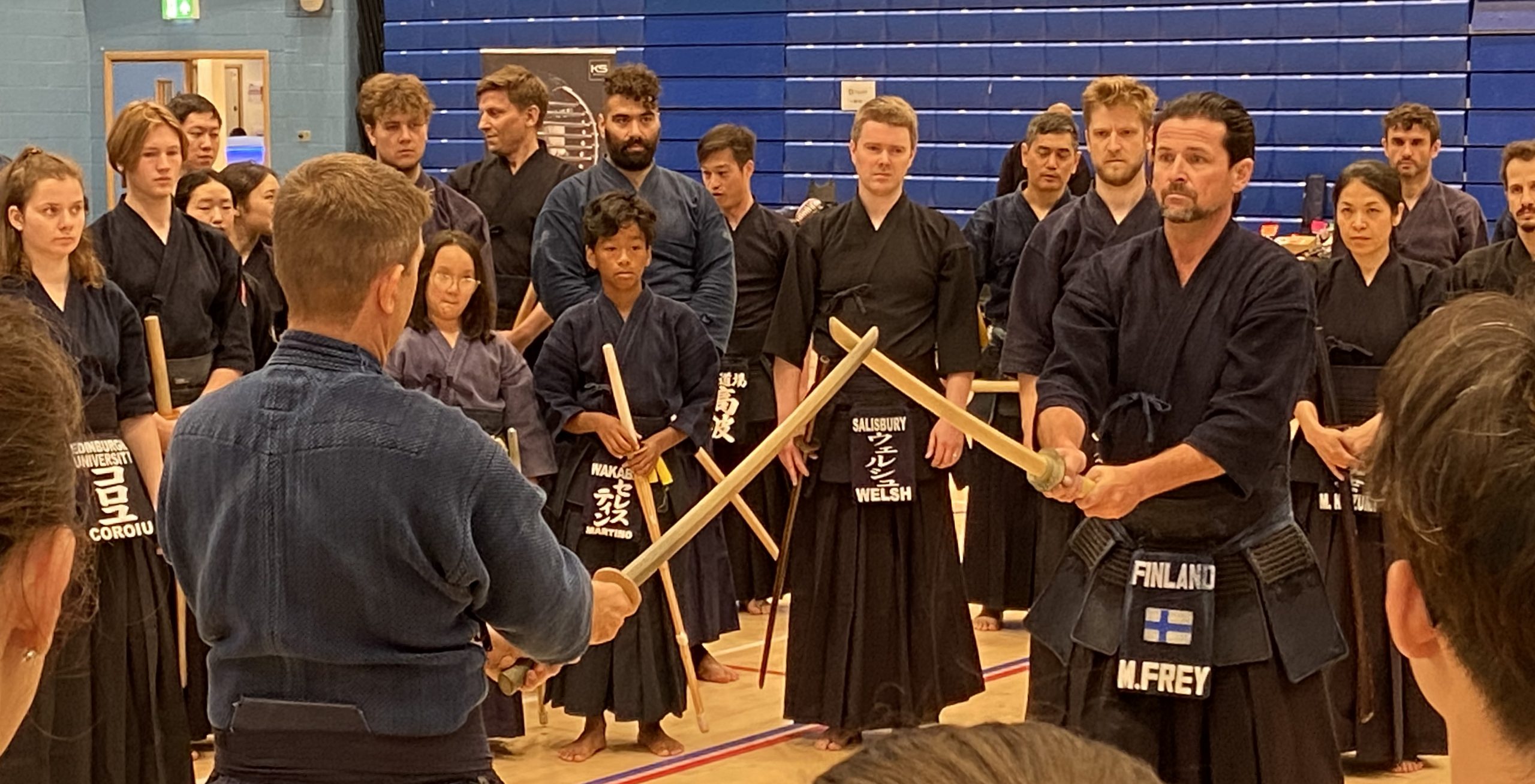
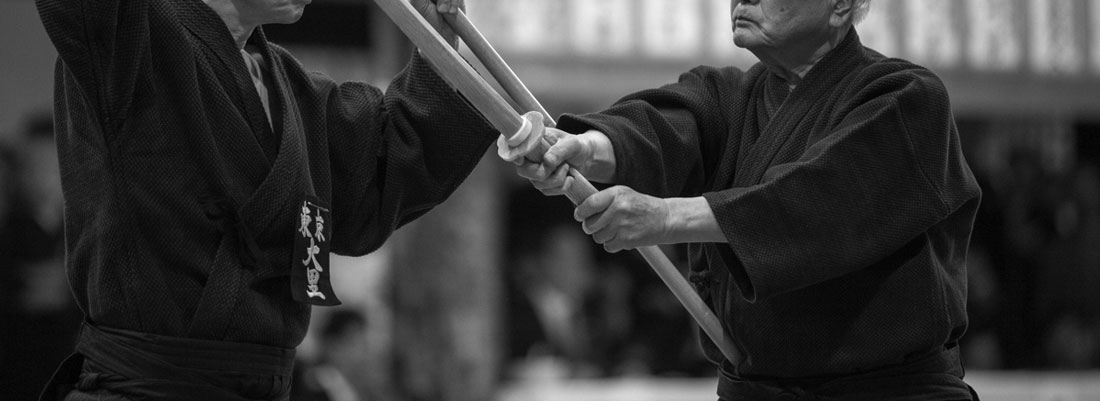
Sumi Sensei at IKET Picture by Phill Thornton
BKA News Online
Issue #13 August 2004
|
Contents |
|
|
Submission Guidelines |
|
|
Contact Details |
|
|
Introduction Notices Diary of Events Taikai results Grading Results |
|
|
Shopping & book list |
|
|
Articles: International
Kendo Enbu Taikai 19th European
Kendo Championships Attitudes
to Shiai Part 1 Third
National Kendo referees Seminar Everybody
is a Teacher Iaido
News from the Emerald Isle Seminars/Competitions:
Forms & Details
Last Words |
|
Submission Guidelines:
Submitting
articles for use online (and thus the newsletter) is easy - just email either
the editor and/or the Webmaster with the article/idea and take it from there.
We are constantly looking for people to write articles and contribute to the
website, so please dont be shy.
This
news online is produced courtesy of the website, please remember, we can only
publish things that we get, so if we dont get anything relating to a specific
event, then we cant do anything about it. You can help us by:
·
Registering your
interest to do an article before an event
·
Be conscientious - if
you say you are going to do it, then do it!
·
Supplying content in
digital format (with pictures)
·
Get someone to
proof-read your article
·
Spell-check it!
·
Electronic submissions
must now be supplied in HTML format, or WORD in an uncomplicated format,
pictures sent separately in JPEG format if not inserted correctly into the
document
·
Items that involve the
team in retyping or reformatting will not be undertaken and returned to
the originator. However typewritten formats are acceptable, as these items can
be electronically scanned and included.
Send
Postal Submissions to: BKA Newsletter, 1 Bayman Cottages, Lye Green Road.
Chesham Bucks. HP5 3NQ
Contact Details:
|
A comprehensive and up-to-date list of BKA contact
details can be found online
Introduction:
Dear
members,
Well
IKET proved to be a GREAT success, celebrating in fine style 40
years of the Association and providing not only a huge boost to Scotland &
the UK for Kendo Iaido & Jodo, but also a fine gathering of many other fine
Japanese arts, Cultural and Martial at an International level.
Next
years event will also encompass the 5 Nations Taikai and we anticipate a much
higher participation right across the board with other new features to be
included.
A
full report is published in this edition and yet still more to come in the
remainder of 2004.
Juniors Day at Kodokan
A get together for all of the junior members of the Association, for Kendo and
a picnic.
Sunday 1st August. 10am to 12.30 - two and a half hour Picnic lunch and restart
- 3pm to 5pm.
there is no charge for children attending, but parents will need to supply
their picnic.
All junior members are invited to attend. Please e-mail paul.budden@kendo.org.uk
Kendo National Squad Training resumes on the 11th
& 12th Sept. at Kodokan Rickmansworth
Next years selections will depend on participation at these forthcoming
sessions.
All BKA members are eligible and invited to attend.
Appointments
for BKA EC positions:
Chairman.
Treasurer. Kendo Bucho. Iaido High Grade. Jodo High Grade are invited.
Please
submit your written application including the reasons and what you have to
offer to the Secretary: Ric Schofield You have until November to apply.
Why delay
Do it now. We need YOUR Expertise and commitment
Professional
Fund Raiser Required
Are you, or do you know someone, who may be
interested in the position of professional fundraiser for the British Kendo
Association? Earnings are on a percentage commission basis subject to
discussions and contract. If you are interested or want further information
please contact the General Secretary,
This is a notification in respect of dojo/clubs that
have been non compliant in respect of the H &S requirements for BKA registration and Instructors Insurance.
These dojo/clubs have now been removed from the BKA Directory website directory
and will not be reinstated until the correct procedures and relevant
documentation has been put in place. BKA members who continue to practice at these
dojo/clubs are themselves at risk, as their individual insurance is in effect
null & void. For full clarification. Contact the H & S officer Stuart
Shirreff:
Stuart.Shirreff@kendo.org.uk
National
Grading Panels.
It has come to my notice that
there has been a misinterpretation of the rules governing BKA National Grading
Panels.
These Panels were set up
for the sole purpose of examining students from 1st Kyu upwards at
National level with International recognition and registration.
They were not set up for
the purpose of open grading for students below the National level i.e.
7th to 2nd
Kyu.
Open grading is therefore
the responsibility of the Dojo leader at club level only.
All club leaders in the
future must advise their students that seminars where a BKA National
examination is being held will not include an open grading.
I recommend that all
persons who wish to progress, should attend these seminars, irrespective of
whether they are taking a National grading or not, as it is in the interest of
advancement at all levels.
John
Howell
Chairman.
It has been for some time now the general policy in
regard to Kendo examination
[1st Kyu and above in the UK], that as
all such examinations are attached to a seminar, members wishing to grade
should therefore attend the seminar in order to take the examination.
The only exception is the October grading, the day after the Lidstone in London, as that does not have a seminar attached.
Diary of Events:
Here is a list of all
Kendo (K), Iaido (I), and Jodo (J) related events in the U.K. and others of
interest in Europe. Events that span all three disciplines are marked
(A). This information is Provisional at the time of going to print and
will be updated in future issues.
The
CLOSING DATE for all shinsa (grading) is TWO CALENDAR MONTHS prior to the day
of the exam. Contact FOR ALL shinsa is the Grading Officer and NOT the person in
charge of running the seminar.
|
Date |
Description / Details |
Location |
Discipline |
Contact (addresses not expanded
can be found in Contact Details) |
|
1st August |
Juniors Day |
Kodokan, Rickmansworth |
K |
|
|
19th to 22nd August |
19th Int Kodokan
Kendo seminar With Masatake Sumi Sensei |
Kodokan Rickmansworth |
K |
|
|
22nd August |
Kendo grading [seminar
members only] |
Kodokan Rickmansworth |
K |
|
|
22 to27Aug |
Iaido & Jodo summer
seminar |
Brighton |
I J |
|
|
27th August |
Iaido & Jodo grading |
Brighton |
I J |
|
|
25th September |
British Open Kendo
championships |
Kagami shin Stoke |
K |
|
|
11thSeptember |
First aid course |
Kashi no ki Olerton |
A |
|
|
16th October |
Lidstone Taikai |
Nenriki London |
K |
|
|
17th October |
Kendo Grading, 1stKyu
to 4thDan |
Mumeishi Cranford |
K |
|
|
November TBA |
Iaido & Jodo Northern
seminar |
Darlington |
I J |
|
|
November TBA |
Iaido & Jodo grading |
Darlington |
I J |
|
|
20th November |
Mumeishi Championships |
Mumeishi Cranford |
K |
|
|
4th December |
National Kendo Refereeing
seminar |
Kashi no ki Olerton |
K |
Kendo
Squad Training & Schedule
Squad training sessions are usually held once a month.
These take place over a weekend. Anyone interested in being involved with the
squad is welcome to attend. There is a charge of £3 per session to help cover
costs.
|
|||||||||||||||
|
|||||||||||||||
|
The next training weekend will be held at Kodokan Dojo in Rickmansworth on 11th
& 12th June |
We particularly want to
encourage more women to come and join the squad.
The only requirements are that you are keen to compete and willing to attend
squad training sessions
Taikai Results:
The Sir Frank Bowden Memorial Taikai:
1st: Nagamitsu A.
2nd: Northumbria University.
3rd: Mumeishi A
Fighting Spirit: Takahiro Shinozaki
25 teams took part
The Premier's Cup:
1st: Stuart Gibson
2nd: Darren Cutting
3rd: Gareth Mason
3rd: William Wright
Fighting spirit: Tim Purcell
61 competitors took part
Many thanks to the
organisers: Kagami Shin Kendo Kai
and the Referees.
Grading Results:
WATCHET 23rd
MAY 2004
IKKYU-S.R.DAVIES, H.YAMAZAKI,
C.MUNRO, S.WASSELL, T.WILLIAMS, B.J.McGINLEY, J.MARTIN, D.WALL, T.DURKIN,
P.GRAY, D.SOUTER, D.J.WORSLEY.
SHODAN-I.JOHNSTONE, K.KAMIYA,
B.O.ROSE, R.ANDERSON, D.SPACEY, G.RUKAS, D.FINCH.
NIDAN-F.FUNG, J.B.PUGH,
I.WICKENHAUSER, S.OSBORNE, W.TAYLOR.
SANDAN-J.FITZGERALD.
|
There are still some 12thWKC memorabilia left Nine Circles videos and BKA tenegui. Address: Nine Circles, PO
Box 54, Gloucester, GL1 2YS Tel/fax: 01452 500655 Website: http://www.ninecircles.co.uk/
Email: quentin@ninecircles.demon.co.uk
BKA Book List (available from nine
circles) Kendo The Definitive Guide
- Ozawa This is Kendo: The Art of
Japanese Fencing - Sasamori & Warner Complete Kendo - Donohue The Heart of Kendo - Craig Looking at a Far Mountain -
Budden Fundamental Kendo Vols 1
& 2 - ZNKR (BKA Only item) Japanese-English
Kendo Dictionary - ZNKR (BKA Only item) Check
out the Kendo World list of available titles The BKA have the
following items on offer to members only!
39 Shinai Standard
quality @ £15 each 34 Childrens Shinai @
£15 each 39 Shinai Silver
quality @ £30 each 39 Shinai Gold quality @
£35 each kids Shinai bags @ £9 each
armour bags @ £20 each water bottles @ 75p each All of these items may be
purchased by cheque/cash by contacting: Trevor Chapman or Rob Wix or Dean Wormall kashinoki.kenyukai@btopenworld.com If you have budo related
equipment item[s] that you wish to part with then please email us with details and you can be
included in the next newsletter (online and printed version). This can include books, shinai, clothing, 2nd
hand bogu, etc - anything relevant. |
ITEMS FOR SALE:
Clothing for Iaido.
DESCRIPTION:
Iai -gi - black cotton -
Size XL. (0500 in Nine Circles Catalogue).
Hakama - Black -
Polyester/Rayon Size 6.
(H2 in Nine Circles
Catalogue).
Ideal for person
6'0" plus.
Clean and immaculate
condition.
0ffers please and items are plus p.p &
insurance.
David Reeves
69 Station Road
Preston
East Yorkshire
HU12 8UY
01482 898274
Mobile 07985034711
"Kendo books for sale - All in very
good condition.
1. "This is Kendo" by Junzo
Sasamori, hanshi, and Dr Gordon Warner, 7th dan: "a
standard reference work"; an excellent introduction; paperback:
£7.00 (was £13.50 new).
2. "Complete kendo" by John J.
Donohue: a thorough introduction, by an anthropologist with an extensive
background as a student of the traditional martial arts; paperback: £7.00
(was £13.95 new).
Contact Teddy Bourne: e-mail to eobourne@btopenworld.com, or phone 020 7433
1948."
Articles:
International Kendo Enbu
Taikai (IKET), Edinburgh 2-4th July 2004

The
planning for IKET really began in 2003 after the BKA had conducted a review of
what had been achieved by the BKA in staging 12WKC in Glasgow.
The
proposal was to develop and enhance the profile of the BKA by organising an
event above and beyond anything attempted before. It was only realised later on
that it also coincided with the 40th anniversary of the BKA-a
perfect excuse for a celebration! So the basic 3-day format of Seminar/Enbu
Taikai/ Asa-geiko was produced.
Paul
Budden (BKA Kendo high grade) determined to make this event unlike any other by
opening it up to the public on the Saturday of the Enbu itself. How to do this
successfully? Perhaps add cultural arts to a martial arts programme? Fine, but
this has been done before. What was needed was active participation and
demonstration of the accessibility of the Japanese arts. That was when the idea
of practical taster workshops was included. Also several of the demonstrations
were to be performed by young people to attract kids to attend IKET.
One
of the most important factors was who should the invited kendo teachers be?
Initially around eight hachidan sensei were invited and indeed Eiga Naoki and
Sato Hiromitsu were personally approached and both said Yes! Unfortunately
due to a set of circumstances beyond everyones control not all could make it.
Finally the superb line-up of hachidan sensei who attended were:

Sumi
Masatake, Chiba Masashi, Okamura Tadanori, Ueigaki Isao, Tashiro Junichi and
very special guest Mr H Matsumoto (sandan)
Japanese
members at Edinburgh Kendo club know most of these men as superb teachers and
legendary fighters but never dreamt that they would receive teaching from a highly
respected kendo teacher and author, an All Japan Champion and other high
ranking members of the ZNKR!
The
scene was set and after sensei-geiko on Thursday evening, the seminar began at
noon on Friday with Zen Nippon Bokuto Kihon Waza. Devised by the AJKF, this
features use of the bokuto to learn basic shinai kendo techniques. It really
helps when one of the persons responsible for creating this practice is present
to teach you.
Hanshi
can mean Perfect picture and thats what both Sumi sensei and Chiba sensei
were all day. Instruction in Kendo no kata was followed by a very special
master class on jodan led by Chiba sensei (3 times All Japan Champion). This
was enjoyed by all and was a really informative and detailed examination of
this style of the art.
The
day was by no means exhausting in any physical sense but was intended to leave
participants with a lot to consider; and as always Sumi sensei emphasised the
simplicity of practice to get the basics right.
Kendo
players attended from Poland, USA, Switzerland, Sweden, Germany, France,
Belgium, and Italy for this first- hopefully annual- event. Witold Nowakowski
chided me that while he and others from Poland have been to the UK three times
in the last year, I had not visited Poland once. This should be remedied with
Edinburgh Kendo Clubs attendance at the Baltic Cup September, 2004.
On
the Friday evening at a Civic Reception hosted by Edinburgh City Council and
Councillor Ricky Henderson (Sport and Leisure), the sensei along with John
Howell and Alain Ducarme (President of the European Kendo Federation), were
presented with commemorative silver quaich while the rest of us tucked into a
lovely buffet. We were all impressed by the grandeur of our surroundings and
the BKA would like to thank Mr Jim Aitken, Director of the Centre for Sport and
Exercise at the University of Edinburgh for all his help in co-ordinating this
very special occasion.
When
Saturday came there was still no real indication whether the Enbu Taikai event
would be a success with the public or not. The BKA had been unable to get
financial support from any sporting or cultural body and, with limited publicity
budget available we were blinded as to the possible attendance.
An
early morning interview on BBC Radio Scotland provided a great opportunity to
promote the event (and the BKA) so accompanied by Sumi sensei and Sotaro Honda
acting as interpreter; we headed off to the BBC studios just around the corner
form the venue. The interviewer was in Glasgow and we three were crammed into a
very small sound studio in Edinburgh. The interviewer (John Beattie former
Scotland and British Lions) was very well informed and Sumi sensei was able to
express himself well but I really wish Mr Beattie hadnt asked me the question
Why are there no more judan in kendo? in front of sensei
you didnt hear the
reply-thank goodness!
The
whole event commenced with the leader from each participating group marching in
behind the pipes and drums of the City of Edinburgh Pipe Band and welcoming
speeches from John Howell and Jim Aitken on behalf of Edinburgh University.

![]()
www.kendo.org.uk
A Day of
Japanese Martial and Cultural Arts to celebrate
The 40th
Anniversary of the British Kendo Association
IKET Schedule
Saturday 3rd July 04
______________________________________________
12.00:
Opening ceremony
Pipes
and Drums of the City of Edinburgh Pipe Band
Jake
Perry and pupils from Beeslack Community High School, Penicuik
12.10:
Kendo no kata

12.45:
Aikido
William
Coyle, Chief Instructor, Derek Clarke Assistant Instructor, Makotokai Aikido
Association, Glasgow

13.15:
Kendo
Katsuya
Masagaki (4th Dan) and members of Wakaba Kendo Club, London

13.45:
Karate
Gordon
Mathie (5th Dan) and members of Takushoku Karate Club
(Dunfermline)

14.30:
Judo
George Kerr (9th Dan), President of the British Judo
Federation
with Andrew Ramage 3rd
Dan and Gordon McCathie 2nd Dan, Kenka Judo Club Edinburgh

15.00:
Shorinji Kempo
Richard Thomas (Senior
Instructor) and Stuart Mason (Club Captain) from Edinburgh Shorinji Kempo
Club

15.15:
Jodo-The Way of the Stick Keith Rose (5th Dan) Doshinkenyukai,
William
Smart 4th Dan Shonenjiku Iaido Club, Glasgow

Vic
Cook (7th Dan Renshi) Shin Bu Kan, Brighton and Fay Goodman
(7th Dan Renshi), Masamune Dojo, Birmingham

16.05:
Kyudo-Japanese Archery
Liam
OBrien: 7th Dan Kyoshi, Ray Dolphin, 6th dan Renshi,
Ritsuko Uechi 4th dan

16.30:
8th Dan Mohan-Jiai (demonstration fights)

Masatake
Sumi 8th Dan Hanshi
Masashi
Chiba 8th Dan Hanshi
Isao Ueigaki 8th Dan Kyoshi
Tadanori Okamura 8th Dan Kyoshi
Junichi
Tashiro 8th Dan Kyoshi

12.30-13.30:
Taiko Drumming Workshop with Jacob Perry
14.00-15.00:
Ikebana Seminar and Workshop with Ruth Davies
Bonsai
Exhibition: Scottish Bonsai Association (Penicuik)
Sword
Display courtesy of Raymond Flockhart
Photography
and Artwork by Phill Thornton and Tulta Behm
Japanese
Cuisine by Bonsai www.bonsaibarbistro.co.uk
Equipment
Shop Nine Circles: www.ninecircles.com
The
martial displays were to be interspersed with kyu to nanadan Enbu Taikai. These
were matched pairs who fenced for 3 minutes to demonstrate their best kendo to
the sensei and an attentive and responsive audience. Although the time was
short (you can go to a World Championships for less than 5 minutes of kendo)
this was a very special keiko and was really enjoyed by each participant who
received a specially designed menjo.
Unfortunately
Chiba sensei became injured on Saturday and could not take part in the Kendo No
Kata display with Sumi sensei. The previous day the opinion of those at the
kata seminar was that never had two kendoka come so close to really doing the
deed and that ipponme was truly awesome!
The
aikido demonstration was based strongly on the sword with disarms, controls and
throws using bokuto and was really a dynamic and non-stop display. Kendo,
karate and judo were strongly represented by kids and young people. In
particular the karate demonstration was very well orchestrated and presented to
the public. A lot of effort went into this display. The kids from Wakaba Kendo
Club gave a wonderful demonstration and inspired several of the kids from my
own club to take part in their practical workshop later that afternoon. It is
not often that you get to meet a kyudan but we were all happy to have George
Kerr Sensei (Chairman of the British Judo Association) in attendance. He also
extended his hospitality to the sensei next day for which the BKA is very
grateful-Kerr sensei has a wonderful Japanese-style flat right in the heart of
Edinburgh city centre.

Shorinji
Kempo is a Japanese martial art that is still relatively unknown and little
seen. It is based on kicks and punches, locks and throws-some of which were
performed on the hardwood floor! Ouch!
The
Consul General of Japan arrived in time for the iaido, jodo and the
(long-awaited) kyudo displays. The
iaido demonstration was given by Vic Cook sensei and Fay Goodman sensei
who performed Muso Shinden Ryu
and Jikiden styles. Goodman sensei also performed 4 kata from Koryu, and a
further three 3 kata from Setei (AJKF) iai. Each Nanadan performed the kata
both sequentially and harmoniously and almost in one mind as they both
completed the Enbu with Seitei kata number 11
finishing in the middle, only missing each other one step to the side! Goodman
sensei commented on the hospitality she received while visiting Edinburgh and I
am very happy that she had such a favourable view of the event from the point
of view of a participant. The intention after all, was to create something new
and an event with a special feeling.
For the jodo, Keith Rose (Doshin Kenyu
Kai [Halifax]) and Steve Boyes from Seishinkan in London performed Shindo Muso
Ryu - Koryu: 6 omote waza. They were joined by joined by Billy Smart and Hugh
Darby from Shonenjiku Iaido Club in Glasgow who added a further 6 AJKF Setei
jodo forms. In particular Steve and Keiths display was very powerful and
dynamic with excellent kiai and zanshin throughout. I am sure that the audience
appreciated this as they sat silently throughout both of these displays and
then showed their appreciation with thunderous applause.
The
kyudo was a sensation and although the complex reigi is not often understood
the loosing of the arrows from those eight foot bamboo bows, right on target
brought gasps from the audience.
Its
impossible to say anything about the kendo hachidan Mohan-jiai
you just had to
be there.

In
the end the venue was packed all day (thats nearly 500 people) and at one
point there were individuals drawing kyudo bows and grappling in the matted
area trying out aikido; the ikebana workshop was full to capacity and there was
the thud, thud of people beating on Taiko drums; kids and adults gave kendo a
try and the Japanese food stall never stopped making all afternoon, Nine
Circles armour shop was very popular and the photographic art, bonsai and sword
displays were well attended throughout the day.

The
Japanese cultural arts were by no means add on or considered peripheral to
the event as a whole. In fact the public voted with their feet and used the
programme wisely to select the arts they wanted to see so there was a constant
flux between the hall and the main concourse.

The
Sayonara Party was the first time all week that everyone could really relax and
there are many stories to be told (Steve Plimbley on the dance floor, Takin it
to the bridge!). Meanwhile Sumi sensei was totally engrossed with the Highland
dancing on show and demonstrated that he is also skilled in the art of disco.

Sunday
morning commenced with approximately 30 Edinburgh and Wakaba Kids practicing
together. When the sensei arrived the format was:
Chiba
sensei: Kids and Kyu grades; suburi and tenouchi
Sumi
sensei: Shodan to Sandan;
issoku-itto-no-mai and shisei
Okamura
sensei: Yondan and above; 5 types of seme

Chiba
sensei continued to give personal tuition to those who use jodan-no-kamae and
after keiko everyone retired to the pub and gave their impressions of the
weekend and said their farewells over a pint or two.
I
offer my personal thanks to all the participants who make a special effort to
come support the event-especially from overseas. There is a review of the whole
event being undertaken so that next years event will be improved. The format
will inevitably be different but just as worthwhile to attend. The feedback
from participants whether old or new friends has been incredibly positive and
some of the critical analysis on what could have been done better has been
taken on board and will be implemented for IKET 2005.
It
was Paul Budden who had the drive and vision to continue the excellent
development of the BKA and to lift the Associations profile through IKET, the
event has been a great success and he should be congratulated for all his
efforts. I would also like to thank the chairman John Howell and the BKA on
behalf of Edinburgh Kendo Club for allowing us to host this first event. We
have an incredible range of skills at our club that we didnt even realise and
they were put to great and effective use.
I
have many personal memories of IKET 2004: along with the sensei, there was a
special presentation of an IKET commemorative jacket to Jaya Irvine (mudan) who
travelled alone down to London for the Ladies Seminar and only three hours of
kendo; John Hepburn was roundly applauded for all his efforts to develop kendo
in Scotland over many years, but the highlight of the entire week (for me) was
on Wednesday 30th June when Edinburgh Kendo Club hosted a one hour
practice with 5 hachidan sensei. There were 23 club members taking part (Bogu
only); including other high grades, the queues were only 2 deep!!!! I raced to
fence with Sumi sensei and could hardly contain my excitement going into sonkyo
and thinking
Theyre here!
All photos courtesy of Phill Thornton, Mingshi Wan and Hiroyuki
Matsumto.
More are available plus a video on application to: Edinburgh Kendo Club
Steve
Bishop
Public Relations Officer (Kendo) British Kendo Association
Dojo
Leader Edinburgh Kendo Club
19th EUROPEAN
KENDO CHAMPIONSHIPS (APRIL 2004)

Compared to our last
trip to Berlin for the Five Nations Championships, the flight to Budapest left
at an extremely civilised hour and the team was met by some familiar faces at
Budapest airport: Mike Davis, Geoff Salmon and Paul Budden [John Howell having
arrived the previous day to attend the EKF Assembly]. The only unfortunate
incident was that Brian Hayes luggage did not appear to have accompanied us to
Budapest (well, not until a couple of days later!).
On arrival at the hotel, we were pleased to
see that the venue for the championships was just across the road, as this
would mean no mad scrambling for buses at some ungodly hour of the morning. The only worry among the team members now
was who would be sharing a room with the not-so-quiet Steve Bishop. Our Coach, Sotaro Honda, seemed to think
that the softly spoken, reflective Brian would be a good antidote to Steve
verbosity and they were put together.
The pairing seemed to work, although Brian lamented that Steve talked
even in his sleep and it is probably still too early to gauge the real effect
of these few days on Brians mental health!
The first day of the
championships, a Friday, saw the ladies team and juniors individual events
take place. The ladies team consisted
of Alex (captain), Tanya and Frankie.
I will not go into much detail here as Alex
has written a separate report regarding the ladies, but they made it out of
their pool before losing to Finland in the first round of the knockout stage.
They all fought with
Great Spirit and produced some amazing waza.
Special mention must also go to Tanya who managed to keep fighting
despite an injured shoulder, which has plagued her for a long time now.
We brought one junior,
Mark, to the championships. He was
fighting so well and with a surprising degree of composure for one so young (in
fact, he looked a little too laid back at times!) that we thought he was going
to make it all the way to the final, but he was sadly knocked out in the
quarter-finals after an exciting fight.
Hopefully this experience will have given him confidence for the next
big competition he participates in.
As Marks fighting was
now over, he took on the indispensable role of water boy and general disciple
to Steve (the guru of isotonic drinks and carbohydrate intake for achieving
peak performance!), for which the team thanks him profusely. Steves astronaut type backpack with tubes
containing strange liquids sprouting everywhere was the envy of all the other
teams!
Saturday saw the
five-man team competition unfold. We
brought seven men to the championships (Dave Bell, Michio Wise, Will, Steve,
Brian, Gibbo and myself) and each one played an important role. We were in a pool of four countries and knew
from the beginning that we had to come first in the pool if we were to avoid
France in the first round of the knockout stage of the competition.
Our first opponents were
Ireland and Gibbo, as sempo, got us off to a flying start by beating his
opponent in what I thought was a pretty fast time. However, Steve proceeded to beat his opponent in ten seconds flat
(surely the record for the day!).
Having beaten Ireland convincingly we then fought Slovakia who we also
beat with ease. Unfortunately
Switzerland had also done the same and this meant that the fight between
Switzerland and us would decide the winner of our pool and hence the team that
would avoid France.
I was relieved when the
first two fights were won by Gibbo and Brian (both 2-0) and was hoping that
Michio would win his fight so that the outcome would be decided before my fight
as taisho. But with Michio you never
quite know what will happen! He seemed
to be in control of his fight until he was hit in the throat and collapsed to
the floor. He managed to get up but was
felled again by a hit to the throat. He
could not continue this time and was taken to hospital where fortunately
nothing was diagnosed as broken.
However, his inability to talk in anything but a horse whisper meant
that he was teased mercilessly by his compassionate teammates! Since Michio had to retire it meant we lost
the fight 2-0. I began to worry just a
little but had full confidence in Steve.
He unfortunately proceeded to lose 2-0, which meant that we were exactly
equal on points and the threat of having to face France loomed closer. I began to sweat just a little! However, using the rough treatment that
Michio had suffered to galvanise me I fortunately won my fight 2-0 which meant
that we avoided France and faced Austria in the first round of the knockout
stage. Austrias style of kendo was not the prettiest but it was awkward to
handle and I again found myself in the unsavoury position that if I lost we
would be knocked out of the tournament.
My opponent was a big fellow who assumed jodan and I remember that his
breath stank! I found his kendo very
awkward and went for a draw, knowing that the big strapping lad that is Gibbo
would be able to beat him in a fight-off.
I got the draw and in the sudden death fight-off, Gibbo represented us
and scored the point, which got us through to the quarterfinals. Well-done Gibbo!

Our opponents in the
quarterfinals were Italy. As they came
third in the World Championships in Glasgow last year we knew it would be quite
a feat to beat them. So it proved. We lost the first four fights, although
Brian scored an outstanding men cut on an opponent who would end up winning
the individual championships the next day.
In fact, Brians men cuts were rather good all weekend and I believe
he was the unexpected success of the championships for us, showing more
confidence in his ability than in previous competitions. Keep it up, Brian!
As we had lost the first
four fights and the outcome was already decided, I could finally just enjoy my
fight. I won it 2-0 (although Im
pretty sure my strike never actually connected for the first point!) which was
nice as its never good for a team to lost 5-0, especially to opponents who my
sister described at the world championships as so good-looking! However, I was really pleased that the team
reached the quarterfinals, as it is the best result we have achieved since I
became a member of the British squad in 1997.
Finland shocked everyone by reaching the
finals, knocking-out the previous champions Hungary en-route, before being
convincingly beaten by France who once again became European champions for the
umpteenth time. The final day of the championships saw the womens and mens
individual competitions take place.
Alex will again describe the womens results, but I will just say that
it was the first time since I have been in the team that everyone, both men and
women, made it out of their pools into the knockout stage of the
competition. Gibbo got the furthest by
making it through to the last 16, I made it through to the last 32, while Dave,
Will, Brian and Steve made it through to the second round of the knock-out
stage. It was unfortunate that Gibbo
had to beat two of his team mates to make it through to the last 16 (myself and
Steve!), although Steve never tired of narrating how he scored the first point
in his fight against Gibbo. Just to let
you all know, it was a kote cut but Im sure Steve would now be excitedly
jumping up and down, wanting to take over the tale from here! An Italian with very nice kendo who beat
Gibbos nemesis won the final.
There was the usual
Sayonara Party on the Sunday night with everyone divesting him or herself of their
sweaty, smelly kendo gear and dressing up smartly. I think our ladies easily out did the men on the smartness side;
it was just the nicely coloured bruises on their arms, which gave them away as
kendo exponents! Dave retired from the
British team at these championships, so we toasted his good health and I gave
what I thought was a very complimentary speech about his dedication and efforts
over the last few years, but he seemed intent on strangling me afterwards for
some strange reason! Other notable
events were Gibbo being suckered by a lady in an extremely short skirt into
parting with a sizeable sum of money for raffle tickets and Sotaro being asked
to dance by a pretty Russian girl.
However, she abandoned him after only one or two songs, leaving him to
lament how used and abused he felt!
On the Monday we had
some time for sightseeing before we flew back home. Although everyone was a trifle weary, apart from Dave who had
spent a comfortable night fast asleep cradling the toilet, we all fell in
behind Alex who did a grand job guiding us around the beautiful sites of
Budapest. It was quite a feat that we
all managed to stick together (perhaps a reflection of our great team
spirit?!), although it was quite unusual in that it was not the girls but the
boys who kept wanting more time to look around markets and venture into shops!
I thoroughly enjoyed
these championships and being part of this team that Sotaro, as coach, has
built up. I know I mentioned it in my
last report after the Five Nations Championships, but I am sure that the good
results we achieved in both the individual and team competitions are a direct
result of the increased support we have been receiving from the BKA. The team would therefore like to thank both
officials and members of the BKA for this.
I would also like to encourage all members of the BKA to turn up to
squad training and work hard to either be selected to represent Great Britain
or to help the team achieve even greater success in future competitions.
Anthony Scott (British Team Captain)

The European Championships Women.
Having arrived, admired
the view of the stadium, sampled the Hungarian cuisine and had coffee whilst
the guys relaxed with a beer it was early to bed for the girls ready for the
womens team matches the next day. Nerves didnt really kick in until warm-up
the next day, when the noise coming from the hall was incredible and we
suddenly realized where we were. However, after 40 minutes of keiko most of the
nerves had disappeared and we were ready for shiai. Waiting outside in glorious
Spring sunshine before going into the opening ceremony gave us a chance to
catch with old friends (and foes) and it was exciting to think that we would
soon be competing in the Europeans.
We were drawn in a pool with
Finland, Norway and Russia and under new rules were fighting four-minute shiai
in the pools and five minutes during the knockout rounds. Our first draw
against Finland saw us giving as good as we got and despite losing we came out
of it feeling really confident it was a good start for us. Unfortunately, our
second round wasnt as good and all of us had difficulties with opponents that
we felt we should have beaten disappointingly we lost by a point. We went
into our third round with Russia feeling that we had nothing to lose (and
everything to gain) so gave it all we got. Despite nursing an injured shoulder,
Tanya, as sempo, showed great fighting spirit and scored a cracking Kote (which
Kobayashi sensei thoroughly approved of) that set the rest of us up. After
which, Frankie went out, scored (whilst inventing a new falling waza) putting
pressure on me and I was relieved when I too managed to win, and even happier
when we found out that we had got out of our pools.
Our opponents in the next
round were Austria who unfortunately beat us. However, the atmosphere was
fantastic and it was really great to get off the shiai court each time and see
everyone in his or her blue squad jackets cheering us on.
The next day it was our
turn to support the guys and we felt more nervous for them than we did for our
own fights and they certainly gave us some heart-stopping moments, especially
when Michio was tsukied and couldnt continue and Gibbo went in Encho against a
Jo-dan player and won to take the team through. It was great watching them
fight, all of them did really well and I only hope we gave them as much support
as they gave us (my hands were really sore from clapping at the end of it).
The final day started
with a shock to the system as we were in the warm up hall at 7am (even worse
without any coffee!). In a full day of fighting (which started at 8 and
finished at 7) with the guys and us fighting at the same time, Sotaro had to do
a lot of running from one shiai court to another as we battled through the rounds.
The girls competition
started with a shock result as Loustalle (a stalwart of the French team) was
knocked out in her pool. This added to the feeling that anything was possible
and gave everyone a lift.
All three of us girls got
through our rounds, Frankie scoring a Men on the Hungarian Sipos (an eventual
medal winner) much to Sipos chagrin and our delight. In a day when most of us
seemed to end up fighting team mates at some point, Frankie and I were then
unfortunately drawn in the next round really difficult as we are friends and
frequently train together, so know each others moves.
It was difficult for
Sotaro and our team mates as well who kindly opted to stand in the middle and
supported us both equally. Well, having finally won through that round I went
on to meet one of the Italians and was knocked out by her (but not before shed
got a hansoku for stepping out of the area and Id had a good attempt on her
Men). For the girls, this was the end of the competition and we all suddenly
felt exhausted (the adrenaline having finally stopped flowing) and had to
fortify ourselves with some exceptionally strong Hungarian coffee before
watching the rest of the competition.
That night saw everyone
at the sayonara party, sipping champagne (thank you Simon) and bidding a fond
farewell to Dave (were sad to see you go) before giving some amazing (well
unique) performances on the dance floor (some of us remember the 80s a little
too well!).
I must end with a really
big thank you to everyone who supported us and especially to Sotaro for all his
help and training. We had a great competition, learnt a lot and are eager to
start training for next year.
Attitudes to Shiai Part 1
Sotaro Honda
University of
Gloucestershire, British Squad Coach
Introduction
In the previous two articles
(BKA news April and June 2004), attitudes to Ji-geiko and how Ji-geiko
in Kendo should be approached were covered.
In this BKA news and the next one, Shiai
in Kendo is examined from various angles.
Kendo can be either a competitive sport or a Budo according to a Kendo-kas
understanding of Shiai, and his or
her attitude to fighting, watching and supporting. Having a proper comprehension and attitude to the Shiai should bring about a better understanding
to the essence of Kendo as a Budo and the wonderful relationship between you
and other Kendo-ka. The purpose of this
article (part1) is to examine 1) the purpose of Shiai in Kendo, 2) competitors attitudes, 3) spectators and team
mates attitudes and 4) teachers attitudes towards Shiai.
1. The Purpose of Shiai in
Kendo
Shiai
literally means, to try each other.
In Kendo, Shiai basically means
to try skills, manners, attitudes and spirit learned and acquired in Keiko, with each other in a competitive situation.
Inoue (1994, p. 162)
explains, The purpose of modern Kendo is to refine ones heart which is
invisible by training in Waza that
are visible. Shiai in Kendo has to take place in line with this purpose. We, as Kendo-ka, therefore have to recognise
Shiai as an important opportunity to
develop our skills and personality and to acquire the correct attitudes to Shiai.
Attitudes of high school
students to Shiai, whose only aim is
to win at any cost, are quite often criticised in Japan. It is quite embarrassing to take myself as such
an example, as my biggest purpose in Kendo was also to win competitions when I
was a high school student. My Kendo at
that time never deserved to be praised and I did not care what people really
thought about my kendo, I only cared about winning. Of course, there is nothing wrong with trying to win in Shiai.
You have to do your best to win, if you are taking part in a Shiai and it is also quite impolite to your
opponent if you fight without doing your best.
As mentioned earlier, however, aiming to develop the skills to win and
to develop an understanding of the essence of Kendo and ones personality is
strongly related to the concept of Shiai,
how to fight in the Shiai and the
results of the Shiai. Moreover, there are manners which one is
expected to follow when doing ones best to win in Kendo as a Budo.
The following points discuss
the various attitudes to Shiai that
we are expected to take from the standpoint of competitors, supporters and
teachers.
2. Competitors Attitudes to Shiai
(before, during and after the Shiai)
It is not my intention to
discuss how to fight in a Shiai. It depends on who you fight against and the
particular situation. Also, all of the
decisions should be left to competitor[s] once a Shiai starts. It used to be
quite often the case that Japanese high school teachers were constantly giving
their students advice or orders on how to fight before and during a Shiai.
This is an act that ignores the students autonomy and hinders the
smooth running and progress of the Shiai
and the Taikai. From my experience, nowadays such acts do
not seem to occur at official Taikai,
but it can still be seen at practice matches.
I would now like to discuss attitudes to Shiai that competitors are expected to take before, during and
after the Shiai.
Irrespective of what the
stage is in the Shiai, the most
important thing is to control yourself.
How can you control your opponent without controlling yourself? You need to calm your excitement to a
certain extent before the Shiai. You need to focus only on the person in
front of you during the Shiai.
You should again calm your
excitement and reflect clearly on how you fought after the Shiai. You should also show
gratitude and appreciation to the opponent who you just fought. It is important to be able to do all of these
things if you are to be good at Shiai
and learn something from the Shiai.
I will now describe these
concepts outlined in more depth. The
important point before Shiai is,
firstly, to imagine your best Kendo, increase your confidence and start
focusing only on your own individual match
(in the case of a team fight, the teams score also needs to be kept in mind). Here, if you think too much about winning,
you will lose patience and also be lured by your opponents trickery and start
attacking too hastily. Haste makes
waste! Tell yourself that a
satisfactory result will follow if you do your best and believe this, rather
than thinking of winning. It is also
important to know who you are fighting against and what your opponents Kendo
is like. Undoubtbly there are some
people who believe that it does not matter who they fight against and that just
trying to do their own Kendo is the best approach. Thinking this way is also important, especially for beginners who
can use only a few techniques and may not have much tactical ability. For others, I would still recommend to
increasing their concentration, imagining their best Kendo according to the
opponents type of Kendo and making tactics (but do not think too much and end
up by confusing yourself) before the Shiai. By doing these things again and again
before, during and after the Shiai,
you will start realising what you need to think about before the Shiai and what tactics you need to
adopt.
Secondly, during the Shiai, you are often driven by the necessity
to modify your tactics and to control emotional stress. Off course this has to be done within a
moment. The ability to cope with this
is not something that you can acquire sufficiently in Ji-geiko, but you can acquire it by taking part in Shiai
and gaining a lot of experience under pressure.
What competitors should
concentrate on during the Shiai is:
try to make the best decisions and perform to their best ability against their
opponents in each particular situation.
An act, such as looking at Shinpan to confirm if you or your
opponent has scored should not be done during Shiai. Even if you think
that you made a perfect strike, you should concentrate only on your opponent
until the opponent turns their eyes and Shinai
away. In a high level Shiai, both you and your opponent will try
to control each other and you can hardly see an opportunity to score. In this situation, the winner or loser can
be decided by a small tactical error, made either by you or your opponent, such
as dropping concentration during the match. It is important to develop the ability to
keep your concentration for the duration of the whole match and to make appropriate decisions under pressure by gaining
experience in the Shiai.
Thirdly, it is also
important to get into the habit of reflecting on how you fought after each Shiai.
In the case where you have your next match
in a short period, it is recommended that you quickly and simply reflect on
your previous Shiai and get ready for
this next match. It is quite often the case that you do not remember
how you fought if you were very nervous or you won in a very close and long match. It is very important, however, to reflect on how you fought when
you were under a great deal of pressure.
It would be ideal if you could watch a video someone taped. If this is not possible, ask people who were
watching for their comments, and reflect again on how you fought.
In a Shiai there are always a winners and losers. What we aim for is to become a good winner
and a good loser. As the author (2003,
p. 141) discussed elsewhere, a good winner means one who fights with the spirit
of Sei-sei-doh-doh (fair and square),
is modest and has an understanding of the meaning of Shiai. Even if one wins a Shiai, one is aware of the losers
feelings and never shows off ones victory. A good loser is a person who
did not win the Shiai, but still
displays the same attitude and understanding as the good winner. On the other hand, a bad winner is someone who
shows off his or her victory and a bad loser is someone who shows off his or
her frustration as the result of losing and cannot praise the opponents victory. These are people who have forgotten the
essence of Shiai in Kendo.
We are only able to do Shiai and learn something from Shiai because there are other
competitors who we can fight with, Shinpan
to judge our Shiai, people who
support our Shiai: recorders, timekeepers
and ribbon tiers. We should never
forget the purpose of the Shiai and
show our gratitude to these people.
3. Spectators and Team Mates Attitudes to Shiai
At a Taikai, we are not supposed to give competitors vocal support and
advice, or to make sounds to cheer them up; we are instead supposed to support
them by only clapping our hands.
Spectators and teammates should be considerate so that competitors and Shinpan are able to focus only on the Shiai in the Shiai-jo and enable the management of the Taikai to proceed smoothly.
It is quite understandable that everyone wants to give competitors as
much support and encouragement, cheering and giving advice. However, as described earlier, all decisions
should be left to the competitors once the Shiai
starts. Moreover, competitors are
expected to show mental strength by coping with all stressful situations by
themselves as they experience the Shiai.
The most annoying thing for Shinpan in Shiai is a camera flashlight.
It is again understandable that you want to take photographs of your
club members fighting and that you want someone to take photographs of you
fighting, but the Shinpan might miss
a critical moment if you take a photograph with a flashlight as the competitors
attack.
Competitors, Shinpan, spectators and Taikai officials should all have the
feeling that they want the Taikai to
be a wonderful experience, which they can all enjoy. The clapping of hands with all your heart and showing
consideration to the Shinpan are the attitudes,
which spectators should adopt.
In team fights, the correct
etiquette is for team members, the manager and coach to watch or wait for their
match in Seiza. It would be awkward,
however, to do a Shiai if you kept
sitting until it was your turn and kept rubbing your numb feet again and again
while you were watching and waiting. This
also does not look good. Nowadays, it
is usual for team members, manager and coach to do Seiza only when Senpo and
Taisho fight (and when there is a
fight-off as well) and the member who fights next will wait in a standing
position (of course this does not apply to people who have difficulty in doing Seiza).
In team fights, it is important to feel totally involved when you watch
your teammates fighting. Although I previously
stated that competitors are expected to cope with all situations by themselves,
when all team members become as one and support their team mates, its as if
they were also fighting, the competitor will feel the strength of this support
behind them and this gives the competitor both courage and confidence. If you really feel as if you are also
fighting, you will find yourself moving your hands and upper body in spite of
yourself as you observe your teammates every action. Ones own victory is everyones victory in team fights.
4. Teachers Attitudes to Shiai
It is the responsibility of
teachers to make their Dojo members
fight fairly, encouraging them and giving them feedback. The important thing for teachers to demonstrate
during Keiko in their Dojo is how to fight and support in the
correct manner. When giving feedback,
teachers should consider giving the appropriate amount of feedback according to
the members level. According to Aoki
(1996), it is the most effective if feedback is given immediately after each performance
in the practice. In the case of Shiai, however, feedback needs to be
given at an appropriate time when their members are ready to accept it, taking
into account the result and content of the Shiai,
each members personality, situation and so on.
5. Summary
It should be now be fairly
evident that Shiai is not everything
in Kendo, but another part of it. The
results of Shiai do not show
everything about a Kendo-ka. What is
important is the way in which a Kendo-ka deals with their Keiko, fights in the Shiai,
reflects on the Shiai and approaches the Keiko
again, aiming to score the Ippon he
or she dreams of. It totally depends on
each Kendo-kas attitude whether they develop character through doing Shiai.
I would also like to mention that it is important to try to enjoy your Shiai without thinking too deeply about
what I have discussed in this article. Shiai is fun and exciting. There is nothing wrong in thinking
that.
We feel like we are in seventh
heaven when we score the Ippon we
have dreamed of. One who has
experienced this would dream of having this same feeling again and again, doing
Keiko very hard, repeating the same practice hundreds of times or even
thousands of times.
It is my hope that many
Kendo-ka will become interested in taking part in Shiai and that Taikai will
become fascinating events, when lots of Kendo-ka will have the opportunity to
learn and experience many valuable assets to add to their kendo.
In the next article, I would
like to introduce some ways of doing Shiai
practice in the Dojo. I would also like to introduce some forms of
Shiai practice that take place at
squad training and explain the aims behind these Shiai practices.
References
Aoki, T. (1996) Sports to Kokoro Shinrigaku-Shiten- (Sports and Mind Psychological Views), in S.
Nisugi et al (eds) Sports-Gaku no Shiten (Views of
Sports Study), pp. 114-128. Kyoto: Showa-do Publishing Co., Ltd.
Honda. S. (2003) Budo or
Sport? Competing Conceptions of Kendo within the Japanese Upper Secondary
Physical Education Curriculum. Ph.D. Thesis. Unpublished Paper.
Inoue, M. (1994) Kendo
to Ningen Kyoiku (Kendo and Human
Education). Tokyo: Tamagawa University Press.
|
|
This was the
third national referees seminar to be hosted by Kashi No Ki Kenyu Kai. The
seminar was lead by Mike Davis kendo 7th Dan Renshi. This was the third time
I had attended the kendo referees seminar, not just because of being the
leader of the above dojo and hosting the event, but I regularly attend the
kendo-refereeing seminar in Brussels each year. |
|
The seminar
started with the basic use of shinpan-ki and the importance of giving correct
and clear signalling. I was pleased to refresh my knowledge again in this
area, as my coordination is pretty poor at times. Most of the rest of the
morning followed along the same lines as previous refereeing seminars
covering formal entering and leaving of the shiai-jo. |
|
|
|
Soon we were well
under way refereeing individual and team shiai matches (or should I say
trying to), its a fact that there is so much to focus on and remember but
this was compensated with the fact that the day was filled with good humour
and excellent tuition. It was nice not to be dragged around the shiai-jo by
my keiko gi if I was in the wrong place at the wrong time. The day also
created much discussion amongst students about refereeing, even those who had
attended just to practice shiai. |
|
After lunch came
the most difficult but most important part of kendo refereeing, identifying
correct Yuko-Datotsu. This really highlighted the importance of the
responsibility you have as shin pan. I, like many other students on the day,
found this subject most interesting and at times difficult to identify but I
am sure this will improve. It is like practicing forms of kendo waza, it
needs to be practiced repeatedly. |
|
|
|
I was most
pleased to see an increase in the number of students attending this seminar,
17 in total, but we do need more of you, especially people to attend
refereeing seminars on a regular basis and develop skills as a shin pan. |
We as an Association need more skilled people
as referees. Please do not use this seminar as an opportunity to gain your
grading requirement; it is an important part of your kendo development. I would
like to end by thanking Mike Davis for attending and giving such excellent
tuition, and to all the students who attended this seminar.
Trevor Chapman, Kendo Godan, Kashi No Ki Kenyu Kai.

Everybody is a Teacher
Some time ago, as a not so young Ikkyu, I was
fortunate enough to have Hiroshi Ozawa sensei, Kendo Nanadan Kyoshi, visit our
Dojo. The seminar itself was reported and is old news, what is more
interesting, is that on conclusion of the seminar, Ozawa sensei signed a copy
of his book, The Definitive Guide To Kendo. This I had wisely purchased
several months earlier, because if you were to buy only one book for your
pursuit of Kendo this would be, as the title rightly suggests The Definitive
Guide!
The interesting thing that started the resulting
Quest was what was written in the book at the time. Ozawa sensei wrote, his
name, the date and the venue, but he also wrote some Kanji that, as he
explained, said, Everybody is a Teacher but me. This Kanji was handwritten,
so was not easy for a novice, like myself, to read. My first task was that I
was just interested in seeing the formal Kanji, and not even giving a thought
for the true meaning of the lesson that had been written for me.
One of my first steps was to buy a copy of the
Kodansha Kanji Learners Dictionary by Jack Halpern, which is very informative
and would hopefully help me find the Kanji, and then make some sense of the
phrases meaning. I was seriously struggling, and although the book has over two
thousand characters, I could not find what I wanted. I then switched to an old
Chinese book I had, just on the off chance, Bingo! It came up trumps with four
of the six Kanji I was looking for. By this time, I had been able to enlist the
help of, Satoshi Yoda, Ph. D a Visiting Research Fellow from the Institute of
Green Chemistry, National Institute of Advanced Industrial Science and
Technology (AIST), Japan. Satoshi san was a Sandan, who was practicing at our
Dojo, while conducting his research in this Country. He soon informed me that
the phrase came from Buddhist Teachings, was very old, and was therefore
written in Chinese Kanji. The Phrase was now starting to take on some meaning
for me, and I realized that Ozawa sensei, in his humble way, was telling me,
that in the Dojo we are all teaching each other.
Once Satoshi
san had enlisted the help of some of his associates, at his home Dojo in Tokyo,
by numerous emails, we had started to crack the case. He had found the two
missing Kanji for me, and was able to give me a literal translation. This
translation is "Ware-igai-mina-waga-shi" which literally translated
is I except everybody-everything my teacher, Satoshi san pointed out an
English speaker; I would maybe be able to come up with a more literal
translation. My Interpretation would therefore be I take from everybody and
everything my Teachings, which is exactly what Ozawa sensei was trying to tell
me. The wider Implications, however, that I hadnt realized, that it also means,
throughout life this also applies, not only to Kendo, but it also reinforces
the fact that, the principles of Kendo, can, and should be, applied to our
daily life. Which is what Budo is all about.
The true meaning therefore, implies that everything
in life has something to teach us. It could also be said, and as I truly
believe, due to recent events in my own life, that many things that happen,
Good or Bad, happen for a reason. How those events lead onto something else has
made me a strong believer in Kismet (Fate).
This shows that the whole of life itself, is
something we can learn from, and again is what the study of Kendo will
constantly help us to achieve. One of my favourite sayings I have heard related
to Kendo, is One must First pick up the Sword, before one can Attain the
Wisdom to put Down which I will leave you to work out for yourself; it could
maybe be the subject for your article?
Which leads me finally to the Origin of the
Phrase, it comes from the story of Sudhanna, the Disciple of Buddha,
Thus
Sudhanna learned from his Experience, that there was true teaching to be gained
from everything he saw
or
heard, One will find teaching for Human Life, wherever one goes
I would like to thank Ozawa Sensei for initiating
this Quest, I would also like to thank Satoshi Yoda for his tireless help and
without whom this article would not have been possible.
Dean
Wormall, Kendo Shodan, Kashi No Ki Kenyu Kai, Ollerton
Seminar Report
Irelands Second National Iaido Seminar
The Second National Iaido Seminar, organised by Dublin Iaikai, took
place on 26th and 27th June in the Belgard Community
Centre, Tallaght, Dublin. This long-awaited event was very well attended, with
people coming from as far afield as Limerick and Sligo. Especially welcome were
the delegation from the Roshukai Dojo in Belfast. A broad range of martial arts
were represented at the seminar, including Aikido, Kendo, Karate and Jujutsu,
and experience levels varied from those who had never done any Budo before to
high-grade black belts.
The seminar was led by Victor Cook Sensei, 7th Dan Renshi,
assisted by his wife Terry, who holds the grade of 5th Dan. Cook Senseis
illustrious Budo career spans over forty years, and his many distinguished
achievements and exceptional teaching skills make him one of Europes most
respected exponents of Iaido.
The Saturday morning session started with Sensei giving a brief introductory
talk and demonstrating the correct way of holding the sword. This was followed
by an introduction to the four basic elements of Iaido: nukitsuke, drawing;
kiritsuke, cutting; chiburi, cleaning the sword; and noto, resheathing. Sensei
then took the class through each of the twelve forms of Zen Nihon Kendo Renmei
Seitei Gata, the standard set of the All-Japan Kendo Federation. It was a mark
of Senseis ability, and the students diligence and enthusiasm, that all
twelve of the kata were covered that day. The day finished with Sensei giving a
demonstration of some old-style Koryu kata, breath-taking in their power,
speed, grace and beauty. Everybody worked extremely hard during the day, and
all were very tired but well satisfied with a good days training.
In Sunday mornings class, Sensei went through the kata again, ensuring
that everybody had a good understanding of the basics of the forms. After lunch
there was a free practice session, followed by an open Kyu grading. For the
grading, candidates had to perform three Seitei kata of their own choice. The
grading panel comprised Cook Sensei, Mrs Terry Cook, and John Gibney.
The results of the grading are as follows:
Rokkyu (6th Kyu)
Mark
Crowe
Barry
Mc Gee
Gokyu (5th Kyu)
Joseph
Cheevers
Keith
Mc Clean
Shane Mc Munn
Colette
Mc Namara
Patrick OFarrell
Andrew
Shinnick
Shytko
Mykhaylo
Yonkyu (4th Kyu)
Finn
Arrignon
John
Byrne
Linas
Grinius
Stanislav
Nazarenko
Paraic
Rooney
Sankyu (3rd Kyu)
Philipp
Herrmann
Janis
Kargins
Leon
Nicholson
Congratulations to everyone on their hard work and achievements.
The success of any event like this depends on the assistance and
dedication of a large number of people. Dublin Iaikai are particularly indebted
to Cook Sensei; Terry Cook; Aisling Gibney; Stuart OMoore and the members of
Tallaght Tomiki Aikido Ryu; Liam Brown; the Belgard Community Centre; Impact
Ireland (Metals) Ltd; Alan de Lacy of de Lacy Architects Studio; and of course,
all who attended the seminar.
Everybody had a most interesting, informative, and enjoyable weekend.
Indeed, bookings have already started to come in for next years seminar! Cook
Sensei was very impressed. I have rarely seen such a degree of enthusiasm at a
seminar. We have here a nucleus from which Iaido in Ireland can start to
develop and flourish.
Iaido classes are currently being held in the Greater Dublin area:
· Friday, 7.30 8.30 p.m. at the Masters Temple Dojo,
Seaview Complex, (behind DART Station), Bray, Co. Wicklow. For further details
contact Master Massan Ghorbani on (01) 2864085 or (086) 8350062; email
massan@masterstemple.com
· Sunday, 2.00 3.20 p.m. in DCU Sports Complex,
Glasnevin, Dublin 9. These classes are run in association with the Dublin Kendo
Club. For more information contact John Gibney on (086) 8233162; email
iaido@ireland.com
Dublin Iaikai website: www.iaido.ie
The 3rd European Jodo Championships &
The 11th European Iaido Championships
The preliminary dates and schedule are as follows:
Stockholm, Sweden 2004
November 8th Mon. 08:00-16:00 Jodo
Seminar
November 9th Tues. 08:00-18:00 3rd
EJC
November10thWed. 08:00-18:00 3rd
EJC, Jodo Dan Examination
November10thWed. Evening
Reception
November11thThurs. 08:00-16:00 Iaido
Seminar
November12th Fri. 08:00-18:00 11th
EIC
November13th Sat. 08:00-18:00 11th EIC Iaido Dan Examination
November13thSat. Evening
Sayonara Party
Persons hoping to represent Great Britain in these
events should attend the National Champions on 19th June and be
present at the appropriate Squad Training sessions.
This year, in Sweden, there will be an additional
Iaido Competition for 6th Dans. This competition is not part of the EIC. It is
to be called the Hayashizaki Goodwill Cup.
A 6th Dan Enbu will be held at the
Nationals in order to help with selection for this match. No funding will be
given to competitors in the Hayashizaki Cup.
It might be possible for us to make some
arrangements for those persons not directly involved in the Championships, for
example; supporters, or those taking a grading. However, non-refundable monies
would have to have been paid well in advance and an initial response was
required by the 21st June. As this date has now passed, all
organisation for non-team / officials is now totally your own responsibility.
Final Entry forms will be sent off directly after
our Summer Seminar. We will not necessarily be sending a full squad!
Yours,
Chris
Buxton & Vito Tattoli
The University of Sussex,
Falmer, Brighton,
East Sussex, U.K. BN1 9QU
The British Kendo Association has great pleasure in
inviting you to our 2004 Summer Seminar and Grading for Iaido and Jodo. We have
the privilege in having 3 senior Japanese Sensei. There will be Otake Sensei 8
Dan Kyoshi to lead the Jodo Seminar and Oshita Sensei 7 Dan Kyoshi and Morita
Sensei 7 Dan Kyoshi to lead the Iaido Seminar. These sensei will be ably
assisted by Four 7 Dan teachers. Jock Hopson, Vic Cook, Len Bean and Fay
Goodman.
Grading will
be held for the following examinations.
Grading in Jodo will be up to and including 3 Dan
Tuesday 24 August
Grading in Iaido will be up to and including 5 Dan
Friday 27 August
The Seminar will be held at The University of Sussex
near Brighton on the South coast of England where there will be 2 large Dojo
with sprung floors in the sports hall for Iaido, and every modern amenity made
available to participants. The cost of the course will include excellent
accommodation, which will be on a self-catering basis at The Brighthelm houses next to Lewes court;
there are plenty of restaurants and snack bars on the campus for those who wish
to use them at very reasonable prices. There are also several grocery shops a
tobacconist and Bank. Also Brighton is 10 minutes drive away, or use the
regular bus service.
Registration will be held on the first
morning of each seminar at the sports centre commencing at 9.30am.
Delegates who have booked accommodation proceed
on arrival directly to Lewes Court Porters lodge. If you arrive after 5.00pm,
on the Sat.21 or Tuesday 29. Please proceed to York House 24 hr reception
Deposits
This year we have instigated a number of changes due
to the lessons learnt from last year. Namely all participants will this coming
year be admitted by ticket only issued on return of post when the balances of
fees are paid.
BKA members please send a non-refundable deposit
of £25 by April 1 and the balance in full by June 1
For our overseas colleagues the ticket Number
will be issued by e-mail on receipt of postal application.
Our insurers and Health and Safety advisors
because of new Health and Safety regulations, which limit the number of places
available on a formula of a minimum practice area, agree upon the reason for
this step.
Note: If
the full balance is not received by June 1 YOU MAY LOSE your seminar place.
Also it will be noticed that a separate koryu
seminar will not be held this year, the koryu will be included within the Iaido
seminar, at the request of teachers at the highest level.
We hope that the new format will not deter your
enthusiasm for taking part in what should be an enjoyable experience.
Applications for single day or part week of
seminar participation will only be considered if spaces are available after
July 22. We are limited for spaces so first come first served.
Reserve for me the following self-catering
accommodation (3 nights per discipline only-
Please tick or circle the required nights)
Aug. 21
Aug. 22 Aug. 23 Aug. 24 Aug 25
Aug. 26
Jodo only
Iaido only Iaido &
Jodo Jodo Iaido Iaido & Jodo
£75 £75 £140 £120 £120
£230
£ _________
If you wish to attend the Sayonara party on the Thursday evening please add
£20
Total
£.________
Name
..Country
Address
..
.
Post
code
Assoc.No
.Tel
...e-mail
.
.
Please contact by post or E-mail:
Mr Douglas
Evans 10 Daglish Close, New Romney, Kent, TN28 8XF

TAIGAKAI IAIDO COMPETITION
18th
September 2004
Taigakai Iaido Dojo
Dartford Girls Grammar School
Shepherds Lane
Dartford
Kent
Mudan Godan
£7.00 Entry fee
For further details please contact:
Warren Dickerson
6 Woodfield Way
Hatfield Peverel
Chelmsford Essex
CM3 2RY
Tel: 01245 380896
Mobile: 07958 708779
Email: warren.mail@tiscali.co.uk
Appointed Persons First
Aid Course
I am sure by now that every Dojo leader, no
matter which discipline you practice, is aware that at least one person must be
present with a recognised first aid qualification for every training and
practice session. This requirement is in place to meet indemnity insurance
cover and to promote a safer training and practice environment.
To meet this requirement I have arranged for
a local first aid training organisation to provide a one-day training course
for members wishing to become first aid trained and hold a national
qualification of appointed person's first aid certificate.
The qualification is valid for 3 years and is
the minimum necessary to satisfy current Health and Safety requirements.
A one-day course will be held at the Dukeries
Recreation Complex, New Ollerton, Notts, on Saturday 11th September 2004 from
10am until 3pm.
For a booking form please visit: kashinoki.kenyukai@btopenworld.com
There is a limit of 20 people per course so
please book early.
Closing date for bookings: 1st September
2004.
Trevor Chapman, Nov. 2003, Kashi No Ki Kenyu
Kai.
If you have problems downloading the booking
form please email us as soon as possible at: kashinoki.kenyukai@btopenworld.com
BRITISH
KENDO ASSOCIATION
4th
NATIONAL KENDO REFEREEING SEMINAR
At Olerton. Notts. 4th December 2004
SEMINAR CONTENT:
The seminar content as been designed to meet
all levels of kendo student.
It will cover refereeing ability, starting from the basic fundamentals of kendo
shiai refereeing, to developing ability to participating as a referee at major
BKA Taikai.
- The role and responsibility of shushin and fukushin
- Entering and leaving the shiaijo in a formal manor
- Formal alternation and rotation of shin pan-in
- Correctly holding shinpan-ki and indicating correct signalling with
shinpan-ki.
- Maintaining correct positioning as shin pan-in on the shiai-jo during the
shiai match.
- Giving clear and correct senkoku.
- Identifying and dealing with prohibited acts.
- Determining accurate yoko-datotsu.
- Refereeing both individual and team matches.
- Discussing Kendo shiai rules and regulations.
This seminar offers a relaxed atmosphere for learning it encourages much
opportunity for discussion and questions amongst its students.
The one-day course will be held at the
Dukeries Recreation Complex, New Ollerton. Notts.
John Howell & Paul Budden and other
senior grades will be in attendance
Full details from: Trevor Chapman, Kashi No
Ki Kenyu Kai.
kashinoki.kenyukai@btopenworld.com
The 19th KODOKAN International KENDO
Seminar
Friday 20th to Sunday 22nd
August 2004
Supported by The BRITISH KENDO
ASSOCIATION
_______________________________________________.
With
MASATAKE SUMI 8th DAN,
HANSHI,
Assisted by Junichi Tashiro 8th Dan
Kyoshi and Morio Kumamoto 7th Dan Kyoshi
Is sold out for 2004
Next
year is the 20th year of the Kodokan Seminar
So book early next year to get a place
Forms will be published in the
News online and on our website in due course:
www.pabudden.com/kodokan
The Award in Coaching Studies is a qualification
given by 1st4sport, which a part of Coachwise; it is accredited by the
Qualification Curriculum Authority as part of the National Qualification
Framework.
The University of Gloucestershire is accredited to deliver this course.
Enquiries to: -
Ian Parker-Dodd
Senior Lecturer
University of Gloucestershire
School of Sport and Leisure
Oxstalls Campus
Oxstalls Lane
Gloucester
GL2 9HW
Phone 01452 876621 Fax 01452 876648
E-mail ipdodd@glos.ac.
Last
Words
We
would like to have the ability to communicate via email with every single BKA
dojo. The contact doesnt need to the dojo leader or secretary, though this is
preferable - any member of your dojo could be a point of contact. This will
greatly assist in distributing information. Please email your dojos contact
information to Webmaster.
Also,
if dojo could check their contact information on http://www.kendo.org.uk/
and make sure any email addresses are valid that would help us greatly.
*
Any dojo that are hosting events are more than welcome to send out
documentation with the newsletter. The newsletter comes out every 2nd
month. See the contact Submission Guidelines / Contact Details at the top of
the newsletter.
*
Reminder: National Phone Line - 01494 581503. This is for information only and
has a recorded message. This is to generate a written response to enquiries
received from other than the web site [Combat magazine/ libraries and other
sources] together with information leaflet and a Dojo list. We would appreciate
if you would circulate this number, wherever you may feel the need for people
to contact the Association who may not have Internet access.
Please
help our web presence by 1. If you have a dojo website that is not listed on
the website please supply it to us: 2. Adding a link to http://www.kendo.org.uk/
to your website; 3. If you already have a link please ensure that it
points to the correct URL: 4. If you have a BKA dojo listing please remove it
ASAP - you are displaying wrong information.
·
Visit the BKA website - http://www.kendo.org.uk/
Thanks
for your time and best regards from the News Online team.
Data Protection Act 1998 The Association reserves the
right to [a] hold your membership record - name, address, telephone /fax number
and e-mail address [if any] and Kendo, Iaido or Jodo interests notified to the
Association by you, on computer as part of the Associations membership list,
[b] to distribute that list among Association members, and[c] to disclose your
name and address to the Associations printer/distributor to permit the
distribution of the BKA News Online by them by means of computer generated
address labels, along with any loose advertising material the Association or
its editor may wish to include with a particular issue of the publication.
Members who object to this may register their objection in writing to the
Associations Secretary and their names and data will then be removed from the
computer record and lists for the future. Your consent to these procedures will
be presumed unless you object.