
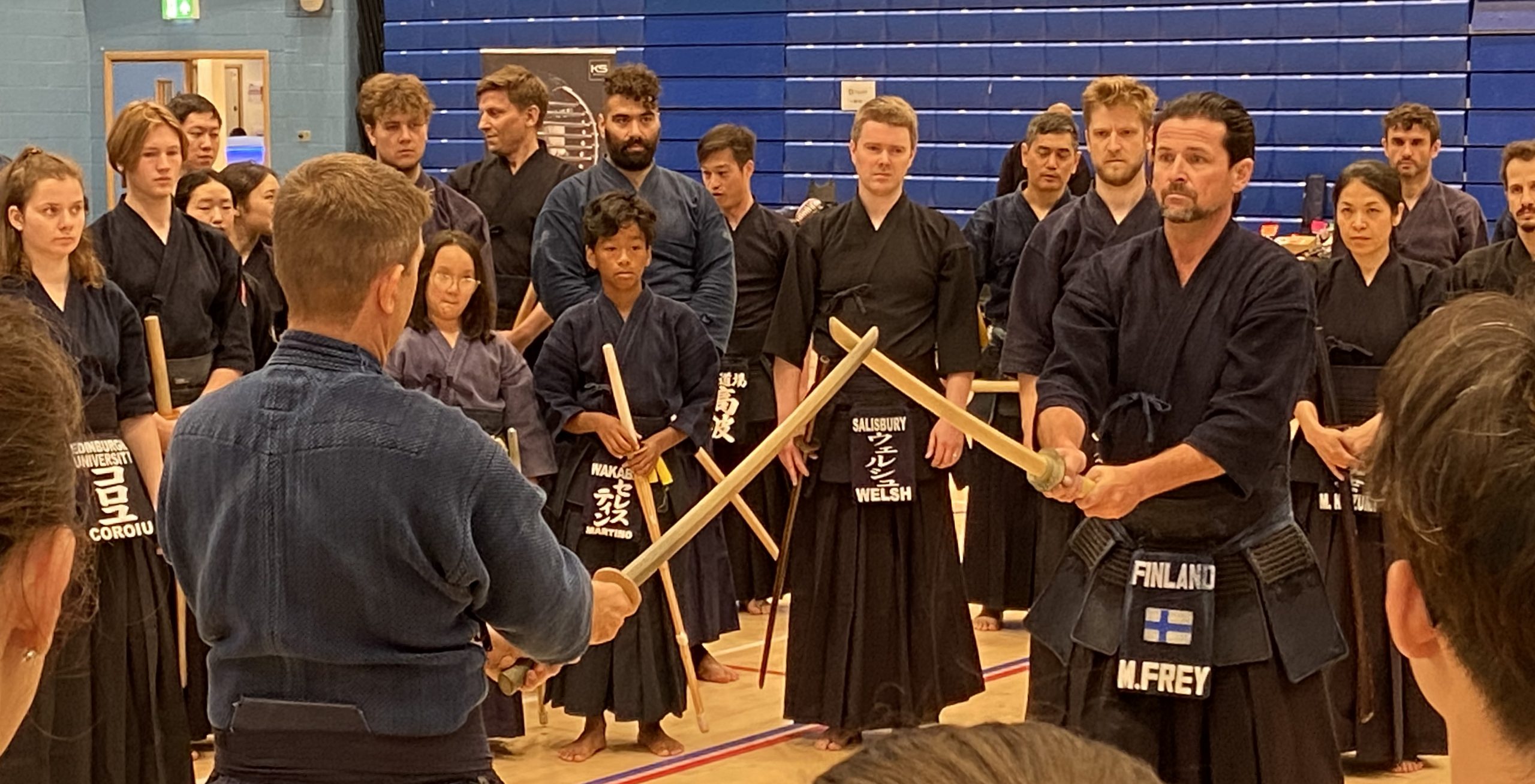


Channel 4's The Games features Kendo

“the most exciting 180 seconds of martial arts ever seen on  TV”


BKA News Online

Issue # 23 April 06


Contents

Submission

Guidelines

Contact Details

Introduction

Notices

Reports


Diary of Events

Grading/Taikai Results

Shopping & book list

Articles

Ladies Seminar: Edinburgh

Iaido and Jodo Koryu Seminar

Glasgow seminar and grading 2006 report

University Kendo Championships 2006

Can do Kendo

Guide-lines for coaching/teaching


Seminars/Competitions: Forms & Details


Last Words


Submission Guidelines:


Submitting articles for use online (and thus the newsletter) is easy - just email either the editor and/or the Webmaster with the article/idea and take it from there. We are constantly looking for people to write articles and contribute to the website, so please don’t be shy.

This news online is produced courtesy of the website, please remember, we can only publish things that we get, so if we don’t get anything relating to a specific event, then we can’t do anything about it. You can help us by:

Registering your interest to do an article before an event

Be conscientious - if you say you are going to do it, then do it!

Supplying content in digital format (with pictures)

Get someone to proof-read your article

Spell-check it!

Electronic submissions must now be supplied in HTML format, or WORD in an uncomplicated format, pictures sent separately in JPEG format [small resolutions please] if not inserted correctly into the document

Items that involve the team in retyping or reformatting will not be undertaken and returned to the originator. However some typewritten formats may be acceptable, as these items can sometimes be electronically scanned and included.


Send Postal Submissions to: BKA Newsletter, co: P A Budden. Gomms Corner. Copperkins Lane. Amersham, Bucks. HP6 5QB


Contact Details:


President John Howell

president@kendo.org.uk


Chairman: Geoff Salmon

chairman@kendo.org.uk


Vice Chairman: Gavin Murray-Threipland

vice.chair@kendo.org.uk


Treasurer: David Spacey

treasurer@kendo.org.uk


Secretary: Ric Schofield

secretary@kendo.org.uk


Membership queries

bkamembership@duco-personnel.co.uk


Kendo Bucho: Paul Budden

kendo.bucho@kendo.org.uk


Iaido Bucho: Vic Cook

iaido.bucho@kendo.org.uk


Jodo Bucho: Alan Nash

jodo.bucho@kendo.org.uk


BKA PRO: Paul Gray

bka.pro@kendo.org.uk


Iaido & Jodo PRO: Fay Goodman

pro.iaijo@kendo.org.uk


Health and Safety Officer: Donald Gordon

health.safety@kendo.org.uk


First Aid Advisor: Trevor Chapman

first.aid@kendo.org.uk


Webmaster: Carl Ranger.

bka.webmaster@kendo.org.uk


News Online Editor: Paul Budden

editor@kendo.org.uk


National Phone line

01494 581503

Automated response for a BKA leaflet

and Club list only.


A comprehensive and up-to-date list of BKA contact details can be found on the website


Introduction:


Dear members and welcome to the online news, which is exactly that.

We hope that you continue to enjoy the content and I’m sure there will be lots of feedback and discussion over the change over, which we welcome.

The next ‘hard copy’ issue will be sent out in June.


The recent Channel 4 programme ‘the Games’ brought  Kendo to mainstream TV exposure with over 8 million viewers watching the build up on E4 and culminating with the finals on channel 4.

We understand that Kendo will be commissioned again for the 2007 series…watch this space


Notices:


Iaido & Jodo European Championships 2006

Proposed Schedule

In response to all the questions I have been receiving about the Euro Taikai. I have put down the

proposed plan that the BKA would like to run. Please be aware that there may be some changes

To the dates. As I am still awaiting final confirmation of our proposed schedule from the EKF.


IAIDO


Date

       Morning

Afternoon

Evening

Sunday 3rd Sept

       Iaido Seminar

Iaido Seminar

Referee Seminar

Monday 4th Sept

Opening Ceremony

Iaido Individual competition

Individual Competition


Tuesday 5th Sept

Iaido Team Competition

Closing Ceremony

EKF Iaido Grading

Sayonara Party


JODO


Date

       Morning

Afternoon

Evening

Wednesday 6th Sept

Jodo Seminar

Jodo Seminar

Referee Seminar

Team Managers Meeting

Thursday 7th Sept

Opening Ceremony

Jodo Individual Competition

Individual Competition


Friday 8th Sept

Jodo Team Competition

Closing Ceremony

EKF Jodo Grading

Sayonara Party


For further details please contact Alan Nash: jodo.bucho@kendo.org.uk


National Kendo Refereeing seminar& Taikai experience workshop at Kashi no ki Ollerton 15th April:  Contact Trevor Chapman kendo.member@kendo.org.uk

Appointed Persons First Aid Course.  A one day course will be held at the Dukeries Recreation Complex, New Ollerton, Notts, on Saturday 13th May 2006 from 10am until 3pm.The qualification is valid for 3 years and is the minimum necessary to satisfy current Health and Safety requirements: Contact Trevor Chapman kendo.member@kendo.org.uk

Special Ladies Kendo Practice and Squad training; June 10th & 11th at Kodokan

Saturday:  Ladies practice 10am to 1pm. Seniors 2:00-5:00pm
Sunday:  10:00am-1:00pm

All age women welcome 14 years old and above. All attendees are welcome to stay for National Squad Training in the afternoon 2 – 5pm, run by Honda Sensei

Please contact ladies coach if you are interested: ladies.coach@kendo.org.uk

Special Young Males Kendo Practice and Squad training: July 8th & 9th at Kodokan

Saturday:  Young Males [15 to 25 years] 10am to 1pm.Seniors 2:00-5:00pm
Sunday:  10:00am-1:00pm


3rd IKET 22nd to 25th June 2006

Full details are now available at: http://www.kendo.org.uk/clubs/edinburghkendo/iket/06/IKET06_Home.htm

and we would ask Dojo leaders to ensure that their individual members are aware that they are very welcome to attend and participate irrespective of grade and are encouraged to attend this highly prestigious event


Over the recent months

There have been several ‘grumbles’ about there being no open forums for our relevant disciplines: Kendo Iaido and Jodo or a BKA members general discussion area.

This has been due to the fact that the BKA website is an information/news/downloads based site and the content tends to be positive as the design is not conducive to forum sessions in the way the for instance a yahoo group is - classic critic routine.

So we are now very pleased to offer through a link ‘Open forums’ for all.

We would like to thank Gerry Kincaid and Kendo UK.net for hosting and making these forums possible.

Please read the information on the website front page in the PDF and follow the link.

As yet we don’t seem to be having much ‘input’… obviously there are no more grumbles? ………hmmm


Kendo & Jodo Grading Questions are now only published on the BKA website: all candidates must bring their completed papers with them on the day of the examination.


Diary of Events

Here is a list of all Kendo, Iaido, and Jodo related events in the U.K. and others of interest in Europe.  Events that span all three disciplines are marked (All).

This information is Provisional at the time of going to print and will be updated in future issues.

The CLOSING DATE for all grading is TWO CALENDAR MONTHS prior to the day of the exam. Contact FOR ALL UK grading is the Grading Officer Keith Dawick: grading.officer@kendo.org.uk  and NOT the person in charge of running the seminar.  For all overseas Grading, members must contact the President John Howell: president@kendo.org.uk  for a letter of permission.


Date

Description / Details

Location

Discipline

Contact (addresses not expanded can be found in Contact Details)

1st & 2nd April

Ozawa Sensei Seminar

Kashi no ki

Ollerton

Kendo

Trevor Chapman

kendo.member@kendo.org.uk

8th & 9th April

Kendo Squad Training

Kodokan Rickmansworth

Kendo

kendo.coach@kendo.org.uk

15th April

National Kendo Refereeing seminar & Taikai experience workshop


Kashi no ki

Ollerton

Kendo

Trevor Chapman

kendo.member@kendo.org.uk

21st to 23rd April

Five Nations Cup

Berlin

Kendo

Sotaro Honda

kendo.coach@kendo.org.uk

22nd April

Coaching course

Light Hall School

Solihull

All

Ric Schofield secretary@kendo.org.uk

29th  & 30th April

Jodo seminar & Grading

Northants

Jodo

Alan Nash

jodo.bucho@kendo.org.uk


6th & 7th May

Kendo Squad Training

Kodokan Rickmansworth

Kendo

Sotaro Honda

kendo.coach@kendo.org.uk

13th May

First Aid Course

Kashi no ki

Ollerton

All

Trevor Chapman

kendo.member@kendo.org.uk 

20th  & 21st May

Kendo Seminar

Tsunami

Watchet

Kendo

Adrian Rowe

Rowerovers@aol.com

21st  May

Kendo Grading

1st Kyu to 3rd Dan

Tsunami

Watchet

Kendo

grading.officer@kendo.org.uk

3rd & 4th

June

Sir Frank Bowden Taikai & Premier’s cup

Kashi No Ki

Ollerton

Kendo

Trevor Chapman

kendo.member@kendo.org.uk

10th & 11th June

Kendo Squad Training

& Ladies practice

Kodokan Rickmansworth

Kendo

Sotaro Honda kendo.coach@kendo.org.uk

22nd & 23rd June

IKET: Kendo, Iaido & Jodo seminars

Edinburgh

University

All

Steve Bishop

kendo.highgrade@kendo.org.uk

23rd June

IKET Grading for Kendo, Iaido and Jodo. 1st kyu to 3rd Dan

Edinburgh University

All

grading.officer@kendo.org.uk

24th June

IKET:

3rd Int Kendo Enbu Taikai


Edinburgh    University

Kendo

Steve Bishop

kendo.highgrade@kendo.org.uk

25th June

IKET morning  practice with the Sensei

Edinburgh University

Kendo

Steve Bishop

kendo.highgrade@kendo.org.uk

8th & 9th July

Kendo Squad Training

& Young males practice

Kodokan Rickmansworth

Kendo

Sotaro Honda

kendo.coach@kendo.org.uk

15th July

Kendo seminar

Kagami shin Stoke

Kendo

Keith Dawick

grading.officer@kendo.org.uk

16th July

Kendo grading
1st Kyu to 4th Dan

Kagami shin Stoke

Kendo

Keith Dawick

grading.officer@kendo.org.uk

19th to 20th

August

21st  Int Kodokan Kendo seminar


Kodokan  Rickmansworth


Kendo

Paul Budden

kendo.bucho@kendo.org.uk

20th  August

Kendo grading seminar members only

1st Kyu to 5th  Dan

Kodokan Rickmansworth


Kendo

Keith Dawick

grading.officer@kendo.org.uk

2nd  September

British Open Kendo championships

Kashi no ki

Ollerton

Kendo

Trevor Chapman

kendo.member@kendo.org.uk

3rd September

First Aid Course

Kashi no ki

Ollerton

All

Trevor Chapman

kendo.member@kendo.org.uk

9th & 10th  September

Kendo Squad Training


Kodokan Rickmansworth

Kendo

Sotaro Honda

kendo.coach@kendo.org.uk

7th & 8th October

Kendo Squad Training


Kodokan Rickmansworth

Kendo

Sotaro Honda

kendo.coach@kendo.org.uk

22nd  October

Kendo Grading, 1stKyu to 4thDan

Mumeishi Cranford


Kendo

Keith Dawick

grading.officer@kendo.org.uk

October

Kyusha Seminar and Grading 7th to 2nd kyu

Kashi No Ki

Ollerton

Kendo

Trevor Chapman

kendo.member@kendo.org.uk  

11th November

Mumeishi 3’s Taikai

Mumeishi

Cranford

Kendo

Terry Holt

mumeishi@mumeishi.co.uk

18th & 19th

November

Kendo Squad Training


Kodokan Rickmansworth

Kendo

Sotaro Honda

kendo.coach@kendo.org.uk

2nd  December

National Kendo Refereeing seminar & Taikai experience workshop


Kashi no ki

Ollerton

Kendo

Trevor Chapman

kendo.member@kendo.org.uk

8th to 10th December

13thWKC

Taipei, Taiwan

Kendo

John Howell

president@kendo.org.uk

11th December

13thWKC Kendo Grading up to 7thDan

Taipei, Taiwan

Kendo

John Howell

president@kendo.org.uk


Kendo Squad Training & Schedule


Squad training sessions are usually held once a month. These take place over a weekend. Anyone interested in being involved with the squad is welcome to attend. There is a charge of £3 per session to help cover costs.


Training Dates for 2006:

April 8th & 9th  at Kodokan

May 6th & 7th at Kodokan


June 10th & 11th at Kodokan

Saturday:  Ladies practice 10am to 1pm seniors 2:00-5:00pm
Sunday:  10:00am-1:00pm


July 8th & 9th at Kodokan

Saturday: Young Males practice[15 to 25 years ] 10am to 1pm

seniors 2:00-5:00pm
Sunday:  10:00am-1:00pm


Sept 9th & 10th at Kodokan

October 7th & 8th at Kodokan

November 18th & 19th  at Kodokan


The next training weekend will be held at Kodokan Dojo in Rickmansworth on Sat & Sun 8th & 9th April

Times
Saturday:  2:00-5:00pm
Sunday:  10:00am-1:00pm

Venue
Kodokan Kendo Dojo
Princess Marina Sports Complex
The Royal Masonic School for Girls
Chorleywood Road
Rickmansworth
Herts. WD3 4HF

Directions (View a map)
By Road: From the M25 Junction 18 (Amersham/Chorleywood exit) take the A404 towards Rickmansworth for about 1 mile. The school is on the left hand side; use the second, signposted entrance (the first is closed). If you reach the Rickmansworth Station roundabout, you’ve gone too far, so go back up Chorleywood Road (A404) and the entrance is about 400m on the right. Parking is in the main school car park. Access to the sports complex is on foot (follow the signs). The gates are not locked, but please close after entry.
By Rail: Rickmansworth Station is on the Metropolitan Line (Baker Street-Amersham) and the Chiltern Line (Marylebone-Aylesbury). The school is just a short walk from the station. From the station front entrance, turn right and follow the above directions from the station roundabout.

Accommodation
Check out: www.stilwell.co.uk Hertfordshire inc Rickmansworth and surrounding area.


We particularly want to encourage more women to come and join the squad.
The only requirements are that you are keen to compete and willing to attend squad training sessions


Please contact The National Coach to register Males: kendo.coach@kendo.org.uk 

or  The Assistant Kendo Coach to register Ladies: ladies.coach@kendo.org.uk


Shopping:


The BKA recommend Nine Circles and Emai shop UK for all equipment purchases.


www.ninecircles.co.uk


http://emaishop.com/top.htm


BKA Book List (available from nine circles)

Kendo The Definitive Guide - Ozawa


Looking at a Far Mountain - Budden

Fundamental Kendo Vols 1 & 2 - ZNKR (BKA Only item)


Japanese-English Kendo Dictionary - ZNKR (BKA Only item)  

Check out the ‘Kendo World’ list of available titles

Nippon Kendo Kata - All Japan Kendo Federation – NEW

Iai Manual - All Japan Kendo Federation – NEW


The BKA have the following items on offer to members only!


39 Shinai ‘Gold quality’ @ £30 each

BKA tenegui @ £5 each

Car stickers £3 each

Blazer badges £12 each

BKA pin badges £3

Referee's progress log £3


12theWKC items:

Shinai bags £10

Sweat shirts £8

Tenegui £2

Limited amount of polo and T shirts £4

Key rings £1

Pin badges £1

Pens £1

Towels £3

Luggage tags £1

Mouse mats £1


All items are plus post & packaging and can be purchased by cheque/cash.

Contact: Dean Wormall

bka.sales@kendo.org.uk


Shinken 2.7 shaku , silver bamboo design fuchi kashira , black nutbuck leather ito, with spare saya, £3000 ono,

contact Rob Anderson 07747768771 robertandlisa@ntlworld.com


Items for sale Kendo equipment: 

Adult size, 5' 11'' Gi bought from 9 Circles, best quality, Indigo dyed Cost £46 Hakama bought from 9 Circles, rayon, Cost £57 

Do and Kote bought from club member Cost £130, Tare bought on E Bay Cost £15 

Youth Size, suit teenager / lady 5 ' 4'' / 5' 5'' Gi and Hakama bought from 9 Circles entry level quality Cost £20 each, Men, Do, Kote and Tare bought on E Bay Cost £110 Kote are slightly damaged 

Happy to throw in a couple of unused tenegui, also have 2 sword bags. No reasonable offer refused. 

Any offers please to me email Andy Pilborough- Skinner: thekickboxer@ntlworld.com or mobile 07866 695566 


If you have budo related equipment item[s] that you wish to part with then please email us with

details and you can be included in the next newsletter (online and printed version).

This can include books, shinai, clothing, 2nd hand bogu, etc - anything relevant.


Any body interested  in Compression suits …check out: http://www.bsccompression.co.uk

Contact Paul Budden: paul.budden@kodokankendo.org.uk


Grading Results

Kendo: Glasgow 12th march 2006:-

Ikkyu: H. Bezum, K. Brogan, L. Watts, M. Richardson, D. Rouwendal, M. Care, L. Carrigan

K. Theodossiou, V. Michail, B. Qiao, S. Kriaucionis, J. Kelso, E. Yamazaki, A. Crowe.


Shodan: H. Shuell, R. Thompson, K. Brogan, R. L. Bolton, A. Bamba, D. Sol, M. Goral, J. Tree

Q. Lee, P. Wilson, R. Marschall, J. Benn, T. Sokec, S. Hutton, D.W. Gordon.


Nidan: D. Winiarczyk, N. Baxter, J.H. Park, J. Jung.


Sandan: N. Edwards, R. Brogan


Kendo Southern Area Grading: 26th March 06:-


Ikkyu: J Barber, T Rutter, S Bainbridge, E Cornish, J Tsoi, R Hooper, W H Yuen, A Jackson,

DN Brestrup, W Y Yang, R Fuligoni, M Keetch, P Evans, M Hayward, G Troughton, S Daniels

P Mooney, M Smalley, M Forte, B Dando, B F Moseley.


Shodan: R Kinugasa-Crinigan, O Carter, R Goodall, D Choudray, A Jackson, A Bill, M Carter,

L A Law, J Walker.


Nidan: J Fujisawa, H Taimuri, N Sharp, J Martin, J M Bates, B Coates, N Stenson, C Porter.


Sandan: L Pereira, E Bauld.


Yondan: J Alexandre, B A Hayes, J Ruddle.


LADIES SEMINAR: EDINBURGH. FEBRUARY 4-5th 2006


Edinburgh Kendo Club held a ladies seminar over 3 days a total of 37 ladies took part from all over Scotland and from as far a field as London.

The British Ladies Kendo Coach Matsuda sensei was invited to help run the seminar ably assisted by Gillian Riddoch and Lyndsey Bishop.

There was also a chance to get yourself well and truly ‘whapped’ by the ladies [which many can testify to] in the open Sunday morning session.  More below from D Hanson…….

Girls!


Edinburgh Rocks!!


Right the first thing about the ladies seminar north o’ the border was ….You had to be there! (Ok so if you were a bloke it might have caused a problem but still …). Although the actual seminar was due to start at 12 on Sunday it was worth an early arrival on Friday night to see Edinburgh dojo in full practice.  I was only too sorry to have arrived too late to get kitted up and joined in.  Gill Riddoch is back in the thick of things with a new looking Jodan style which seemed to provide a thought provoking ji-geiko.


You are not going to believe this but following to practice we went down to the local (a pub dedicated to Scottish rugby) and sat out side for much of the evening! I guess the tables and awnings gave it a Mediterranean feel that was only slightly off set by the pints plonked on the table.


The day of the seminar dawned and thanks to Lindsey’s precision planning an assorted crew of ladies from the UK, Kiwi land, Europe and Japan assembled in the Southern Cross cafι for a full Scottish breakfast.  The whole place was full of French rugby fans whole were also tucking into eggs and haggis.  There was even vegetarian haggis for those that feel that these shy creatures should be left to roam free in the glens of Glasgow.


Then the real stuff started with Matsuda sensei at the University Centre for Sport and Exercise.  She had also been suitably stuffed with the cafιs finest victuals, but soon managed to turn it into a lot of energy.  There were a wide spectrum of grades and abilities, ranging from the home grown yon dan via MoMo a Japanese 4th dan down to those who were only just into their first few sessions in bogu or kendo as a whole.  We started with kihon kata and looked at basic foot work exercises before moving onto work with the bokken.  Having gone through all the kata she drew our attention to comparisons with the basic kendo kata forms for example the doh cuts in kata number 7 with the doh cuts in the kihon keiko ho.  We were then asked to provide voluntary attempts at kata demonstrations.  These were great fun and soon turned into a new game of “Matsuda says.”  The demonstrating pair was asked to perform any Kendo kata at random! This provided not only some impressive feats of focus but some real moments of bewilderment and good humour. 


We then swapped venues with the fellas but not before a guided tour of Steve Bishop’s “office” i.e. a state of the art sports centre that seemed to have just about every thing including a shooting range in the basement!


The afternoon session kicked off with another look at foot work and a really simple exercise of combining fumi-komi with clapping, a great way to look at foot work and timing with out the distraction of a shinai .Then having armoured up, it was up to all sorts of tricks starting with kiri-kaeshi where the doh is used, then using the doh and men alternately and then striking twice at the same side of the men.  Motadachi were used for part of the afternoon to help with looking at assorted oji-waza and other techniques.  This was my first opening into the world of standing out and being a motadachi for a line of ladies for much of the after noon; and it was a real learning curve for me.  It really is hard work! Ok any higher grade reading this may nod sagely but to me this was a new experience in Kendo and it was a real eye opener.  It takes a lot more effort to even try to be a good motodachi than I had ever thought! Certainly one to file away in the training diary , make every chudan as perfect as you can , make each men cut for kakarate’s oji-waza perfect , use only  the best that you can time after time .  I got as much out of it as those lined up in front who were performing the exercise  and if a lady ever thinks its hard work,  use the secret  motivation of all women to keep going …think of the burned off calories !!!!


Ji-geiko was great fun! Alas we only had a minute for each one and on more that one occasion it passed all too soon, just as things were really heating up! This part of the seminar came to a close all too soon and we hurried out of the closing sports centre as it shut.


That evening Lindsey had organised an all you can eat oriental buffet! Sake was on hand too! So having been filled to bursting point we all went on the Bishop and Riddoch guide to Edinburgh night life in which the Victorian Grey Friars Bobby ( a cute and loyal canine or one of history’s stupidest mutts fondly referred to in previous visits by Paul Budden as ‘Robbie the dog’ . ) had a star roll  , but  …..er…. well like I say you had to be there to…er … “Snog The Dog”! 


Much talk had been given over to different approaches that women have to kendo in philosophy, psychology and physiology.  There are certainly a lot of topics for discussion here and a long and involved article would result, but try this for a contrast.  Four female kendo ka spent a day of hard practice and then a good night out on the town before squeezing themselves and their damp bogu into a small apartment.  The following morning the air through out the house was still breathable!!!  Could a group of kendo blokes do this and not have the UN Security Council “do” them for being in possession of biological weapons of mass destruction?


Lastly the Sunday practice dawned .The streets of the city filled with yet more rugby fans drawn towards the sacred turf of Murryfeild for the France Scotland match.  The sight of  Scots rugger captain Jason White  taking a calm pre match  stroll with his I pod round the base of the castle rock proved to much for Gilly who needed calming down.  Once in the dojo talk of kendo put thoughts of Scotland’s bravest in blue (and for some reason, frequent mentions of the All Blacks) on a back burner.

The Sunday practice mingled the ladies with the junior members of Edinburgh Dojo and the regulars.  There were a few unusual games with foot work just to get the very youngest fired up (Ever used “pizza” as a kiai?).  There was another game that involved hitting balls with a shinai.  Having now relaxed and warmed up there followed some good and hard ji-geiko.


A three day kendo session! Great!  Real thanks to every one for every thing: To all who were there, to the mystery kiwi, To the Mighty MoMo. To JoDan Gill. To Lindsey “L on Earth” Bishop for the whole thing.  Of course to Matsuda sensei for imaginative and patient teaching.


D Hanson

Kagami shin kendo club


Iaido and Jodo Koryu Seminar with Ishido Sensei

Paris 3rd to 5th March 2006


Those of you reading this will never realise the pain and anguish writing this causes me. Why, you may ask. Has Andy finally realised the enormous depths that martial arts training represents and now finally understood his insignificance amongst the immensity of this universe? Has he received news that compromises his future plans for world domination? No – none of these – my forearms are screaming bloody murder in pain after last weekend’s sword thrashing (otherwise known as iaido).


That’s the semi-humorous warm-up paragraph out the way, now I can bore you with the travel details of our journey to Paris to this seminar. I am never sure how to write these articles in order to break the mould of BKA report writing (i.e. weather; hall; Dougie’s legs; the seminar; Saturday night beers; the hangover; thanks to the sensei; smarmy endliner) so I won’t bother.


This koryu seminar is held every year in Paris and Ishido sensei has attended for the last five years. Through that time, although I have only been to one other, I understand they have grown and grown until now when we easily see about one hundred participants from various countries in the Eurovision zone (i.e. Sara from Jordan turns up as well). Sensei was assisted by 7th dan Messers Jock Hopson, Ard van Wijngaart and Rene van Amersfoot although I am sure the above will agree that this seminar is a learning experience for everyone. It was also great to see so many people from the BKA there as well. I am sure that one of the appeals of this seminar is the fact that Sensei comes to them without any official delegation and he is much more himself in his humour and in his demonstrations/explanations.


The first day consisted of a jodo seminar in which it was pointed out that we should be focussing on Shimizu/Hiroi sensei’s Tokyo style of Shinto Muso Ryu Jodo and use the Fukuoka style as an interesting study aid without devoting any great amount of time to it. Once again however we initiated with Tandoku Dosa basics training before working into those forms which appear in Seitei and Koryu. I mention this emphasis on Tokyo over Fukuoka as I detected a preference from sensei to Tokyo’s simple but effective jodo over the Fukuoka slightly convoluted honryu. This is an interesting point I feel as it is all too easy to be seduced by the slight variations that the Fukuoka style offers but I saw more and more the reasonability of Shimizu sensei’s development and slight simplification of jodo. I won’t discuss the kata explanations here of course but it was gratifying to see the clarifications on otherwise slightly woolly points. We finished the afternoon by nearly but not quite finishing the Omote waza. I was tenacious in understanding a bit more about Hosomichi and so badgered sensei for some answers. Thankfully he was direct (“Get lost Andy, you freakshow!”).


Saturday and we started nice and early to get stuck into Muso Shinden Ryu Iaido. Without too much explanation we covered shoden in the morning and chuden in the afternoon. It was in the afternoon that I made the suicidal decision to train down the end with Rene’s group where he seemed to be doing a nice smooth and continuous practise. The training was absolutely continuous with no breather at all – a great way of ensuring you do lots of training but not so good for one’s evening social life where I was suffering from dehydration and exhaustion.


Sunday concluded with seated and standing okuden. Sensei explained that typical seminar style was that if there was plenty of time then people would study a few forms to great depth. Given only a short time, people would study lots of forms but to a very slight depth – it was made clear that that was what we were doing this weekend. Further emphasis went onto the fact that this weekend should represent only the start of ones training and knowing the forms in the head does not mean that one can represent them with the body.


During the relaxed afternoon okuden tachiwaza session (relaxing because we weren’t on our knees of course) sensei mentioned his preference for and against the use of videos at seminars. His opinion was that although videos served as a good aide memoir, there was a risk that the owners of these videos would not bother to train in what they had videos of as the videos would always be there to remind them of forms if and when the owners needed them. Instead, people should continue to train hard in these forms in order to remember them instead of consigning them to electronic memory. This was a very eloquently put point as it is not the first time that a Japanese sensei has expressed a negative attitude towards videoing but this was the most reasonable answer why.


For the benefit of those that couldn’t make the seminar (and are in any way interested) I will here attempt to summarise some of the key learning points from each teaching set:


Shoden


The purpose of shoden, being the omote waza, is to teach the basics of iai and the emphasis is in the practise of taking and making distance (ma-ai) hence the apparent ranginess of it’s forms. The first four forms allow one to respond to an attack from any angle and the riai of the 2nd, 3rd and 4th forms are not that one should turn their back or side to an opponent but merely that the opponent was always there. Furikaburi is rather flat in order that a deflection of an attack may take place if necessary. I will not go into too much detail around the specifics of each form but it was emphasised and demonstrated in Ryuto how offence and defence are rolled into one in iai through good shisei and correct technique.


At the introduction to this set, sensei addressed the common question as to why an exponent would be sitting in seiza with a katana in their obi (which of course would not happen in Japanese culture where one leaves their sword(s) at the door before entering a house). The answer to this was that it was argued that iaido while standing was something that could be accomplished comparatively easy and that to further develop oneself that the exponent should be put into situations where mobility was challenged i.e. sitting in seiza. Thus one learns to do swordsmanship in a far more difficult scenario and therefore deepen and strengthen ones abilities. All other reasoning as to the sitting position (low ceilings, using silhouettes for ID’ing an opponent etc) are considered possibilities but not the underlying principle.


Chuden


While shoden teaches distance, chuden teaches versatile and dextrous bodily movement. These forms also incorporate the “increase difficulty” approach like shoden but this time the exponent is armoured and thus are sitting differently and the techniques themselves may express a way to be executed to overcome the armour. Furikaburi is more diagonal and direct. Later on during the weekend, chuden was chosen to exemplify how and why iai must be executed in a smooth efficient manner to nullify the risk of the opponent turning the technique against you (so easy to do with close range techniques as the bruise on my shin will testify). This I think was the most significant learning point and has been emphasised time and again that merely learning the form is not enough – one has to be thoroughly experienced in it, exploring and ironing out every weakness. This doesn’t mean rushing the kata but merely that a mastery of doing the technique correctly will lead to its own natural increase in tempo and efficacy.


During a couple of the forms Sensei demonstrated how the close proximity of the opponent could lead to a counterattack being received if the kata wasn’t delivered extremely expediently and all the weaknesses ironed out. My personal nemesis was the draw on Yukigumo without being obstructed by the opponent.  This form in itself offers the opponent many opportunities to turn the attack against the exponent. Similarly, if the form is developed and executed skilfully, these exact points of counterattack can be turned back against the opponent.


Okuden


Okuden incorporates all of the qualities of the previous two sets and aims to improve the harmony between sword and body. While Shoden and Chuden had pretty well established formats of kata, it became obvious that Okuden was relatively fluid in what became considered as the orthodox way of executing a form. Virtually every form in Okuden had at least one kae waza, some had as many as four. Compounding this, with every version of the form there are a number of levels of tempo and flow which one must go through before progressing to the next. This was exemplified in several katas and is easy to demonstrate in the standing form Yukizure. In this, the basic method is to execute two distinct cuts at diagonal angles as shown in Fig 1.

Fig 1. Basic two-cut version of Yukizure


However the ideal is to move to a one-cut flowing action incorporating something known as “inashi”. This has various literal meanings but in this sense it indicates using the action of the sword to both cut and dispose of the first opponent and continue to flow into the second part of the cut. See below.


Fig 2. One cut incorporating Inashi


One of the revelations from the seminar was a proper explanation of Kabezoi and why one comes up onto the toes to make the cut. Sensei’s explanation for it made perfect sense and I represent it here for your personal digestion…


Kabezoi


The scenario of this kata is that as well as being constricted from the walls on either side, the opponent literally has their back to the wall. This is one of the most dangerous situations for a number of reasons concerning how the opponent can use the wall to defend themselves.


Fig 1. The scenario where one is pursuing the opponent into a closed end alley


If one executes a conventional cut to an opponent’s head at the same height the Fig 2 shows how the trajectory of the tip of the sword will continue to travel forwards and could embed itself into the wall (it is appreciated that the shape of the cut and the mechanics involved are more complex than merely hinging at the shoulder, the model below however provides enough representation of the dynamics).


Fig 2 How to shorten the length of your sword in one easy lesson


While with a less than proactive opponent this would mean damaging ones sword, an opponent could potentially avoid any attack by merely ducking down while staying flat against the wall. This would lead to the sword embedding itself harmlessly into the wall and leaving you in a position of weakness.


In order to avoid this happening, by raising ones own height it allows a good quality cut to the opponent with a reduced risk of the tip travelling forward into the wall. See Fig 3.


Fig 3 Kabezoi – impress your friends living in a cul-de-sac


Note that the effect of standing on one’s toes is merely to ensure that the entry point of the sword occurs when the sword is lower than normal.


The rest of the form is reasonably self explanatory and this explanation certainly helped to clear up the riai for this form after hearing explanations about boxes in the way, avoiding yokogiri cuts and abduction from aliens.


It would be good to continue this explanation for all the things learned at the seminar (for my own good I mean) but this would take reams of pages and by the time I would have finished then it would be Paris 2007. I will finish this article with an interpretation and extrapolation of Sensei’s definition of the two types of kata which exist…


Jokyo (Context)


This is typically the type of form which people imagine when they perform iai. There is an expected combative scenario, riai (logic) and outcome from these forms. It assumes that the imaginary opponent is actually doing something to attack the exponent. Most of the forms in MSR and MJER are Jokyo forms and it is important to research and understand the riai of these forms in order that one can understand how to maximise the expediency of the form. The one problem of Jokyo forms are when they are confused with…


Toho (Sword Methodology)


While all iai forms should be performed with some awareness of an enemy, the objective of some forms is to merely develop certain skills of the swordsman and no logical context exists for such forms. Seitei no. 11 Sogiri for example is not a contextual form – there is no particularly logical sequence of movements for the enemy. The purpose of the form is to develop the ability to cut at three levels, to execute a horizontal cut with the same cutting timing and then to conclude with a vertical cut. It should be noted that Sogiri and Somakuri (Gohogiri) are different in this way in that the latter form is a contextual form. For a Toho form, it is not worth too much effort in trying to work out or question what the opponent is doing as this may not be the purpose of the form.


To a certain degree all the forms contain a certain amount of Jokyo and a certain amount of Toho and while this article does not specify which forms are which it is worth bearing in mind this point and focussing on practise rather than whiling away the hours trying to establish which kind of opponent is nine feet tall, has six legs and is a guru at Yoga.


My thanks go out to my dojo colleagues who joined me on this excursion, to Al Colbourne who entertained us on the Friday night and to Stefano who had to try and follow my haphazard English in order to translate to French – God only knows how the translation came out in the end after going through two “washes”.


Andy Watson

Seishinkan Dojo, Ealing


PS: Don’t forget to come to this years two BKA main events


GLASGOW SEMINAR AND GRADING 2006 REPORT


Timetable


Friday 10th March, Open Keiko 2000-2100 Kelvin hall international sports arena

Saturday 11th March, High Grade practice, 1000-1200 Kelvin hall international sports arena.

Saturday 11th March, Seminar, 1300-1800 Castlemilk Sports center

Sunday 12th March, Grading, 0900-1200, Castlemilk Sports centre.


Opening keiko

The seminar traditionally starts with an opening keiko at the Kelvin hall for those of us who can make the trip to Glasgow Friday evening.  The format of the keiko is mawari keiko for the first 40 minutes followed by an open keiko to pick up any fights on the dance card not covered by the normal rotation.  In other words fight whoever ends up in front of you then fight who you want to.  Numbers were up this year with 30 at the opening keiko and 70 inc sensei at the seminar

The venue for this practice is always the Kelvin hall because of it's proximity to the west end of Glasgow and the many excellent bars/restaurants and nightclubs as Kendoka on an away trip we are bound by constitution to go for


High grade practice

Prior to the main seminar is the High Grade practice led this year by Malcolm Goodwin and on his arrival fresh from the Games Sotaro Honda sensei?  The theme of the practice was similar to the main seminar and followed logically on from last year's theme of EN (maintenance of mental contact with the opponent)


Seminar

The key theme as described by Honda sensei was Ken-tai-ichi Honda sensei emphasised that this feeling or attitude does not just happen but is a result of extending the understanding of EN through continuous practice and constant application of these principals.


Ken meaning to attack or strike the opponent

Tai meaning to wait while calmly observing the opponents movement

Ken-tai-ichi was the key metaphor for the seminar which was broken down as follows;

1.Bokuto ni yoru Kendo Kihon waza keiko ho and Kendo Kata

Put an importance not only on learning patterns of movement but also the meanings contained in the movements Tackle these by recognising that they build up the foundation of Shinai Kendo

Try to maintain physical and mental states so that you can attack and react to your partners attack anytime

2. Basic cutting, Uchikomi geiko and Kirikaeshi

Use Ukuri ashi and turn properly after striking and quickly take kamae that enables you to be ready for anything

Smoothly move on to Tai-atari after striking, execute correct tai-atari, shinai handling

3. Waza geiko - the best moments to strike

When the opponent finishes a strike

When the opponent blocks a strike

When the opponent begins a strike

4. Shiai and refereeing practice

Competitors - show correct step in, maintatin EN throughout, Learn what Ippon is

Referees - Learn correct instructions, What to look for and where, Maintain the basic triangle between shushin and fukushin

5. Ji-Geiko Try what you have learned!

Not being able to do is not a shame - not trying to do is


As ever with Honda sensei the content was carefully thought through and presented in a way understandable to everyone in attendance.  This was clearly demonstrated at the shodan shinsa on the Sunday


Grading

Due to freak weather conditions everyone was awarded snowdan.  On awakening at 0630 there was 12 inches of snow in the drive To the great credit of everyone involved from the grading panels to the participants of about 50 registered only about 5 could not make it At the panel briefing we took the decision to put all who made it through their registered grade even if it meant changing the sequence.  To accommodate this.  Two shiai-jo were in operation with one panel dealing with Ikkyu and the other grading Shodan to Sandan. Despite the weather the grading was completed on time.

From the view of the organisers it was a successful event with high numbers both for the seminar and the grading.  The content was accessible to everyone and was understood at the appropriate level of the individual.  Thanks to all who participated and hope to see you next year


Gerry Kincaid


UNIVERSITY KENDO CHAMPIONSHIPS 2006


The 10th annual British University Kendo Championships was held at Oxford University Sports Centre on Sunday 19th March.  Over 60 competitors from 10 different universities turned out for an exciting day of fencing, despite many being in the thick of “exam crisis”!

The standard of the kyu grade competition was exceptionally high, especially considering many of the participants started their Kendo career at Uni and have therefore been training for less than 18 months. The worthy victor was Dipak Choudhary of UKKC.

In the Dan grade section we were treated to some super-fast shiai action from the Japanese competitors. The exception was  Max Davies (Portsmouth) who battled through to the semis, but the final was a zen-Nippon affair between Kamegawa (UCL) and Kohira (Oxford).

The ladies’ final was a skilful match between Misato Makita (Gloucester) and Reiko Shimoda (Cambridge).

The grand finale was the team comp, which culminated in an all UCL dust-up. The “home-grown” A team put up a valiant fight but the mighty B team (Saito, Tosaka, Treen, Kamegawa,  Matsuoka) won through. Gibbo was so pleased he nearly bought a round!


Thanks must go to all the referees and officials, but especially Ian Parker-Dodd who called upon his vast experience of running sporting events to make sure the whole day went smoothly.

A special mention goes to Weihao Yuen (OUKC President, 2005/6) who shouldered responsibility for putting on the show this year.


Results


Kyu Grade Championship (38 Entries)


1st Place:                                 Choudhary - Kent

2nd Place:                                Tsoi - UCL

Joint 3rd Place:                       Murray - Edinburgh, Fulgoni - UCL


Dan Grade Championship (27 Entries)


1st Place:                 Kamegawa - UCL

2nd Place:                                Kohira - Oxford Brookes

Joint 3rd Place:                       Tosaka - UCL, Davies - Portsmouth


Ladies Championship (14 Entries)


1st Place:                                 Ms Makita - Gloucester

2nd Place:                                Ms Shimoda - Cambridge

Joint 3rd Place:                       Ms Muranishi - Oxford Brookes, Ms Banba - Edinburgh


Team Championship (12 Entries)


1st Place:                 UCL B

2nd Place:                                UCL A

Joint 3rd Place:                       Imperial B, Oxford A


Fighting Spirit Award:         Ms Li, Imperial College.


In addition to the trophies and medals, shinai were also awarded as prizes courtesy of Eiko-Budogu. Our thanks to Imai-San for her generous donation.

UNIVERSITY KENDO CHAMPIONSHIPS 2006 LIST OF REFEREES:


Mr I. Parker-Dodd (Gloucester Uni)


Mr K.C. Yung (Imperial College)


Mr Tsuchihara


Ms E. Yoshikawa-Gubbins (Imperial College)


Mr D. Lever (Oxford)


Mr M. Molloy (Oxford)


Mr Yamazaki Snr. (Aberdeen)


Mr J. Richards Jnr. (Shudokan, Cheltenham)


Mr S. Gibson (UCL)


Mr J. Fitzgerald (UCL)


Mr L. Pereira (UKKC)


Mr Y. Ota (UKKC)


Mr C. Charlamow (Shudokan, Cheltenham)


Can do Kendo

by

Ian Parker Dodd


Published in the British Journal of Teaching PE Spring 2006 and reprinted by permission


So how did I, in the first term of my retirement from the University of Gloucestershire, come to be teaching Kendo, the Japanese Way of the Sword, as a leadership course at Kingshill School and Sports College in Cirencester? It was a coming together of many threads which I would like to share with you.

I started Kendo 20 years ago to remind myself what being a sporting novice was like, the bug bit and I am still involved. In 1994 I started the University Kendo club and also, because of my work as a physiology lecturer, became fitness advisor and later manager of the British men’s and women’s squads. In this time the men’s team won two European bronze medals and the women’s team one, and we were ranked in the top division at the Kyoto world championships in 1997. In 1997 I initiated the University Kendo Championships.

Professor Masatake Sumi of Fukuoka University of Education has been instrumental in helping develop my interest in the educational aspect of Kendo. At his invitation, I spoke at a PE symposium in 1990 and presented posters at the World Student Games Conference in Fukuoka in 1995. A student of his, Sotaro Honda, and I developed a Kendo module for first year undergraduates in 2000 and the Japanese Academy of Budo published our findings from the module in 2004. Sotaro completed his PhD in 2003 at Gloucestershire University entitled Budo or Sport: competing conceptions of Kendo within the Japanese Physical Education curriculum.

Kendo is part of the main stream of Japanese Physical Education but its role is debated. It is seen as having an important role in the development of character-citizenship in our terms as well as being important in developing a healthy lifestyle; all fairly familiar stuff but being carried by a different movement culture.

In 2001 the Japanese Embassy launched a series of events in this country to demonstrate aspects of Japanese culture. As the result of this I took a Kendo experience into three schools; a very positive response resulted. Shortly afterwards I was invited to take part in a Sports England launch at Pittville School Cheltenham, where the then Head of PE, Julie Pitt, asked if I would be interested in starting an ‘After School Club’. Initial recruitment of students was by assembly presentation given by me; some twenty pupils, mainly from Year 10, signed up for it. 

One of the immediate difficulties was that very few people in this country have any idea what Kendo looks like, what it is you are trying to do, what the point of it is and who does it. So where did I start with the children? I also have a problem in that the condition my knees and feet do not allow me to sit formally on the floor in what is called seiza nor can I squat down in the formal starting position called sonkyo.

I had made a tape as an introduction to the undergraduate module but this was too long for schools. In the University I had taught with colleagues, so full demonstrations could be given. In the event, I tried a variety of different approaches, from making a shorter videotape to producing written handouts, to using rolled-up newspapers as swords. A ‘steady drip of information’ technique was used. What was always rewarding was the buzz with each new aspect I introduced and I found that many things were picked up by the children even when I had the impression that they were not paying attention!


An early class at Pittville School


Two years later, mainly due it seemed to the onset of Year 11 GCSE courses, the numbers had dropped from twenty to a regular eight but the hard core of starters were still there and had moved from being somewhat clumsy and unbalanced to having confidence and ability. Two of these students, in their Year 11, took part in a National Competition. Their year was so impressed by them that they were voted ‘Achievers of the Year’ by their peers. One of them has since gone on to gain a bronze medal in his National age group category.


Making it to the semi-final


The Pittville club is still progressing and has full support from the present head of PE Natalie Meier. Assemblies are still used to recruit, but members, dressed in full kit, have given demonstrations. This has boosted the self confidence of some. At the moment there are fifteen pupils from years 7, 8 and 9 attending regularly.


In full kit and ready for action


In 2004, Rachel O’Bryan, Partnership Development Manager for the Cotswold School Partnership, together with Matt Pauling, Director of Sport at Kingshill School and Sports College, Cirencester, asked me to demonstrate Kendo at an event day with a focus on International Sport. Following this I was delighted to accept an invitation from Matt Coe, the Head of PE, to develop an ‘After School Club’ and a Leadership Course for years 10 and 11.

This trial involved a six session course for Years 10 and 11 during curriculum time. A session was a hundred minutes and there were three classes in each half term. Approximately a hundred and twenty pupils took part in this. The school club runs for an hour after school. Forty children, ranging from Years 7 to 11, have attended more than twice; fifteen have received grades and seven have joined the BKA. The experience I was lacking was teaching Kendo in curriculum time as opposed to ‘after school’ time. There was a difference in attitude towards the lesson despite the fact that most of the children had opted for the activity and I made some classic beginner’s mistakes by standing in the wrong place and not being as clear as I might have been in my instructions. Full advantage was then taken of my ambiguities. My learning curve was, I think, probably steeper than the pupils but despite some sessions where I drove home saying to myself ‘What am I doing this for?’ I have found great enjoyment in this teaching. It was also made more diverting when I was asked to provide, at fairly short notice, Kendo lessons for visiting French and German schools

The session content involved firstly an introduction via demonstration and video and the sessions concentrated on: - (i) Developing the proper etiquette. This involves sitting, standing, bowing and meditating correctly; (ii) How to handle the shinai and bokken properly. The shinai is a flexible bamboo sword used in full contact competition and the bokken is a solid wooden sword; (iii) How to take the correct stance; (iv) How to swing a shinai and bokken properly, with good footwork but no target (v) How to strike a target properly with a shinai; (vi) They also learnt how to wear a keikogi and hakama, a training jacket and a long pleated pair of trousers that goes from waist to the feet. The armour consisting of hip and chest protector, tare and do, together with the helmet, men, and gauntlets kote were also tried on. The targets in Kendo, head, wrist and lower stomach, are all covered by this armour and strikes to other parts of the body are not allowed. The equipment, together with its ethos of mutual respect, makes Kendo a very safe activity and in my experience produces fewer injuries than any other contact sport or game I have been involved in.

From this beginning a Junior Kendo Leader’s Award was designed for Year 10. The National Governing Body for Kendo supported this and two runs took place in the summer term of 2005. The equipment for this trial was mainly supplied by the author, the cost of the teacher was borne by the school and the NGB provided a booklet and certificate for each successful pupil. There were six lessons of fifty minutes duration with mixed classes of twenty and twenty-six pupils respectively. The first four lessons covered material already familiar, the wearing of the clothing and armour, the opening formalities and the basics of sword handling and target striking, and started with a demonstration of the activity as a reminder. This was followed by reciprocal style teaching using cards and focussing on how to teach the skill, rather than just do it. The fifth lesson was a planning session, to be recorded on A1 sheets, for a lesson to be taught to Year 5 and 6 pupils from a feeder primary school. The taught session-the sixth in the series-then took place and the Year10 pupils worked in pairs with two or three pupils. At the end of this session the taught group demonstrated what they had learnt. There were a few hiccups, as might be expected and all but two of the pupils managed to demonstrate sufficient leadership abilities to be awarded their certificates.


Learning to move and swing the shinai. It’s harder than it looks


The impact of Kendo upon British children has provoked both discussion and reflection. Kendo is strange to begin with. It takes the student out of the familiar and usual. Some respond to this and some do not. Teachers’ impressions suggest that Kendo attracts some pupils who have been turned off conventional games. The ‘Achievers of the Year’ at Pittville for example were not seen as being particularly ‘sporty’. The strict code of behaviour, for which reasons are given, together with the requirement to shout loudly whilst hitting targets, initially provokes a kind of embarrassed reticence. The ‘dressing-up’ is seen as great fun by most but it too is not straightforward. The ability to hit skilfully with a shinai is harder than it looks. When the opportunity to ‘strike a teacher’, albeit one dressed like Darth Vader, was offered, some of the ‘hard cases’ were surprised that their efforts were deemed too soft, that  polite correction to their technique was offered and that improvement was acknowledged with courtesy. The usual ‘pecking order’ of sporting ability did not seem to function, as all struggled initially. One student, a cricket team member, was observed practising forward defensive stokes with a shinai after clearly finding the movements and actions of Kendo frustrating. This frustration is a common experience to all beginners and is overcome with patience and persistence. It has also had an impact on some with ‘challenging’ behaviour. One ADHD boy who initially came to school sessions has maintained his commitment to Kendo. His father says he wishes other people could see his son doing Kendo because he is so calm whilst practising and obviously concentrates hard upon what he is doing. The student’s comment about the period of meditation which takes place before and after each practice was revealing, “I like doing that-it gets my head in order” Another student, often in trouble because of lack of involvement and application with regard to school work, came regularly to the club over a considerable period and showed great application. This pupil, after leaving school, is taking a course in a local college, to which he is deeply committed, as well as continuing with Kendo. 


Striking time


There have been other exciting developments. The feeder junior schools have requested Kendo as an option and so the Junior Kendo leaders will have an opportunity to further their skills. Owing to the success of the after-school club at Kingshill it has been possible to open a family Kendo club in the evening where parents and children practice together. This has been running now for some eight weeks and has enough members to pay for the accommodation. It is a mixture of British and Japanese families and the parents have either joined in themselves or give help to their children directly. A children’s section has started this September at the University of Gloucestershire Kendo Dojo and this too has again a mixture of British and Japanese families.

One story I think worth telling concerns some of the Kingshill pupils who went on an exchange visit to India. One of them who had is an after school club member, took Kendo equipment to show Indian friends as an example of their activities. To the best of my knowledge Kendo has never been practised in India and it seemed entertaining that an Asian activity should be introduced from the UK; an example of the global village maybe.

The British Kendo Association is a small organisation but we managed to stage the 12th Kendo World Championship in 2002. It was opened by the Queen and Prince Philip and was also the first World Championship not to lose money. The Association is seeking to expand its activities in the area of children’s Kendo and my work will act as a demonstration project to show how good relationships can be developed with schools and how family focussed clubs can be started. If you have an interest in this kind of development then you could e-mail me at giparkerdodd@btopenworld.com. It would be of great help to us to know where there was interest so that we could focus our resources.

Kendo has many things to offer. It is a safe, exciting and social activity; you progress at your own pace; it can provide a very good physical work out and be part of a healthy active lifestyle; it puts you in touch with another culture and has all the romance of the Samurai; it can be practised by men and women on equal terms from the age of six to the mid-eighties.


GUIDE LINES FOR COACHING/TEACHING

These two terms are used  interchangeably in this text..

This is quite deliberate


Coaching/teaching is intentional planned interactive activity that occurs

in a social setting and whose outcomes are uncertain

Some initial thoughts

We remember 10% of what we read, 20% of what we hear, 50% of what we see and hear, 70% of what we discuss with others, 80% of personal experiences.

But 90% of what we teach someone else

The process of coaching involves giving organised help to people who are wishing to improve their performance. According to some sources this can involve

(i) Instruction which is helping in the acquisition of technical competence,

(ii) Teaching which is the sharing of ideas and how to apply and use them

(iii) Training which is the adaptation of body and mind to develop performance.


Learners tend to assume that a teacher’s job is to provide concrete and complete answers to all questions or to demonstrate perfectly, on every occasion, skills that are to be copied accurately and faithfully.

If a teacher does this then they will be very active and the learners quite passive. The teacher feels good demonstrating their abilities and the students feel safe because they are not being challenged

When we move out of our comfort zone then we often feel confused, anxious and bewildered. This is often when learning is taking place Sometimes the teacher’s role in this is to act as a focus for the discomfort engendered whilst learning is occurring. So don’t expect to be liked as a teacher but don’t go out of your way to engender dislike

The teacher also acts as a confirmer of success.

So teachers’ self awareness is also important, as their aims, assumptions and ambitions may not be the same as the learners.

 If a teacher can provide a setting where physical skills can be practised then concrete experience is offered.

If they can enable the student to develop a framework of understanding and ask questions to stimulate curiosity then reflection and conceptualisation can be developed.


If the students can be encouraged to play about with the skills and understanding then they can develop their ability to experiment

What do learners need?

Decisions about movements-What are we going to do?

Selection of cues-What to attend to and why?

Control of movement-How do we do it?

Review of performance-What happened?

Put another way we have (1) sensations; (2) we translate these into understanding; and from this understanding we create (3) meaningful movement and activity

Coaches’ job for 1 is to say what cues to attend to-Can you feel your weight there?

Coaches' job for 2 is to provide meaning-Do you understand me?

Coaches’ job for 3 is to clarify important movements.-Move your hands together!

What do learners dislike?

Feeling frightened; Being bored; Having no interest being shown in them; Not being listened to; Being criticised; Having complicated explanations provided

What stages do learners go through?

According to Schmidt and Wrisberg in 2000 these stages are

Verbal cognitive (time spent talking and thinking)

Often large and rapid gains; instruction, demonstration, links are important.

Motor (refinement and stability)

Gains less rapid/instruction and feedback less important but feedback must be very precise and targeted

Autonomous (action with little or no conscious thought about the movements)

Improvements difficult to detect because individuals are reaching the limits of their capabilities but a classic study on workers on a cigar making production line showed the time it took to make a good cigar was still reducing even after seven years of continuous practice; that is after about 100 million repetitions

The qualities of good coaches and teachers appear not to have changed. A book that I had to read as a trainee teacher and recent research about elite coaches from Canada indicate the following qualities have always been important

There are several stages to the process of coaching. Put simply they are:-

Planning

Performing

Evaluating

They are all important but the focus for the novice coach is often the second one because to coach you have to perform in front of other people and that can feel scary. That scary feeling, based upon my forty years of experience, does not go away but can become a help because other things are in place.

So first Planning

My planning starts with remembering what it is like to be a beginner because that is what learning involves-Being a beginner

And this means:

(i)Trying something new:

(ii)Being eager for a challenge:

(iii)Being interested and engaged in activity:

(iv) Risking failure:

(v)Possible loss of self respect:

(vi)Possible loss of public face.

So there is always the risk of something good and something bad happening whilst learning.

The coaching task is therefore to try and enhance the good bits of learning and to try and diminish the bad bits.

This is where planning comes in because good conditions for learning involve the following and these can be put in place:-

(i)  Behaviours being asked for are specific:

(ii) Skills and behaviours are modelled:

(iii) Skills and behaviours are practised:

(iv) Opportunities for safe rehearsal are provided:

(v) Opportunity to see self in action is provided:

(vi) Feedback is constructive and follows quickly and is on the basis of no failure only feedback:

(vii) Problems are recognised and there is a wish to solve them with coaches being seen as obstacle removers:

(viii) A group identity is present and support exists within the group.

The process that adult learners go through is cyclical and goes somewhat like this:-

(i)A sense of acute self consciousness followed by  

(ii) A resigned sense of sink or swim leading to

(iii) Frustration in having understanding but limited mastery over the necessary movements which then becomes

(iv) Relative mastery.

This goes back to the beginning as the next challenge arrives.

The two challenges that I see in Kendo are

Firstly going from the deliberate thought process of ‘move this leg with that arm’ to the automatic movement that occurs without our being aware of it. I suppose learning to drive a car is another good example of this process;

The second process is making the apparent automatic and instinctive processes, like annoyance and fear, subject to deliberate thought.

So when we come to actual planning

There is the cascade of processes.

The BKA is responsible for development of the arts of Kendo Iai and Jodo

Each of these arts has a curriculum which a person can follow throughout life if they so chose.

Out of this curriculum should come a number of syllabuses;

(a) for beginners,

(b) for Kyu grades,

(c) for Dan grades

So does your dojo have a yearly programme?

If so who planned it and who does what when?

Is it published?

Where do the syllabuses fit into the programme?

Where do you get information about them?  

Who decides what is in it?

Are they written down?

Are they checked and evaluated?

How is time allocated?

What numbers do you have in the class?  

What is the ability/experience range in your dojo?

How are mixed levels of experience dealt with?

How are individual programmes developed?

There are lots of questions here and if they can’t all be answered immediately then don’t worry but you now know what answers you are looking for.

Lesson plans

You are now at the point of planning sessions from a syllabus. This is where lesson plans come in. Please note they are statements of intent and not ‘tablets of stone’.

Each lesson starts with at least one aim or objective; from this should come the content required to meet that objective and the method or style of presenting that material. You should also note how you intend to evaluate what you have done by the end. You use this evaluation to return to your original aims, see what has been accomplished and then modify or confirm the aim for the next session and so the cycle turns again.

Now at least you know what you are going to teach and why

Having got to this point how might your session progress.

Try these four stages


Introduction

After preparation usually called warm-up-pulse raising, stretching, easy paced movement rehearsal and mental focussing

Get attention-How?

Arrange the group so that everyone can hear-What the best placing for this?

 Name the technique or focus and the reason for learning it

Demonstration

How are you going to demonstrate? Yourself, another performer, video or DVD?

Prepare the group for the demonstration by saying what is going to happen

 Demonstrate and explain 

Put the demonstration into context

Receive and answer questions

Practice

Arrange the group for safe practice;

Fear of harm, failure, ridicule and boredom are great demotivators: deal with these before during and after the practice

Allow time for practice

Feedback

Take time to observe and evaluate what is happening

 Give effective and appropriate feedback.

Give feedback as soon as possible after performance

Praise effort and success; they are not always the same thing.

Give simple, precise instructions for any changes.

Do not provide information overload

Make sure the performer has understood you


More on feedback

Intrinsic is what you get from yourself

Extrinsic (also called augmented or enhanced) comes from outside e.g. person, video crowds.

This can give both knowledge of results and knowledge of performance.

It is important if intrinsic feedback is difficult to get. It can give information about patterns of movement; it can help to maximise certainty, it can help minimise energy expenditure and can help reduce the time taken to accomplish movements and to increase the speed of learning

So feedback

(i)gives information,

(ii) can help motivation which can enable effective effort;

(iii) can reinforce wanted action by praise and extinguish unwanted action by criticism-

but overused it can produce dependency and this can reduce performance when the teacher/coach is not present. Performers are ultimately on their own when performing and this needs to be recognised.

Finish

 Time to cool down, review and reflect

You may have an image of a learning curve. Varieties are drawn below but there are more shapes than these.


Some pointers

Speak softly to make people learn forward to hear you but not so quietly that they cannot hear you. Leaning forward encourages listening

Think where you are going to stand so that you can make eye contact.

If you are going to speak for longer than a minute then bring people round and if you are dealing with youngsters get them to sit down. They fidget less and listen more in this position

In this communication, plan what you are going to say before you say it, be clear and precise when indicating where to move, the signal to move and what people should do when they arrive at the destination to which you have sent them.

Consider the use of notice boards to reinforce this communication.

You have two eyes, two ears and one mouth; Watch and listen at least twice as long as you speak!

When you speak use the appropriate level of language-don’t hide behind technical jargon

If possible use showing, speaking, feeling lines of communication so that every one gets their favoured input for information.

Eliminate, where possible, distractions from other areas-this is sometimes extremely difficult.

Remember that face to face communication allows real dialogue

You are giving the message and errors of understanding can occur in two ways; the giver told it wrong; the receiver heard it wrong. You are giving the message so you are responsible for its effectiveness.

No matter how many times you have taught a particular thing, don’t seemed bored, don’t sound bored, don’t feel bored. It is the first time the student has heard it, seen it, felt it-remember what that felt like for you and remember the enthusiasm.

There exists a variety of teaching style descriptions but to my mind the most useful ones for teaching physical activity are those identified by Mosston

Those appropriate to Kendo are

Command style-almost self explanatory

With young participants it can help them to socialise into a group

With older participants it can help personal development and initiation into culture

It is important in safety matters, when precise performance is required or where there is a predetermined model to be copied

If used with affection, charm and care it motivates learners and develops self concept and esprit de corps.

If used badly it becomes abuse of power through excessive control and reprimand. This leads to rejection of teacher and teaching material


Practice style-again fairly self evident

Allows a coach to watch

Wall charts can be useful.

Allows for differentiation

Provides a chance for individual/group practice, feedback and questions but beware of:- continuous repetition of corrections-if a number make the same error, stop and call the group together;

people stopping and waiting for you to come to them-reassure that you will get to them and make sure you do

These two (out of several others) are called reproductive styles because they involve learning something already in existence.  The following is a productive style because something new is produced

Guided discovery

In this style the coach leads the learner into the unknown and poses questions, which do not have to be verbal ones, leading the learner to search; from this search the learner may pose questions to the teacher which results in a similar search by the teacher. Here teaching is very much learning

The searches can involve memory, discovery, creativity and mediation by coach

Answers to the questions are found which may be possible, feasible or desirable.

New insights can lead to new movements.

It strikes me that martial arts have traditionally been taught by guided discovery

Donn Draeger 1973 in ‘Classical Budo says

‘The master deliberately places the trainee in technical dilemmas from which the trainee must escape by his own actions’

By putting teaching styles into another framework we can use the idea of SHU-HA-RI in which Command style is Shu; Practice style is Ha and Discovery style is Ri

I hope these notes can be of use to you but I know that if all you do is read them then only 10% will sink in; discuss them with friends and try things out.

I would like to offer my thanks to those generations of students that helped me put flesh on these bones.

Remember the outcome of what you teach is always uncertain.

Ian Parker Dodd

Feb 2006


Seminars/Competitions: Forms & Details


7th NATIONAL REFEREES SEMINAR AND TAIKAI EXPERIENCE WORKSHOP

15th April 2006. 10am until 4pm.


6. Refereeing requirements for grading candidates: Regulations [Consolidation]

From 1st January 2006 the Regulations will be as follows;

That each grade, bearing in mind as stated above that 3rd Dan have a three year period to the next grading, 4th Dan 4 years and 5th Dan 5 years.

3rd Dan: Attendance at a minimum of one seminar and the refereeing of at least 6 matches as assistant referees at recognised competitions together with a compulsory grading question.

4th Dan: Attendance at a minimum of 2 seminars and the refereeing of at least 12 matches of which 2 must be as chief referee together with a compulsory grading question.

5th Dan: Attendance at a minimum of 2 seminars and refereeing throughout a competition as required by the chief referee plus a compulsory grading question.

A match is deemed to be the episode when two people are fighting. It does not mean a team match.

The endorsements for both refereeing and seminar attendance will be given to people immediately after the event in such a form [Hanko - stamp plus signature] which can be entered into their ‘Blue’ book  or ‘New’ Referee's progress log and can be presented as evidence to the grading officer on the day of registration for their specific grading.


Cost £10 for shinpan, £5 for shiai.


This seminar will now be open to 2nd Dan Candidates to take part as shinpan


Contact Trevor Chapman: kendo.member@kendo.org.uk


BKA COACHING COURSE 22nd APRIL. BIRMINGHAM

Application to take part in a Coaching Workshop

 FAMILY NAME

GIVEN NAME

ADDRESS

TELEPHONE Home

Work/Mobile

Email

Taikai competed in                                              Date

Help given at Taikai                                        Date

BKA No.

PI INSURANCE

GRADE Kendo                                                  Date Awarded

Iaido                                                     Date Awarded

Jodo                                                     Date Awarded

DOB

Present BKA Coach Level                               Date Awarded

Fee £30 [payable to the ‘British Kendo Association A/C 31235204’]

Workshop takes place at Light Hall School, Hathaway road, Birmingham

On Sat. 22nd  April 2006 from 10am until about 5pm.

Last date for application Fri. 14th April 2006.

SIGNATURE                  DATE

Return to E. Schofield, South View, Cross Lane, Braunston, Daventry, NN11 7HH


         BRITISH KENDO ASSOCIATION


COACH EDUCATION PROGRAMME, REGULATIONS & REQUIREMENTS


1] Introduction

                 The Programme is designed to develop and maintain standards of coaching practise by the education and development of BKA coaches of Kendo, Iaido and Jodo. It will seek to promote a raising of standards: -

                i               Of personal standards of coaching competence

                ii              Of competence in effective and safe teaching methods.

                 The Programme is administered by BKA member Senior Coach Tutors appointed by the EC.


2] Technical Excellence

                Measuring technical ability is the responsibility of the Bu, and in addition depends upon the knowledge and experience of the individual gained through practice. For coaching purposes, grade is taken as a measure of this.  Potential coaches must obtain a recommendation of suitability from a BKA Coach, or senior member, and BKA [usually Bu] approval before entering the Coaching Programme. .


3] General.  The following requirements apply at all levels:                                                                                  

                i               Acceptance of the provisions of the BKA Coaches Code of Practice, and any other                                             regulations pertaining to the administration of the coaching programme as may be adopted from time to time.

                ii              A recommendation of suitability and BKA approval.

                iii             Payment of the appropriate registration fee.

                iv             Hold an instructor indemnity insurance policy to the minimum requirement of the                                                 BKA at the time of registration


4] Progression

a] Coach Level One

Objective:    To introduce individuals to the Coach Education Programme, and qualify them to teach in the Dojo.

At this level emphasis will be on introducing beginners to the disciplines.

                Requirements: -

                i               Be a Minimum of 18 years of age at the date of registration, hold the grade of 1st  Dan in the appropriate discipline(s), and have held full membership of the BKA for 1 year.

ii              Present a recorded coaching log of a minimum of 25 hours.

                iii             Satisfactorily attend an approved Level One Coach Workshop, conducted by an approved Coach Tutor.

iv             Present an outline course of about six lessons, suitable for introducing a group of beginners to the appropriate discipline.

v.             Will have taken part in a BKA Taikai, and assisted at a BKA event.


                After the Workshop the candidate will be observed, whilst coaching, in the candidate’s home Dojo. The observation will be carried out by an approved BKA Coach Observer.


                Upon satisfying all these requirements, the candidate will be registered on the BKA list of coaches.


                b] Coach Level Two.

Objective:    To further raise the more experienced Coach’s level of awareness of good coaching practise. This is the level to which all Dojo instructors should aspire.

                Requirements:


i               Be a Minimum of 19 years of age at the date of registration and hold the grade of  2nd Dan in the appropriate discipline(s).

                ii              Have held the qualification of Coach Level One for a minimum period of 1 year whilst in full membership of the BKA, have completed a minimum of 100 hours of logged coaching practise, and presented the evidence of this.   

                iii             Satisfactorily attend an approved Level Two Coach Workshop, conducted by an approved Coach Tutor.

v              Submit a 500 word paper on an aspect of Kendo, Iaido or Jodo coaching, and be prepared to lead a ten minute discussion on it.

 After the Workshop the candidate will be observed, whilst coaching, in the candidate’s home Dojo. The observation will be carried out by an approved BKA Coach Observer.


Upon satisfying all these requirements, the candidate will be registered on the BKA list of coaches at this level.


                c] Senior Coach.

 Objective: To prepare Coaches who wish to contribute to the BKA at the highest level of coaching.

                Requirements:-

i               Be a Minimum of 24 years of age at the date of registration and hold the grade of 4th Dan in the appropriate discipline(s).

ii              Hold the qualification of Coach Level Two for a minimum period of 1 year whilst in full membership of the BKA, have completed a minimum of 200 hours of logged coaching practise, and presented the evidence of this practise.   

iii             Must satisfactorily attend an agreed course of study or obtain an agreed qualification in coaching.

Examples are:- A degree in any sport related discipline; Qualified teacher status related to the teaching of sport; An agreed course of study organised by a reputable body; A selection of approved courses put on by such bodies as the NCF; Any other previously agreed course of study.


 Whilst levels one and two guarantee a minimum level of study organised by the BKA, to achieve Senior Coach we are looking outside the BKA in the hope that Senior Coaches will bring wider thinking into the BKA. The ‘outside’ study can be undertaken at any time, and may predate the L1 award. In other words it recognises a coach’s experience whenever it was acquired.


iv             Submit a 2000 word paper on an agreed aspect of Kendo, Iaido or Jodo coaching, and be prepared to lead a discussion on it

                v              Have satisfied five of the following:

                                                - Hold Qualification Teacher Status other than in the PE area.

                                                - Hold Renshi or higher.

                                                - Instructed at an approved BKA course.

                                                - Organised an approved BKA Taikai.

                                                - Refereed or Judged at an approved BKA Taikai

                                                - Attended an approved international seminar of at least two days duration

-Hold Dan grade in a second BKA discipline

-Been a Dojo leader OR been an instructor in a Dojo for at least three years.

                                                 -Hold a Coach Award in another recognised governing body of                                                                                                sport, OR have completed a minimum of three years inspected teaching of                                                                              some activity other than a BKA discipline.

 - Successfully attend a Coach Observer’s workshop.

 - Attend squad training for at least two years.

                                                 -Hold BKA international status as a competitor.


                Candidates aspiring to Senior Coach may be required to sit a written examination, one hour in duration, which will evaluate their knowledge of key issues and information at all levels of the programme. A required pass mark in this examination must be achieved.

                After the Workshop the candidate will be observed whilst coaching, in the candidate’s home Dojo, or at a suitable BKA event. The observation will be carried out by approved BKA Coach Observers.


Upon satisfying all these requirements, the candidate will be registered on the BKA list of coaches as a Senior Coach.


d] National Coach: BKA members recommended by the Bu and appointed by the EC to work with BKA teams.

 Honorary Coach: Experienced visitors who make a significant contribution to coaching in the BKA. Both these groups will hold high grade and will have considerable experience or qualification in their own country.


e] Coach Observer: BKA members with considerable Educational or Coaching experience, or those experienced in working with people, who have satisfactorily attended a BKA Coach Observers Workshop.


                f] BKA Coach Tutors: Experienced BKA members who are deemed competent to assist at Coach Workshops.


g] BKA Senior Coach Tutors: Experienced BKA members who are deemed competent to deliver all levels of the BKA Coach Award scheme.


Candidate Tutors will be expected to match the following criteria:

                 1.Be a minimum of 30 years of age.

 2. Be a minimum grade of 4th Dan, be in possession of a Senior Coach qualification OR a Teaching qualification OR a

Sports Science degree OR equivalent, OR be in possession of specific expertise valuable to the programme.


5] Code of Practice.              A copy of the Code of Practice will be issued to all individuals on initial registration.


6] Exemptions.      Holders of the Assistant Coach and Club Coach awards will be transferred automatically to Coach Level One of this scheme.

                                Holders of the Coach Award will be transferred automatically to Coach Level Two.


7] Coaching Log.  The hours in the coaching log are cumulative, ie all hours recorded whilst a coach continue to count to the totals at all levels. Coaching prior to entering the scheme may also be taken into account, provided it can be verified. By agreement, other verified teaching experience, may be acceptable.


8]                             Applying: Application should be made to:-

E. Schofield, South View, Cross Lane, Braunston, Daventry, NN11 7HH.


JODO SEMINAR AND GRADING

29th and 30th April 2006

The BKA once again invites all you nice Jodo people to participate in our April Jodo seminar and grading up to 3rd dan.

The seminar will be held at

John Henry Newman Leisure Centre

Hitchin Road
Stevenage
Herts
SG1 4AE


Training times will be from 12:30 to 17:30 on Saturday

And 10:30 to 16:30 on Sunday with the grading being held about 14:30 on the Sunday.


All grading applications to be sent to The Grading Officer as usual please. Details of relevant cost can be found on the BKA web site.


Cost of the seminar will be £35 for both days or £20 for one day.

Cheques to be made payable to: British Kendo Association A/C No 3123 5204


Send this form and your payment for the seminar to:


Alan Nash

31 Walton Road

Harrow

Middx

HA1 4XE


Name_______________________________________Grade___________________

BKA Number_________________Dojo____________________________________

Address______________________________________________________________

_______________________________________________post code______________

Phone Number___________________email_________________________________

Please tick your availability:       Sat_______Sun_______Both Days_______


APPOINTED PERSONS FIRST AID COURSE

I am sure by now that every Dojo leader, no matter which discipline you practice, is aware that at least one person must be present with a recognised first aid qualification for every training and practice session. This requirement is in place to meet indemnity insurance cover and to promote a safer training and practice environment.

To meet this requirement I have arranged for a local first aid training organisation to provide a one day training course for members wishing to become first aid trained and hold a national qualification of appointed person's first aid certificate.

The qualification is valid for 3 years and is the minimum necessary to satisfy current Health and Safety requirements.

A one day course will be held at the Dukeries Recreation Complex, New Ollerton, Notts, on Saturday 13th May 2006 from 10am until 3pm.

For a booking form please click here. (If you need Adobe Acrobat Reader to open the file click here.)

There is a limit of 20 people per course so please book early.

Closing date for bookings: 5th May 2006.

Trevor Chapman, Nov. 2003, Kashi No Ki Kenyu Kai.

If you have problems downloading the booking form please email us as soon as possible at: contact@kashinokikenyukai.org


KAGAMI SHIN KENDO KAI KENDO SEMINAR AND GRADING TO YONDAN


Sat / Sun July 15th – 16th   06


Stoke-on-Trent


The venue  for  both days  is

Wallace Sports &  Education Centre

Abbotts Road

Abbey Hulton

Stoke-on-Trent

NB:  This is a change from previous years DO NOT turn up at Fenton Manor

A map is available at

http://www.multimap.com/map/browse.cgi?lat=53.0382&lon=-2.1431&scale=10000&icon=x

Leave the M6 at Junction 15

Take the A500 towards Stoke-on-Trent. Stay on this Dual Carriageway for approx 2 miles. You will reach a traffic signal controlled roundabout. Take the 3rd exit, -- under the railway bridge. At the mini roundabout, bear sharp left, continue to the lights, straight on, stay on this road, signposted for Leek,  until next roundabout, straight on until major junction with lights (car show room front left and right), straight on for 1.5 miles.

Turn right on to Abbotts road ,  The Sports Centre is 300yds on your left just past the shops.

If you pass the crematorium on your right you have missed the turn by 100 yds.


There will be a grading to Yon-DAN on the Sunday.  The closing date for grading application is 16th May

Which must be sent to the grading officer NOT me.

.

Seminar Session times:    15/7/05       10:00  to  16:30

                                                 16/7/05  09:00  to  15:00

Seminar Fees                                                         £20.00


We have managed to obtain accommodation places  (B&B) at Staffordshire University for Saturday 15th. There are a limited number of places so as usual these are on a first come first served basis  at £30.00. 

Please book on the form below, If you require accommodation please send the Cheque to guarantee your place. The closing date for accommodation is 1.7.06 .


SEMINAR FEES & ACCOMMODATION - PLEASE  MAKE CHEQUES PAYABLE TO

BRITISH KENDO ASSOCIATION A/C 3123 5204

Send to:

Steve Plimbley

43 Copplestone Grove,

Longton

Stoke-on-Trent

Staffordshire

ST3 5UD

01782 324351 (Home) 021 506 4131 (work) Steve.@plimbley.fsnet.co.uk or sjp@mcrane.co.uk


Booking Form     


Name                                      :-

£20

 
                                                Dojo                                       :-

SEMINAR                             £                                                                                             

 B&B £30


£:


Accomm.                                                              TOTAL


The 21st KODOKAN International KENDO Seminar

Friday 18th to Sunday 20th August 2006

Supported by the BRITISH KENDO ASSOCIATION

____________________________________________.


With: MASATAKE SUMI 8th DAN, HANSHI,

Assisted by Junichi Tashiro 8th Dan Kyoshi and Morio Kumamoto 7th Dan Kyoshi

With Susumu Nagao Sensei 7th Dan Kyoshi, Junpei Matsumoto 7th Dan Kyoshi.


This Years Seminar will again take place at our Dojo in the Princess Marina Sports Centre, Rickmansworth.  Herts.

All location details are on our website: www.kodokankendo.org.uk


The official Check in is from 9am on Friday.


This seminar is fully residential ONLY: Inc. Accommodation/ Light lunch/ Evening Meal, Friday & Saturday (plus Breakfast) and Breakfast/ Lunch on Sunday.

All single and shared room accommodation.


NO External visits or attendance will be permitted


PRICE £220.00.  Plus additions as listed.


All communication will be by e-mail following receipt of deposit/payment


As in previous seminars, there will be a practice on Thursday evening 17th August and bed & Breakfasts are available, prices as indicated on the application form.


Places are limited to seventy, so please apply as soon as possible to avoid disappointment.


On Thursday the 17th there will be a special senior grade practice for one day only, for 3rd Dan and above and Dojo leaders even if their grade is less than 3rd Dan.

Times: from 10am until 12pm and 2pm until 5pm.  The cost for this practice will be £35 per person inc.lunch and you do not have to be participating in the rest of the Seminar, to attend.  [But you do need to apply, please use the application form]


On Sunday the 20th August, there will be a Dan examination

1st Dan to 5th Dan.  This grading is open to participants of the seminar only,

No external candidates will be accepted.

Full details from the BKA grading officer: Mr Keith Dawick


This seminar takes place only once a year, so don’t miss it!

I am as always, indebted for the continuing support of Sumi Sensei in this the 21st Seminar.  Don’t forget: SEVENTY PLACES ONLY.  Please apply as soon as possible to avoid disappointment.


The price increase reflects the 2006 costs for accommodation, food and facility hire.


Best regards.  Paul BUDDEN


Application Form for the 21st KODOKAN International KENDO Seminar: 

                                            18th to 20th August 2006 


Please reserve (No of places at £220).................


Payment enclosed.  (Please circle)  Full.  £220.  Deposit.  £60.


Balance due:  £60 by 25th April.  £50 by 25th June.  £50 by 25th July.


NAME………………………………………………………..[m/f]…….


ADDRESS…………………………………………………………………


………………………..Tel No…………………e-mail…………………...


GRADE……………AGE…………NO.YEARS PRACTICE……………


PHYSICAL CONDITION OR SPECIAL NEEDS (No funnies please).


……………………………………………………………………………..


DIETRY NEEDS…………………………………………………………..


I require evening meal on Thursday 17th @ £12 

[yes/no]


Bed &Breakfast Thursday night and Friday morning @ £25

[yes/no]

Aprox arrival time........…..


Thursday the 17th special Senior practice 3rd Dan or above

or Dojo leader @ £35 inc lunch.

[yes/no]


Please add all of the amounts to your final payment here.  Total £…….....


Send this form with your payment ASAP.  Cheques payable to:

KODOKAN Kendo Dojo.  C/O  P A  BUDDEN. 

Gomms Corner, Copperkins Lane. Amersham, Bucks. HP6 5QB


Maps and itinerary will be sent out on receipt of your final payment.


Refunds for cancellation [in full less admin charges] will only be made if notification is given before the 31st July 2006


All communication will be by e-mail following receipt of deposit/payment


Attendance is at the organiser’s discretion.


Last Words

We would like to have the ability to communicate via email with every single BKA dojo. The contact doesn’t need to be the dojo leader or secretary, though this is preferable - any member of your dojo could be a point of contact. This will greatly assist in distributing information. Please email your dojo contact information to Webmaster.

Also, if dojo could check their contact information on http://www.kendo.org.uk/ and make sure any email addresses are valid that would help us greatly.


* Any dojo that are hosting events are more than welcome to send out documentation with the newsletter. The newsletter comes out every 2nd month. See the contact Submission Guidelines / Contact Details at the top of the newsletter.


* Reminder: National Phone Line - 01494 581503. This is for information only and has a recorded message. This is to generate a written response to enquiries received from other than the web site [Combat magazine/ libraries and other sources] together with information leaflet and a Dojo list. We would appreciate if you would circulate this number, wherever you may feel the need for people to contact the Association who may not have Internet access. This number is NOT for contacting the Association about general matters or members of the EC such as the Grading officer or General Secretary.


Please help our web presence by 1. If you have a dojo website that is not listed on the website please supply it to us: 2. Adding a link to http://www.kendo.org.uk/ to your website; 3. If you already have a link please ensure that it points to the correct URL: 4. If you have a BKA dojo listing please remove it ASAP - you are displaying wrong information.


* Visit the BKA website - http://www.kendo.org.uk/


Thanks for your time and best regards from the News Online team.


Data Protection Act 1998

The Association reserves the right to [a] hold your membership record - name, address, telephone /fax number and e-mail address [if any] and Kendo, Iaido or Jodo interests notified to the Association by you, on computer as part of the Association’s membership list, [b] to distribute that list among Association members, and[c] to disclose your name and address to the Association’s printer/distributor to permit the distribution of the ‘ BKA News Online’ by them by means of computer generated address labels, along with any loose advertising material the Association or it’s editor may wish to include with a particular issue of the publication. Members who object to this may register their objection in writing to the Association’s Secretary and their names and data will then be removed from the computer record and lists for the future. Your consent to these procedures will be presumed unless you object.